

Google DeepMind's Gemini 4 Argon (gemini-4-argon) is now live on PoYo API. First previewed to trusted cybersecurity defenders in the Fairwind Program on September 30, 2026 and rolled out globally in October 2026, Argon is a next-generation sparse Mixture-of-Experts (MoE) frontier reasoning model built to sustain deep, multi-step execution across software engineering, finance, legal analysis, scientific research, and defensive cybersecurity.
Its most important architectural change for developers is an industry-first 1,000,000-token unified input-output limit—expanding maximum output capacity from 64,000 tokens to 1,000,000 tokens in a single trajectory. On PoYo, you can call gemini-4-argon today at $1.60 per 1M input tokens, $8.00 per 1M output tokens, and $0.16 per 1M cached input tokens—a flat 20% discount off Google's $2.00 / $10.00 / $0.20 standard rates.
Core specifications at a glance
| Specification | Gemini 4 Argon (gemini-4-argon) |
|---|---|
| Provider & Architecture | Google DeepMind · Sparse Mixture-of-Experts (MoE) Transformer |
| PoYo API Model ID | gemini-4-argon |
| Unified Context Window | 1,000,000 tokens (combined input + output) |
| Maximum Output Tokens | Up to 1,000,000 tokens (up from 64K in Gemini 3.x) |
| Native Input Modalities | Text, images, audio, video, and PDF documents |
| Output Modality | Text (including reasoning/thinking tokens and structured code) |
| Knowledge Cutoff | March 2026 |
| Supported PoYo Endpoints | POST /v1/chat/completions (OpenAI-compatible)POST /v1beta/models/gemini-4-argon:generateContent & :streamGenerateContent (Gemini Native) |
Gemini 4 Argon API pricing: Google Official vs PoYo
Google launched Gemini 4 Argon at an introductory standard rate of $2.00 per million input tokens and $10.00 per million output tokens (scheduled to rise to $4.00 / $20.00 after November 30, 2026). PoYo passes on a 20% discount across all token meters using pay-as-you-go credits (200 credits = $1.00 USD):
| Token Meter | Google Official Standard | PoYo API Price (USD) | PoYo Credits / 1M Tokens | Savings |
|---|---|---|---|---|
| Input Tokens | $2.00 / 1M | $1.60 / 1M | 320 credits | 20% off |
| Output Tokens (incl. thinking) | $10.00 / 1M | $8.00 / 1M | 1,600 credits | 20% off |
| Cache Read Tokens | $0.20 / 1M | $0.16 / 1M | 32 credits | 20% off |
Real-world workload cost examples
Because Gemini 4 Argon can generate 100K+ thinking and output tokens in a single pass, output tokens dominate total task spend. Here is how PoYo compares with official pricing across three typical production workloads:
- Multi-file repository refactoring (150K input + 50K output including thinking):
- Google Standard:
0.15 × $2.00 + 0.05 × $10.00= $0.80 per run - PoYo API:
0.15 × $1.60 + 0.05 × $8.00= $0.64 per run (128 credits)
- Google Standard:
- Enterprise financial/legal due diligence with cached corpus (400K cached input + 50K new input + 25K output):
- Google Standard:
0.40 × $0.20 + 0.05 × $2.00 + 0.025 × $10.00= $0.43 per run - PoYo API:
0.40 × $0.16 + 0.05 × $1.60 + 0.025 × $8.00= $0.344 per run (68.8 credits)
- Google Standard:
- High-volume agent loop (10M input + 3M output monthly):
- Google Standard: $50.00 / month
- PoYo API: $40.00 / month (8,000 credits)
To test gemini-4-argon interactively or inspect live rate tiers, visit the PoYo Gemini 4 Argon model page.
Benchmarks: Gemini 4 Argon vs GPT-6 Astra vs Claude Opus 5.5
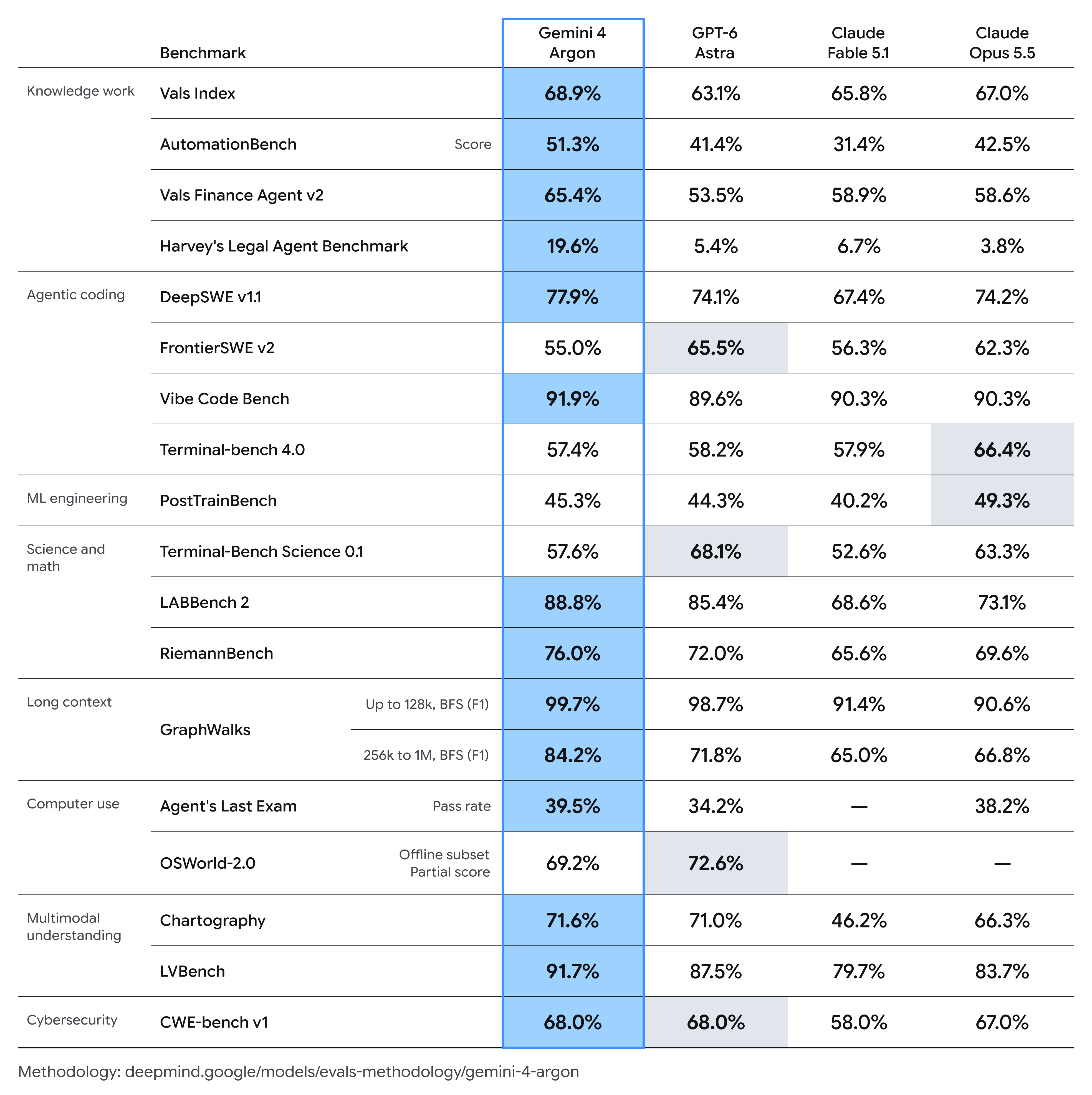
In Google DeepMind's October 2026 Model Card evaluations, Gemini 4 Argon leads on 13 of 18 published benchmarks and ties on 1 when compared against GPT-6 Astra, Claude Opus 5.5, and Claude Fable 5.1:
| Category | Benchmark | Gemini 4 Argon | GPT-6 Astra | Claude Opus 5.5 | Claude Fable 5.1 |
|---|---|---|---|---|---|
| Knowledge Work | Vals Index (GDP-weighted) | 68.9% | 63.1% | 67.0% | 65.8% |
| AutomationBench (Zapier) | 51.3% | 41.4% | 42.5% | 31.4% | |
| Vals Finance Agent v2 | 65.4% | 53.5% | 58.6% | 58.9% | |
| Harvey's Legal Agent Benchmark | 19.6% | 5.4% | 3.8% | 6.7% | |
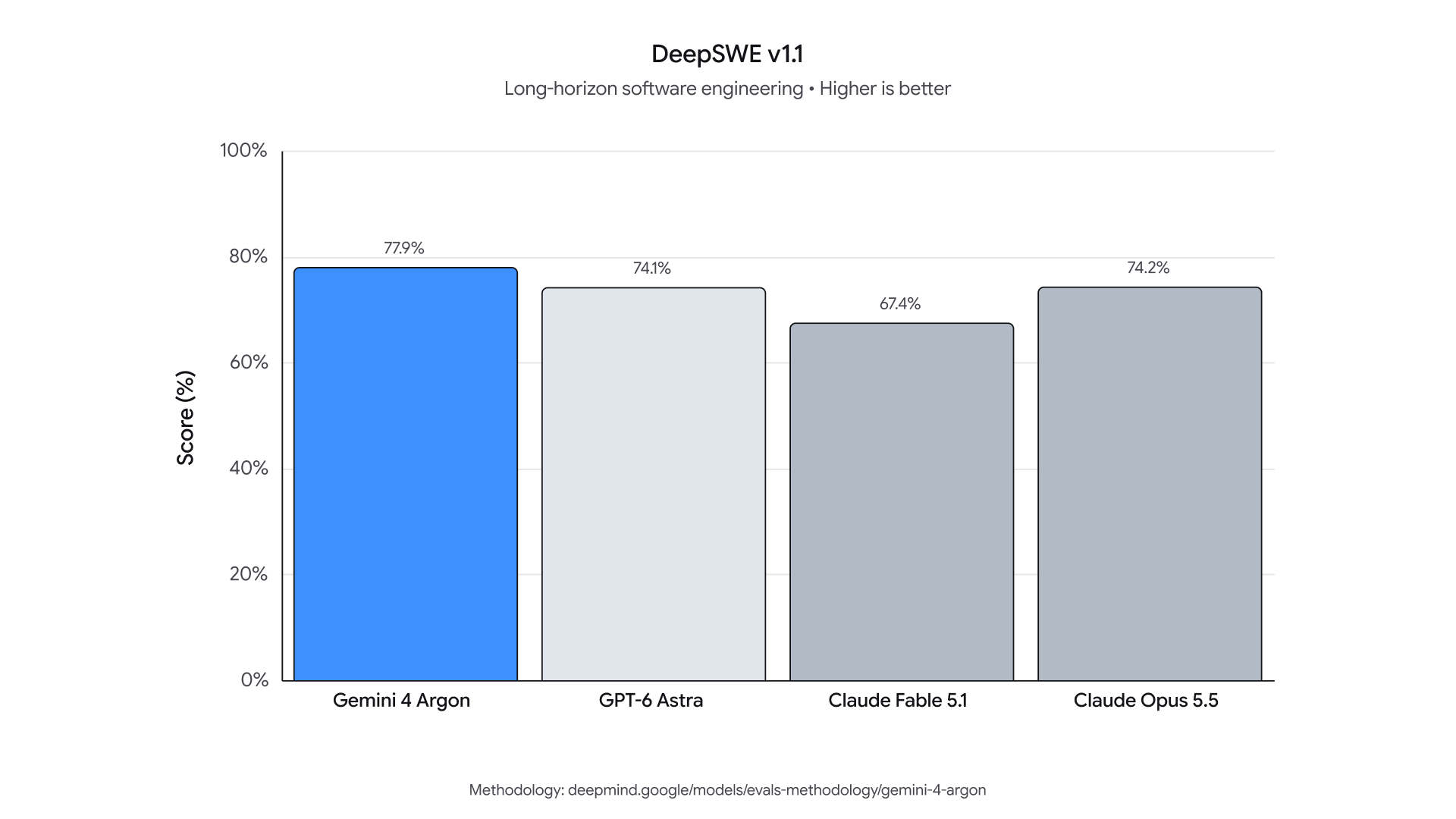
| Agentic Coding | DeepSWE v1.1 | 77.9% | 74.1% | 74.2% | 67.4% |
| Vibe Code Bench | 91.9% | 89.6% | 90.3% | 90.3% | |
| FrontierSWE v2 | 55.0% | 65.5% | 62.3% | 56.3% | |
| Terminal-Bench 4.0 | 57.4% | 58.2% | 66.4% | 57.9% | |
| ML Engineering | PostTrainBench | 45.3% | 44.3% | 49.3% | 40.2% |
| Science & Math | LABBench 2 | 88.8% | 85.4% | 73.1% | 68.6% |
| RiemannBench | 76.0% | 72.0% | 69.6% | 65.6% | |
| Terminal-Bench Science 0.1 | 57.6% | 68.1% | 63.3% | 52.6% | |
| Long Context | GraphWalks (≤128K, BFS F1) | 99.7% | 98.7% | 90.6% | 91.4% |
| GraphWalks (256K–1M, BFS F1) | 84.2% | 71.8% | 66.8% | 65.0% | |
| Computer Use | Agent's Last Exam (Pass rate) | 39.5% | 34.2% | 38.2% | — |
| OSWorld-2.0 (Offline partial) | 69.2% | 72.6% | — | — | |
| Multimodal | LVBench (Long Video) | 91.7% | 87.5% | 83.7% | 79.7% |
| Chartography | 71.6% | 71.0% | 66.3% | 46.2% | |
| Cybersecurity | CWE-bench v1 | 68.0% | 68.0% | 67.0% | 58.0% |
Key takeaways for model routing
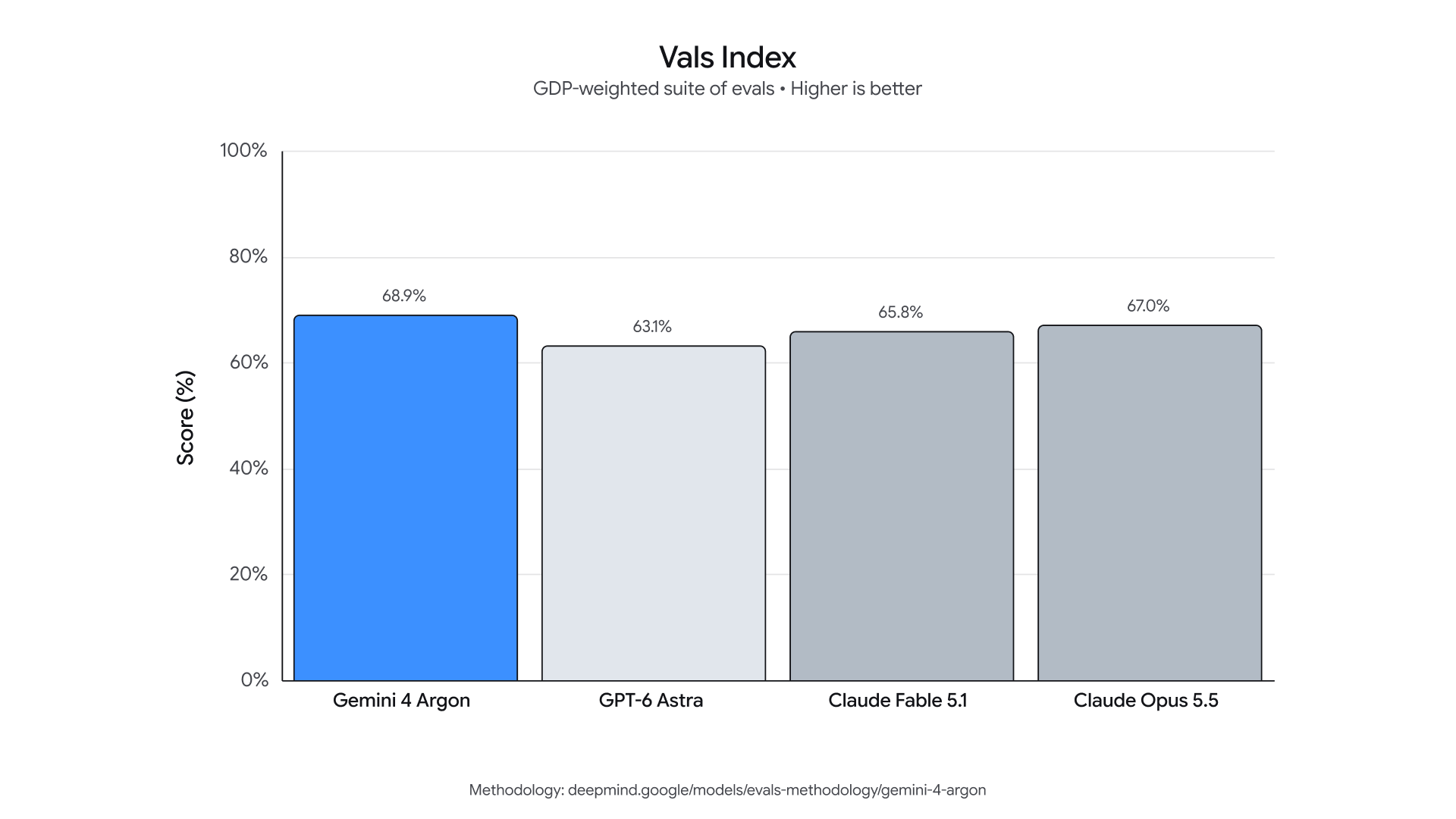
- Where Gemini 4 Argon wins decisively: Long-horizon repository refactoring (DeepSWE v1.1: 77.9%), ultra-long context reasoning between 256K and 1M tokens (GraphWalks: 84.2% vs 66.8% for Opus 5.5), structured enterprise workflows (AutomationBench: 51.3%), legal and financial synthesis (Harvey: 19.6%, Vals Finance: 65.4%), and long-video multimodal analysis (LVBench: 91.7%).
- Where Claude Opus 5.5 or GPT-6 Astra hold an edge: Interactive command-line shell execution (Terminal-Bench 4.0, where Claude Opus 5.5 scores 66.4% vs Argon's 57.4%) and specialized SWE/science harnesses (FrontierSWE v2 and Terminal-Bench Science 0.1, where GPT-6 Astra leads).
- Price-to-performance advantage: At $1.60 / $8.00 on PoYo, Gemini 4 Argon costs 50% less per token than Claude Opus 5.5 ($3.20 / $16.00 on PoYo) and 80% less than GPT-6 Astra ($8.00 / $40.00 on PoYo), matching the token price tier of GPT-6.1 Sol and Claude Sonnet 5.5 while delivering flagship frontier reasoning.
What makes Gemini 4 Argon different in production?
1. 1M unified input-output window for uninterrupted trajectories
Previous Gemini models capped output at 64K tokens, forcing coding and research agents to truncate large diffs or stitch together multi-turn continuations. By unifying the 1M token pool across input and output, Argon can spend 100,000+ tokens on internal chain-of-thought reasoning and still emit complete multi-file code migrations, formal mathematical proofs in Lean, or exhaustive compliance audits in one response.
Inside Google, engineers used Argon to separate 6 million lines of legacy browser feature code from Chromium's 40-million-line repository, rewrite 32K lines of SIMD video decoding in libgav1 into safe Rust (running 2.7x faster than the prior Rust port), and accelerate Gemma 4 E2B vLLM inference throughput by 2.85x on A100 GPUs.
2. Defensive cybersecurity & prompt injection resilience
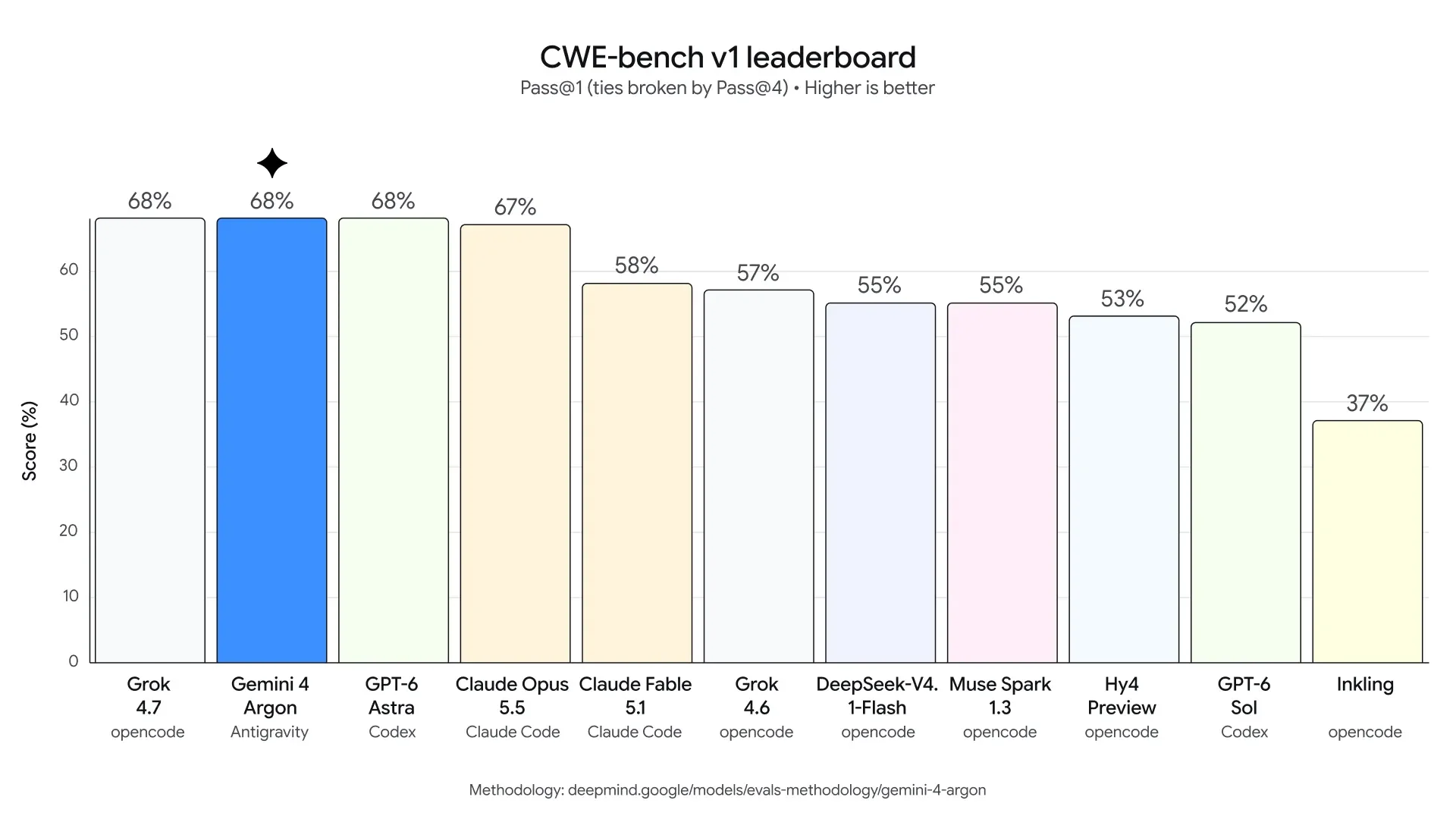
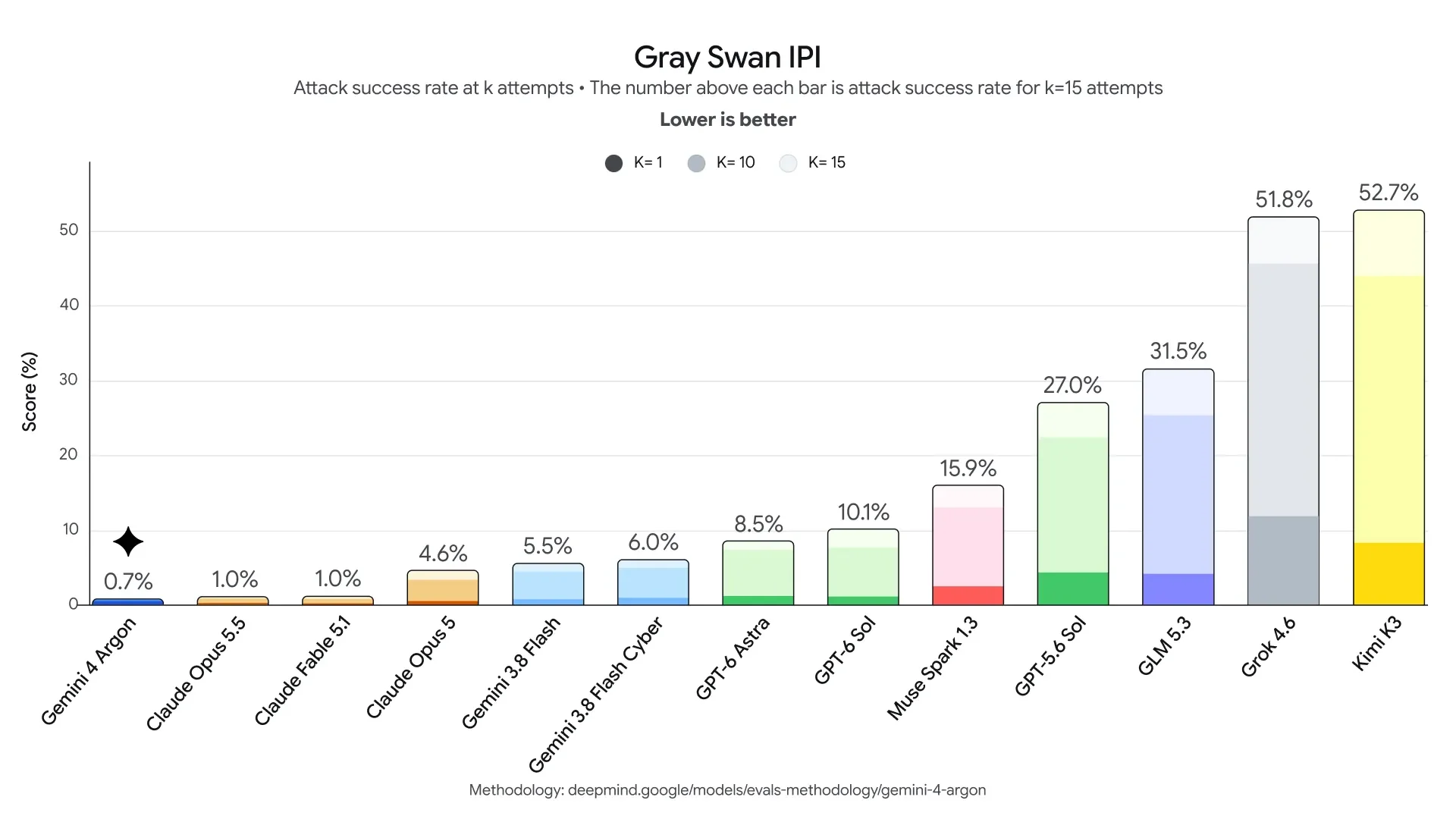
Trained for defensive security teams in Google's Fairwind Program and deployed in Wiz's Scan for Good initiative, Argon ties for #1 on CWE-bench v1 (68.0%) and uncovers multi-step vulnerability chains across 20 programming languages. For enterprise agents browsing untrusted web pages or parsing external PDFs, Argon achieves a 0.7% attack success rate across 15 adaptive attempts on Gray Swan's Indirect Prompt Injection (IPI) benchmark—the lowest hijack rate reported among frontier models.
3. Native multimodal, 3D spatial, and scientific reasoning
Unlike text-plus-image models, Argon natively ingests text, high-resolution images, audio, long video, and PDFs. It scores 87% on Embodied Reasoning (ERQA) and 91.7% on LVBench, enabling "Video-to-Sim-to-Real" robotics pipelines, 3D archaeological reconstructions from 50 GB of LiDAR and CAD archives, and 2.3x faster molecular structure prediction in quantum chemistry (xTB).
How to call Gemini 4 Argon API on PoYo
PoYo supports both OpenAI Chat Completions (/v1/chat/completions) and Google Gemini Native (/v1beta/models/gemini-4-argon:generateContent and :streamGenerateContent) with a single PoYo API key.
Option 1: OpenAI-compatible Chat Completions (POST /v1/chat/completions)
Use your existing OpenAI Python/Node SDK or cURL by setting the base URL to https://api.poyo.ai/v1 and model to gemini-4-argon:
curl --request POST \
  --url https://api.poyo.ai/v1/chat/completions \
  --header "Authorization: Bearer YOUR_POYO_API_KEY" \
  --header "Content-Type: application/json" \
  --data '{
    "model": "gemini-4-argon",
    "messages": [
      {
        "role": "system",
        "content": "You are a principal systems architect and security auditor."
      },
      {
        "role": "user",
        "content": "Design a memory-safe Rust migration plan for a C++ video frame ring buffer, including zero-copy slices and unit tests."
      }
    ],
    "temperature": 1.0,
    "max_tokens": 16384,
    "stream": false
  }'
Option 2: Google Gemini Native Format (:generateContent & :streamGenerateContent)
For native multimodal parts, systemInstruction, and generationConfig, call the Gemini-native endpoint directly:
curl --request POST \
  --url "https://api.poyo.ai/v1beta/models/gemini-4-argon:generateContent" \
  --header "Authorization: Bearer YOUR_POYO_API_KEY" \
  --header "Content-Type: application/json" \
  --data '{
    "systemInstruction": {
      "parts": [
        { "text": "Provide rigorous financial and legal analysis with explicit citations." }
      ]
    },
    "contents": [
      {
        "role": "user",
        "parts": [
          { "text": "Compare the working capital adjustments and indemnification caps across these merger agreement clauses." }
        ]
      }
    ],
    "generationConfig": {
      "temperature": 1.0,
      "maxOutputTokens": 32768,
      "topP": 0.95
    }
  }'
For streaming responses in Gemini Native format, replace :generateContent with :streamGenerateContent?alt=sse.
Frequently asked questions
What is the exact model ID for Gemini 4 Argon on PoYo?
Use gemini-4-argon for both /v1/chat/completions and /v1beta/models/gemini-4-argon:generateContent.
Are thinking tokens billed separately?
Following Google's billing specification, output token usage includes internal reasoning (thinking) tokens and is billed at PoYo's output rate of $8.00 per 1M tokens (1,600 credits). Set max_tokens or maxOutputTokens appropriately to bound reasoning spend on routine tasks.
How can I get started?
Generate your API key in the PoYo Dashboard, test prompts live on the Gemini 4 Argon Playground, or browse all frontier chat models in the PoYo AI Chat API catalog.