GPT-6.1 SOL · COMING SOON TO POYO

Coding, document analysis, computer use, and multi-step agents in one model

GPT-6.1 Sol API for Coding and Agent Workflows

GPT-6.1 Sol is OpenAI's Sol model for complex coding, computer use, and professional work. It supports agents that inspect code, use tools, read detailed documents, and carry a task through multiple steps.

Its 1,050,000-token context window and adjustable reasoning effort help developers work across large codebases and long source material. OpenAI reports gains over GPT-6 Sol on software engineering, document understanding, business automation, and computer-use evaluations.

Key Features of GPT-6.1 Sol API

Capabilities for development teams and agents working across code, documents, and applications.

01

Complex Coding and Software Engineering

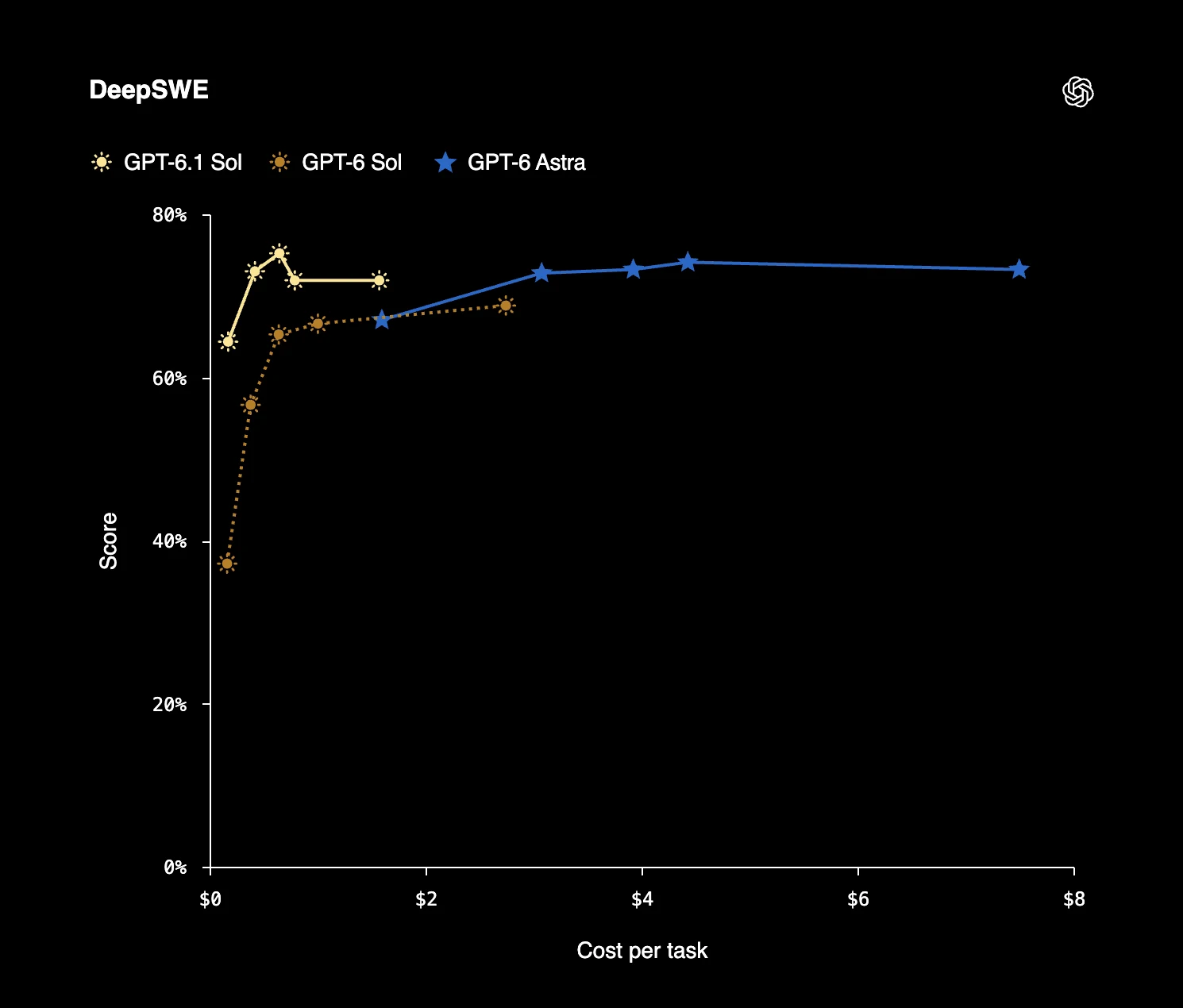
GPT-6.1 Sol can investigate a codebase, trace failures, edit multiple files, and verify changes across a longer development task. In OpenAI's DeepSWE v1.1 evaluation, it reached GPT-6 Astra's result and improved on GPT-6 Sol's best score by 6.4 percentage points at a lower reasoning setting.

  • Investigate code across multiple files
  • Implement and verify scoped changes
  • Support long-running coding agents
OpenAI DeepSWE v1.1 evaluation of GPT-6.1 Sol, GPT-6 Sol, and GPT-6 Astra on software engineering tasks

02

Document Understanding and Business Workflows

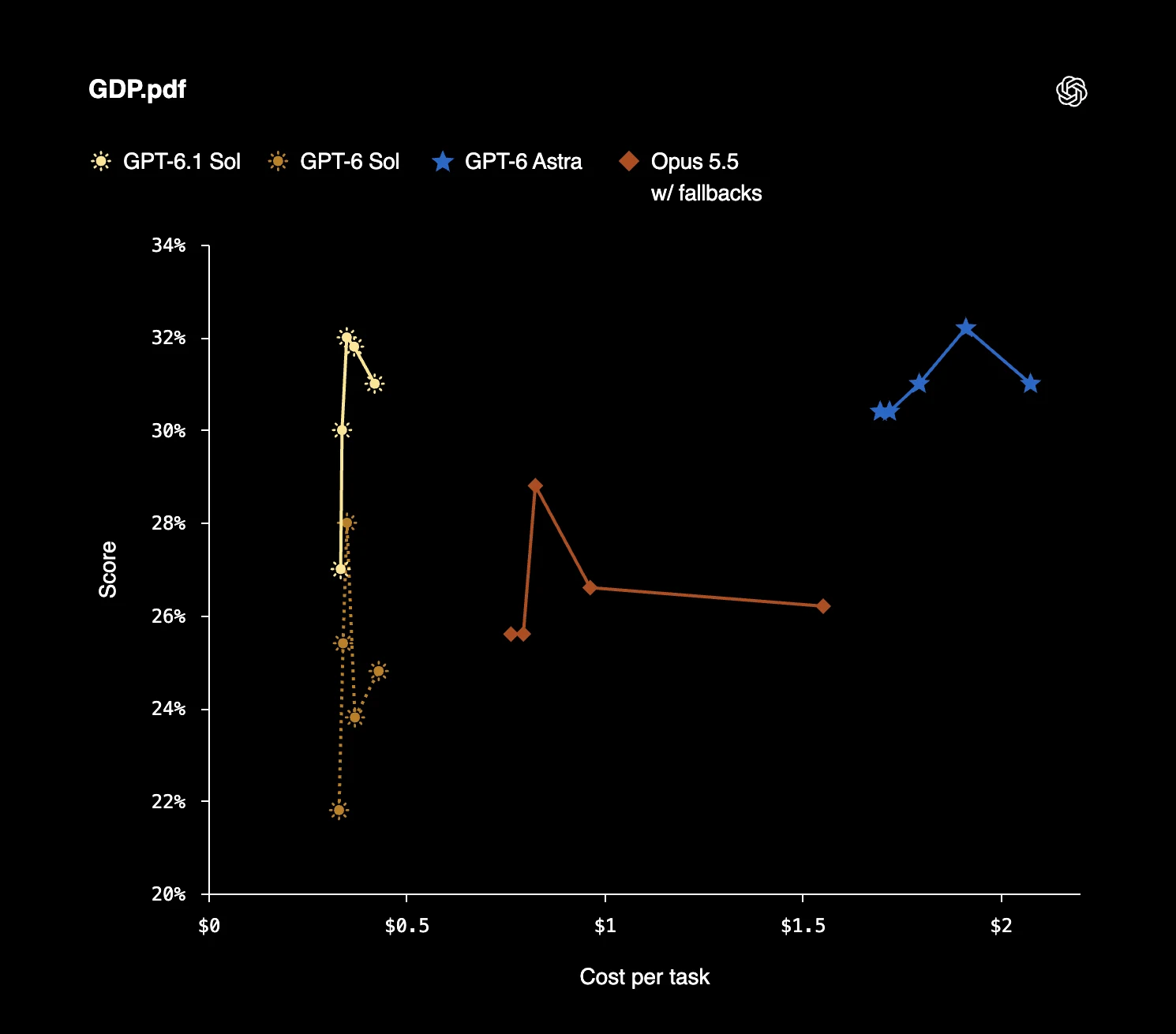
GPT-6.1 Sol works with detailed PDFs containing tables, charts, diagrams, and fine print. It also coordinates multi-step business workflows that use many tools. OpenAI reports stronger results than GPT-6 Sol on GDP.pdf and a 4.8-point improvement on AutomationBench at medium reasoning effort.

  • Read complex tables and diagrams
  • Connect findings across long documents
  • Carry out multi-step tool workflows
OpenAI GDP.pdf evaluation of GPT-6.1 Sol on professional document understanding

03

Computer Use Across Applications

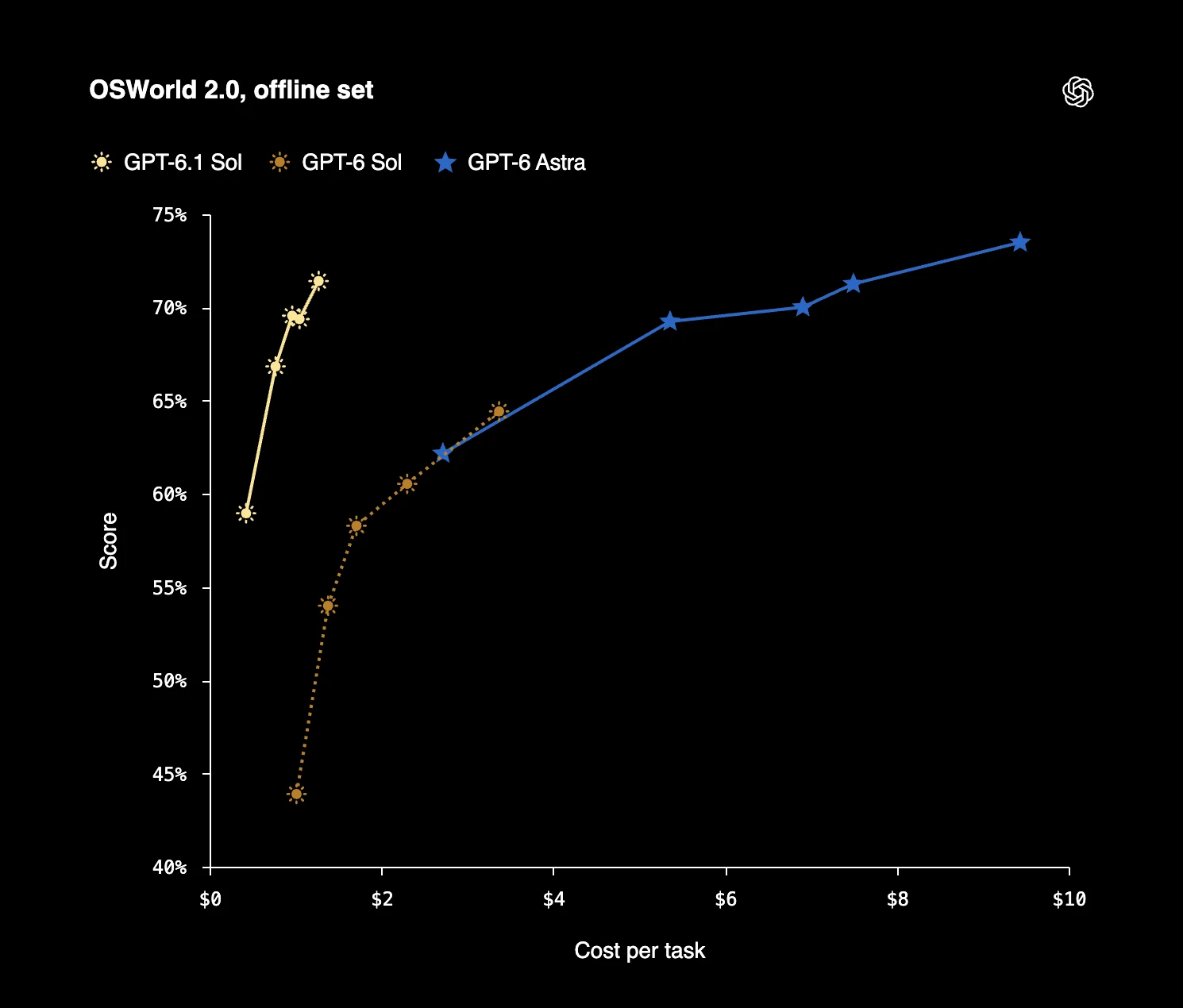
GPT-6.1 Sol can interpret visual context and work through application interfaces as part of an agent workflow. On the offline OSWorld 2.0 evaluation, OpenAI reports a seven-point gain over GPT-6 Sol at maximum reasoning effort. Teams can use this capability for tasks that combine screenshots, interface actions, and verification.

  • Interpret screenshots and visual state
  • Work through application interfaces
  • Check results after each action
OpenAI OSWorld 2.0 offline evaluation of GPT-6.1 Sol on computer-use workflows

04

Long Context and Adjustable Reasoning

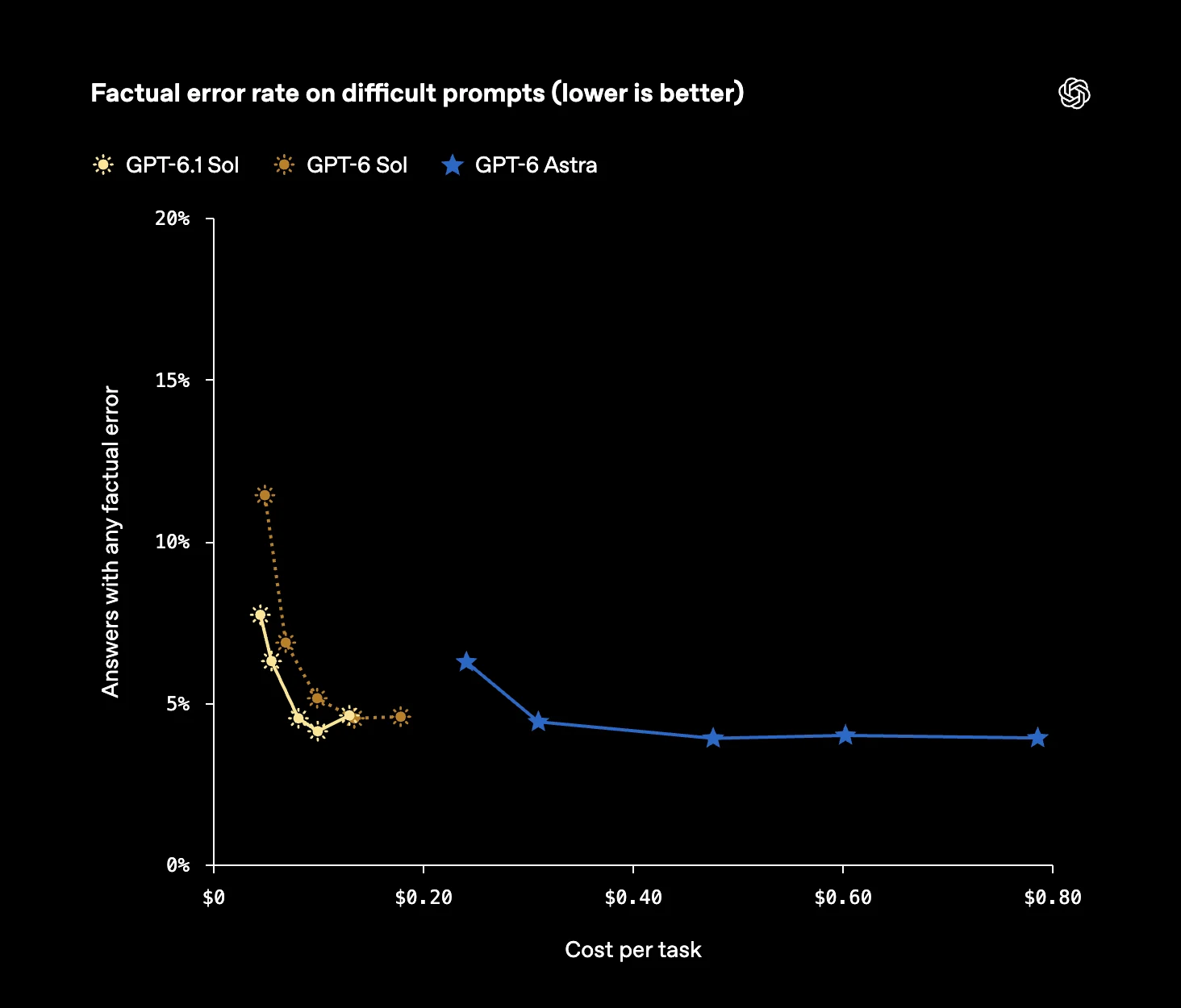
GPT-6.1 Sol accepts up to 1,050,000 context tokens and produces up to 128,000 output tokens. Developers can choose low, medium, high, xhigh, or max reasoning effort to match the depth of work. OpenAI's factuality evaluation also shows more reliable answers at low reasoning effort. This range supports large repositories, lengthy reports, and extended agent sessions.

  • Read up to 1,050,000 context tokens
  • Choose from five reasoning settings
  • Produce up to 128,000 output tokens
OpenAI evaluation of factual accuracy across reasoning settings for GPT-6.1 Sol and other GPT-6 models

Who Can Benefit from GPT-6.1 Sol API?

01

Software Development Teams

Use GPT-6.1 Sol to explore a repository, implement features, resolve bugs, and review changes across multi-file development tasks.

02

Agent Builders

Build agents that plan steps, call tools, inspect results, and continue work with the context of earlier actions.

03

Document and Research Teams

Analyze detailed PDFs, combine evidence from charts and text, and prepare summaries grounded in source material.

04

Product and QA Teams

Use screenshots and application state to examine interfaces, carry out workflows, and check observable results.

05

Operations Teams

Coordinate repeatable business processes across tools, documents, and handoffs while tracking each step.

06

Scientific and Data Teams

Work through terminal-based analysis, simulation, and research tasks that require code and iterative checks.

GPT-6.1 Sol vs GPT-6 Sol and GPT-6 Astra — Model Comparison

CapabilityGPT-6.1 SolGPT-6 SolGPT-6 Astra
Model focusComplex coding, computer use, and professional workflowsComplex coding and agent workflowsThe most demanding end-to-end work
DeepSWE v1.1Matches Astra; 6.4 percentage points above Sol's best score6.1 Sol exceeds its best score by 6.4 percentage pointsMatches 6.1 Sol
OSWorld 2.0 offline (max effort)7 percentage points above Sol; within 2.1 points of Astra6.1 Sol scores 7 percentage points higher2.1 percentage points above 6.1 Sol
Terminal-Bench Science 0.1 (max effort)More than 2× Sol's score6.1 Sol scores more than 2× this resultTop reported score: 68.1%
Factual error rate (low effort)7.7%11.4%6.1 Sol is within 1.9 percentage points across tested efforts
Official price · Standard input / 1M tokens$2.00$2.00$10.00
Official price · Cached input / 1M tokens$0.10$0.20$1.00
Official price · Cache writes / 1M tokens$2.50$2.50$12.50
Official price · Standard output / 1M tokens$10.00$10.00$50.00

Frequently Asked Questions about GPT-6.1 Sol API

What is GPT-6.1 Sol?

GPT-6.1 Sol is OpenAI's Sol model for complex coding, computer use, and professional workflows. It supports long-running agents that work across code, documents, tools, and application interfaces.

What can GPT-6.1 Sol do for software teams?

Software teams can use GPT-6.1 Sol to investigate large codebases, edit multiple files, debug issues, and verify changes. OpenAI reports that it matches GPT-6 Astra on DeepSWE v1.1 and improves on GPT-6 Sol's best score by 6.4 percentage points in that evaluation.

How does GPT-6.1 Sol help with documents and business tasks?

It can read detailed PDFs with tables, charts, diagrams, and fine print, then connect findings across long material. It also supports multi-step tool workflows, with OpenAI reporting a 4.8-point gain over GPT-6 Sol on AutomationBench at medium reasoning effort.

What context window and reasoning settings does GPT-6.1 Sol support?

GPT-6.1 Sol supports a 1,050,000-token context window and up to 128,000 output tokens. Developers can set reasoning effort to low, medium, high, xhigh, or max according to the work they want the model to perform.

What is GPT-6.1 Sol's official API price advantage?

At OpenAI's standard API rates for prompts up to 272K input tokens, GPT-6.1 Sol's $2 input and $10 output per million tokens are each 80% below GPT-6 Astra's $10 input and $50 output. Its $0.10 cached input rate is 50% below GPT-6 Sol's $0.20 rate. These are OpenAI direct API rates; PoYo pricing will be published with its launch.

When is GPT-6.1 Sol coming to PoYo?

GPT-6.1 Sol is coming soon to PoYo. This page brings its coding, document, computer-use, and agent capabilities together for teams planning their integration.

Why Choose PoYo for GPT-6.1 Sol API Integration

01

Explore One Model Catalog

Find GPT-6.1 Sol alongside other PoYo models and review its coding, document, computer-use, and agent capabilities in one place.

02

Select with Published Evaluations

Use OpenAI's published benchmarks to compare GPT-6.1 Sol with GPT-6 Sol and GPT-6 Astra for the tasks your team handles.

03

Plan Developer Workflows

Map long-context inputs, reasoning settings, and tool steps to your coding and agent workflows before integration.

04

Track the PoYo Launch

Follow GPT-6.1 Sol's coming-soon status on PoYo and use this page to prepare for its availability.