


Model icon
gpt-6.1-terra
Model:
OpenAI's fast, efficient GPT-6.1 model for visual reasoning, precise computer use, and clear, natural writing, with text and image input and a 1.05M-token context.
Chat

This Playground is for demo purposes. Data is only valid in the current window and will be cleared on refresh.

Type a message...

Configuration
1.0
1.0
Pricing details

Pay as you go. No subscription, no hidden fees.

1 credit = $0.005
ModelInput /1M tokensOutput /1M tokens
GPT-6.1 Terra
100K input + 20K output tokens: $0.160
$0.800/1M tokens
160 credits/1M tokens
$1.00/1M tokensSave 20%
$4.00/1M tokens
800 credits/1M tokens
$5.00/1M tokensSave 20%
How it's billed: Input and output tokens are billed separately, per 1M tokens.

Charges are based on the final output.

GPT-6.1 TERRA

Visual reasoning, computer use, and natural writing for high-volume work

GPT-6.1 Terra API for Computer Use and Visual Reasoning

GPT-6.1 Terra is OpenAI's fast, efficient model for work that moves between screens, images, and text. It reads technical drawings, matches product photos to catalog entries, acts on application screens, and drafts clear proposals and reports.

The model accepts text and image input, returns text, and supports a 1,050,000-token context window with up to 128,000 output tokens. On PoYo, call it with model ID gpt-6.1-terra through Chat Completions or Responses.

Key Features of GPT-6.1 Terra API

OpenAI built GPT-6.1 Terra for the computer-based and communication tasks that fill a workday, from reading screens and drawings to writing and scoped coding.

01

Computer Use Across Desktop Applications

Many office tasks require an agent to read a screen, decide on an action, and carry work between applications. GPT-6.1 Terra handles these steps for tasks such as filling out forms or entering invoice details into accounting software. On Agents' Last Exam at medium reasoning effort, OpenAI reports a 15-point gain over GPT-5.6 Terra at about one-third the cost, and results on par with GPT-6 Astra.

  • Read application screens and act on them
  • Fill out forms and move data between apps
  • Finish tasks over 3× faster than GPT-6 Astra and GPT-6.1 Sol
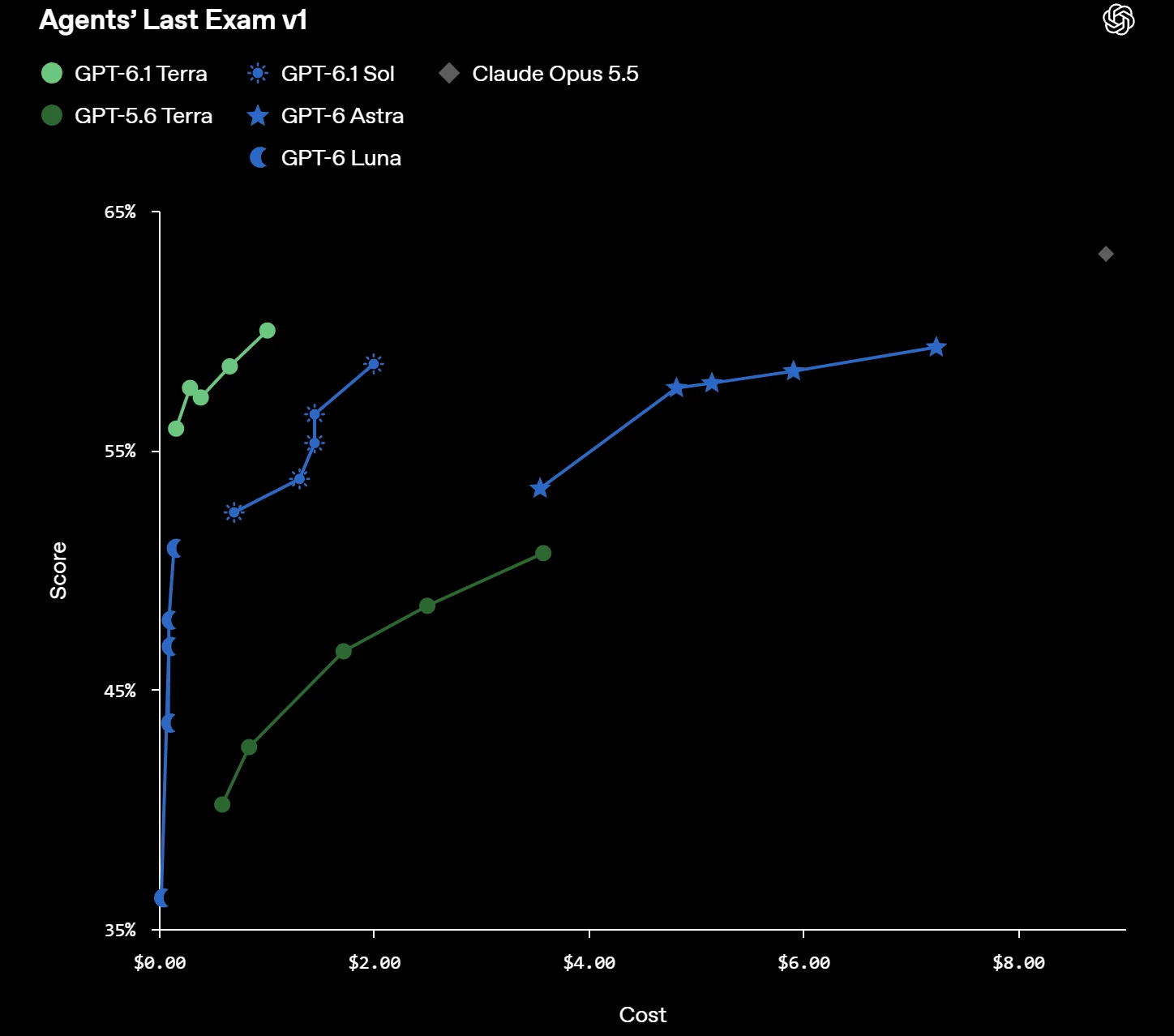
OpenAI Agents' Last Exam v1 chart comparing GPT-6.1 Terra score and cost with GPT-5.6 Terra, GPT-6.1 Sol, GPT-6 Astra, GPT-6 Luna, and Claude Opus 5.5

02

Visual Reasoning on Images, Drawings, and Screens

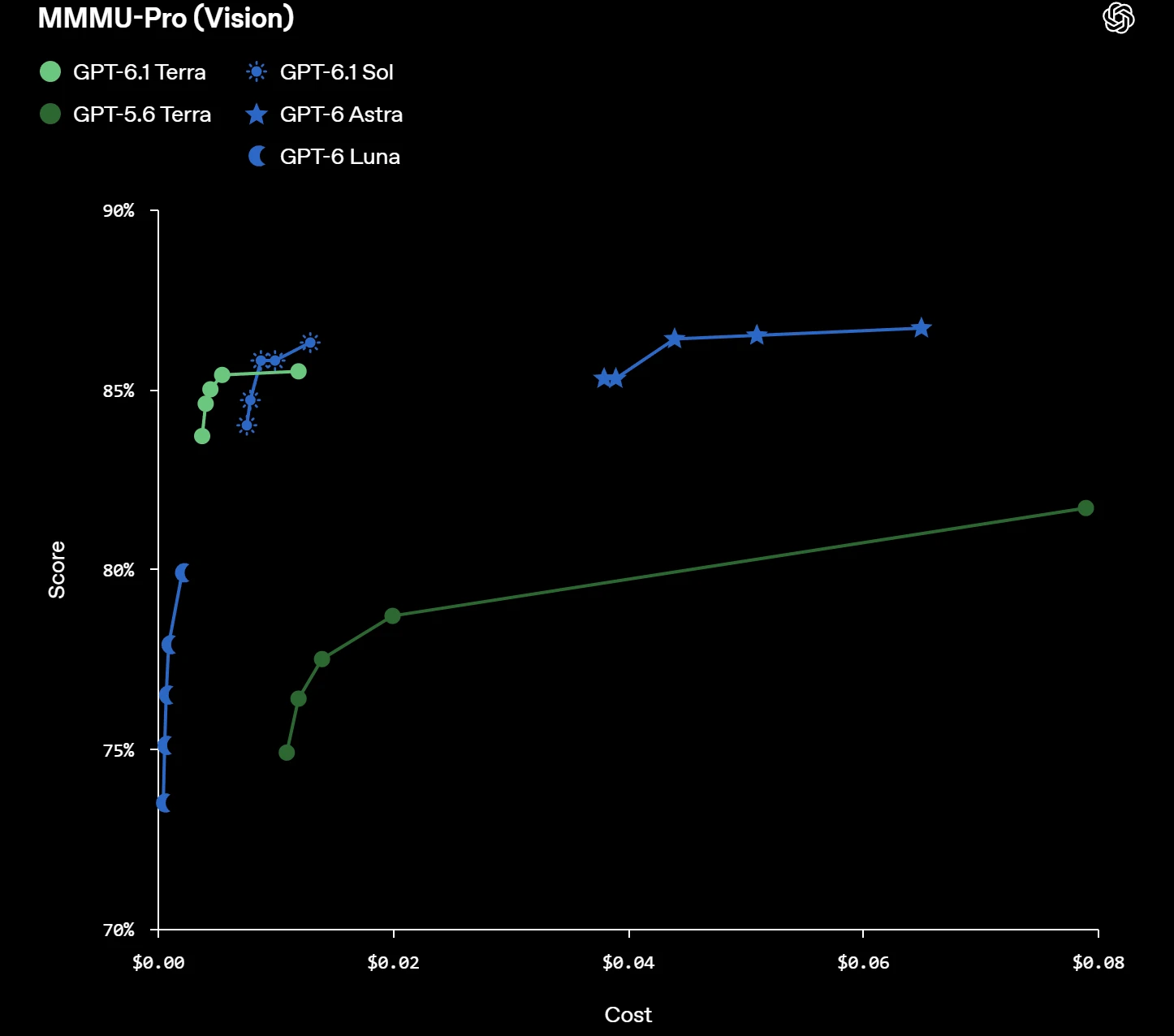
Images often carry the details a workflow depends on, such as dimensions on a drawing or attributes in a product photo. GPT-6.1 Terra interprets these visual details alongside written instructions. On MMMU-Pro, OpenAI reports that it outperforms GPT-5.6 Terra at every reasoning setting and nearly matches GPT-6 Astra and GPT-6.1 Sol at a much lower cost.

  • Interpret technical drawings and diagrams
  • Match product photos to catalog entries
  • Combine image details with text instructions
OpenAI MMMU-Pro (Vision) chart comparing GPT-6.1 Terra score and cost with GPT-5.6 Terra, GPT-6.1 Sol, GPT-6 Astra, and GPT-6 Luna

03

Fewer Factual Errors and Clearer Writing

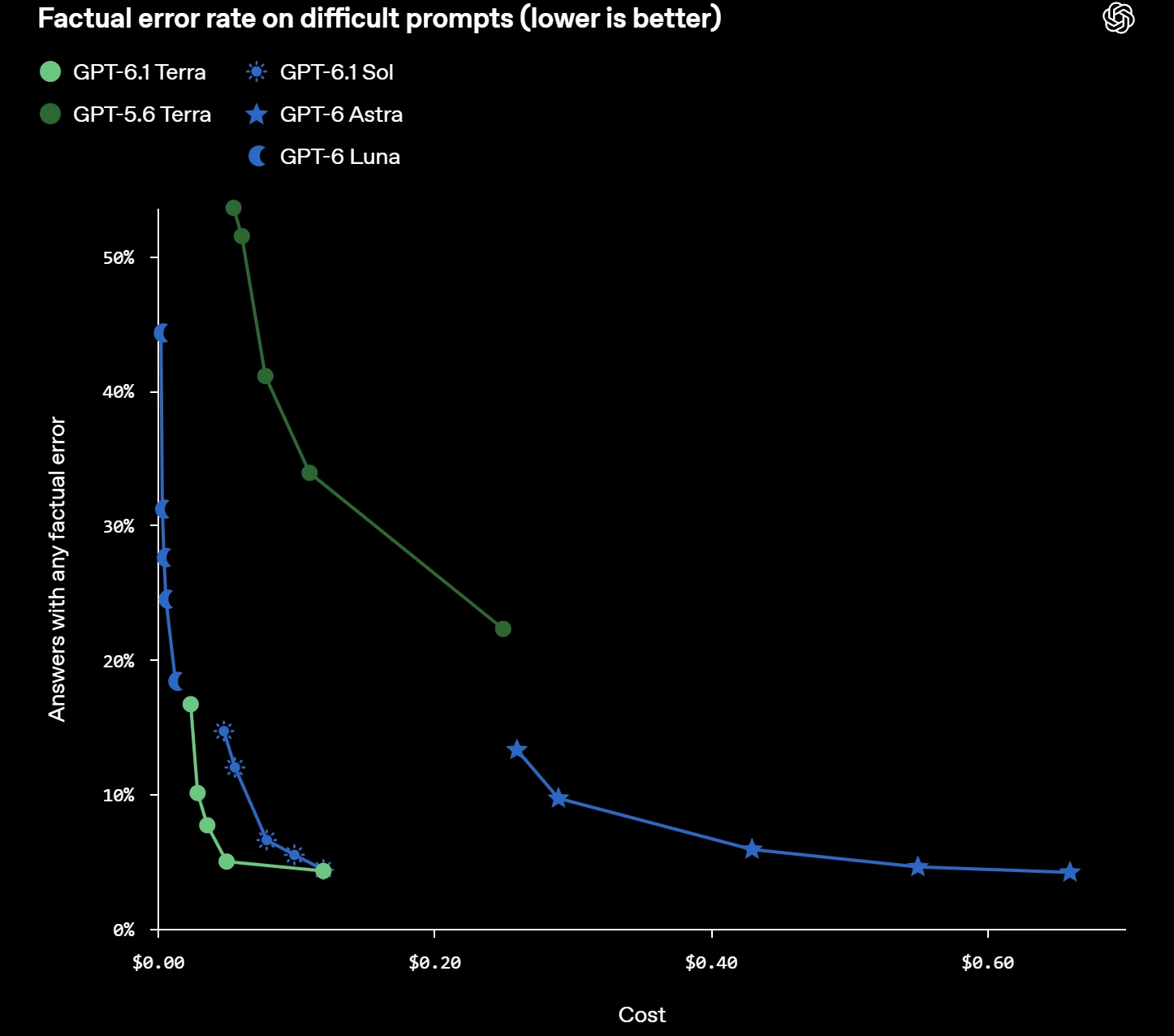
Drafts that contain factual mistakes cost reviewers time. GPT-6.1 Terra writes in a clearer, more natural style and makes fewer factual errors than its predecessor. On OpenAI's internal set of error-inducing prompts, the error rate at low reasoning effort fell from 53.6% with GPT-5.6 Terra to 16.7%, and reached 4.3% at max effort.

  • Draft proposals, summaries, and reports
  • Revise text in a clear, natural style
  • Reduce factual errors on difficult prompts
OpenAI chart of factual error rate on difficult prompts versus cost for GPT-6.1 Terra, GPT-5.6 Terra, GPT-6.1 Sol, GPT-6 Astra, and GPT-6 Luna

04

Scoped Coding from the Command Line

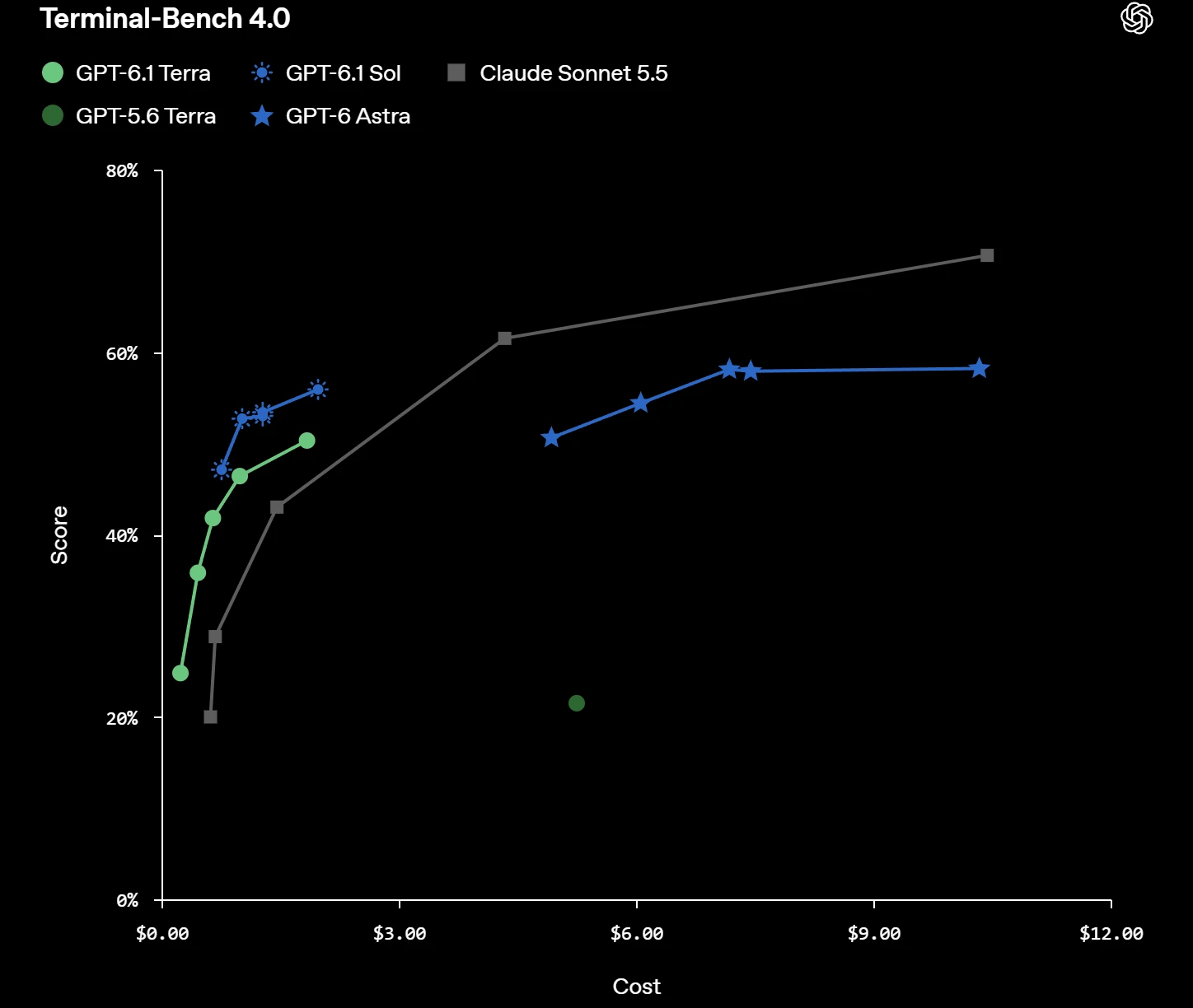
Coding agents need to solve focused problems in a terminal without the cost of a frontier model on every step. GPT-6.1 Terra solves 50.3% of Terminal-Bench 4.0 tasks at max reasoning effort, more than double GPT-5.6 Terra's published 21.5%. OpenAI still recommends GPT-6.1 Sol or GPT-6 Astra for the most complex coding tasks.

  • Fix well-scoped bugs from the terminal
  • Run focused tasks for a lead coding agent
  • Use code for data and science workflows
OpenAI Terminal-Bench 4.0 chart comparing GPT-6.1 Terra score and cost with GPT-5.6 Terra, GPT-6.1 Sol, GPT-6 Astra, and Claude Sonnet 5.5

Who Can Benefit from GPT-6.1 Terra API?

01

Computer-Use Agent Builders

Build agents that read application screens, click through interfaces, and verify each step. GPT-6.1 Terra suits repeated desktop tasks where speed and per-task cost matter.

02

Finance and Back-Office Teams

Read incoming invoices, extract the details, and enter them into accounting software. Automate form filling and record updates across business applications.

03

E-Commerce and Catalog Teams

Match product photos to catalog entries, check attributes against listings, and prepare product descriptions from images and specifications.

04

Engineering and Construction Teams

Interpret technical drawings, pull dimensions and notes from diagrams, and turn visual details into structured summaries for project workflows.

05

Content and Communication Teams

Draft proposals, reports, and customer messages in a clear, natural style, then revise them with GPT-6.1 Terra against source material.

06

Developer Teams

Assign well-scoped terminal and coding tasks to GPT-6.1 Terra, and keep GPT-6.1 Sol or GPT-6 Astra for the most complex engineering work.

GPT-6.1 Terra vs GPT-6.1 Sol — Model Comparison

GPT-6.1 Terra and GPT-6.1 Sol share the same context window and input types. Terra focuses on fast visual reasoning, computer use, and writing at half the token price, while Sol targets the most complex coding and professional work.

CapabilityGPT-6.1 TerraGPT-6.1 Sol
Best forVisual reasoning, precise computer use, and clear, natural writingComplex coding, computer use, and professional work
Input / outputText and images in, text outText and images in, text out
Context window1,050,000 tokens1,050,000 tokens
Max output128,000 tokens128,000 tokens
Knowledge cutoffJune 1, 2026April 30, 2026
Reasoning effortnone, low, medium (default), high, xhigh, maxlow, medium (default), high, xhigh, max
Agents' Last Exam task speedOver 3× faster on averageBaseline
MMMU-Pro (Vision)Nearly matches Sol at a much lower costSlightly higher score at a higher cost
Terminal-Bench 4.0 (max effort)50.3%OpenAI recommends Sol for the most complex coding tasks
Terminal-Bench-Science 0.1 (max effort)Scores above Sol at a lower costBelow Terra
Factual error rate (max effort)4.3%Nearly the same as Terra

How to Use GPT-6.1 Terra API on PoYo

Step 1: Register and Create an API Key
Sign in to PoYo and create a key for your application.
Create API Key →

Step 2: Add Credits
Fund your account and review the input and output token rates in the pricing table above.
Add Credits →

Step 3: Integrate the API
Send requests with model gpt-6.1-terra to /v1/chat/completions or /v1/responses. Test prompts and image inputs in the Playground before moving them into your application.
View Integration Reference →

Frequently Asked Questions about GPT-6.1 Terra API

What is GPT-6.1 Terra?

GPT-6.1 Terra is a fast, efficient OpenAI model released on October 26, 2026, for visual reasoning, precise computer use, and clear, natural writing. It accepts text and image input and returns text. On PoYo, you can call it with model ID gpt-6.1-terra through Chat Completions or Responses.

What tasks is GPT-6.1 Terra designed for?

OpenAI positions GPT-6.1 Terra for communication and computer-based work, such as drafting proposals, interpreting technical drawings, filling out forms, and entering invoice details into accounting software. For the most complex coding tasks, OpenAI recommends GPT-6.1 Sol or GPT-6 Astra.

How does GPT-6.1 Terra compare with GPT-5.6 Terra?

OpenAI reports a 15-point gain on Agents' Last Exam at medium effort, at about one-third the cost. On Terminal-Bench 4.0 at max effort, it solves 50.3% of tasks versus 21.5%. Its low-effort error rate on difficult prompts fell from 53.6% to 16.7%.

What context window and reasoning settings does GPT-6.1 Terra support?

GPT-6.1 Terra supports a 1,050,000-token context window, up to 128,000 output tokens, and a June 1, 2026 knowledge cutoff. OpenAI lists reasoning effort settings of none, low, medium, high, xhigh, and max, with medium as the default.

How much does GPT-6.1 Terra API cost on PoYo?

PoYo charges 160 credits ($0.80) per million input tokens and 800 credits ($4.00) per million output tokens. OpenAI's standard rates are $1 input and $5 output per million tokens, so PoYo's rates are 20% lower. You pay only for the tokens you use.

Can GPT-6.1 Terra analyze images?

Yes. GPT-6.1 Terra accepts image input together with text, so you can send screenshots, product photos, charts, and technical drawings in the same request. It returns text only; audio and video are not supported.

Why Use PoYo for GPT-6.1 Terra API Access

01

Familiar API Formats

Call GPT-6.1 Terra through OpenAI-compatible Chat Completions or Responses, so existing OpenAI clients can connect with a base URL and key change.

02

One Key for Many Models

Use the same PoYo API key for GPT-6.1 Terra and other chat, image, video, and audio models available on PoYo.

03

Usage-Based Token Pricing

Pay per million input and output tokens at the rates in the pricing table, with no subscription required.

04

Playground Before Integration

Test prompts and image inputs with GPT-6.1 Terra in the Playground, then reuse the same request format in your application.