










Claude Fable 5.2
claude-fable-5-2 for agentic coding, deep research, computer use, and document work. Adaptive thinking runs on every request, and the effort parameter sets how deeply the model reasons, from low to max.Pay as you go. No subscription, no hidden fees.
| Model | Input /1M tokens | Cache read /1M tokens | Cache write (5 min) /1M tokens | Cache write (1 h) /1M tokens | Output /1M tokens |
|---|---|---|---|---|---|
| Claude Fable 5.2 100K input + 20K output tokens: $1.28 | $6.40/1M tokens 1280 credits/1M tokens $8.00/1M tokensSave 20% | $0.160/1M tokens 32 credits/1M tokens $0.200/1M tokensSave 20% | $8.00/1M tokens 1600 credits/1M tokens $10.00/1M tokensSave 20% | $12.80/1M tokens 2560 credits/1M tokens $16.00/1M tokensSave 20% | $32.00/1M tokens 6400 credits/1M tokens $40.00/1M tokensSave 20% |
Charges are based on the final output.
Demanding reasoning, hours-long agent sessions, and multistep research in one model
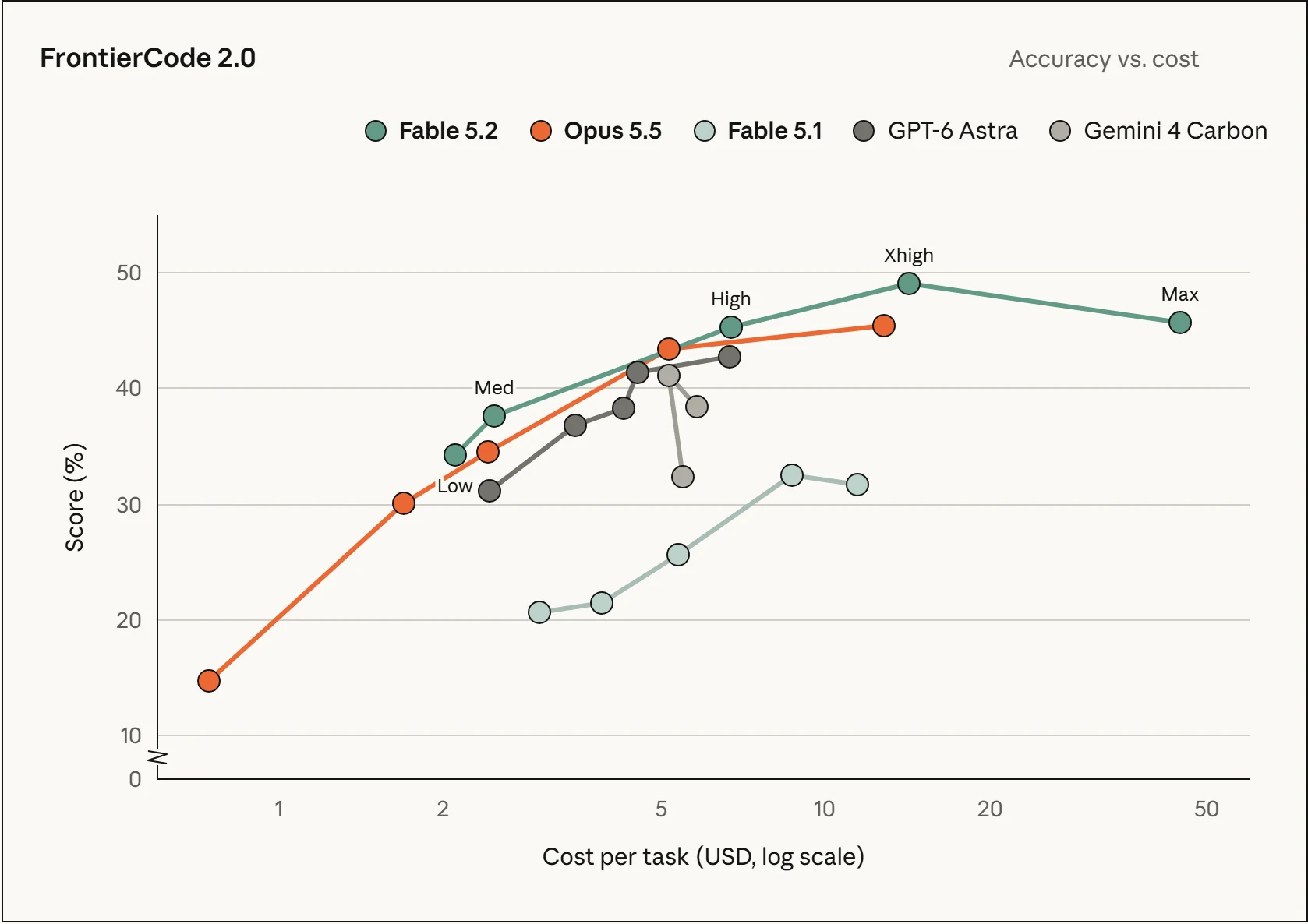
Claude Fable 5.2 is Anthropic's model for demanding reasoning and long-horizon agentic work, released on November 9, 2026. It keeps agent sessions on track for hours, carries multistep research through to a finished document, spreadsheet, or deck, and scores 49.1% on FrontierCode 2.0.
Start calling it on PoYo today with model ID claude-fable-5-2 through /v1/chat/completions or /v1/messages, at $6.40 input and $32 output per million tokens, 20% below official rates.
claude-fable-5-2 for agentic coding, deep research, computer use, and document work. Adaptive thinking runs on every request, and the effort parameter sets how deeply the model reasons, from low to max.Anthropic's launch results show Claude Fable 5.2 leading on agentic coding, long-running agent work, hardware design, and robot control.
01
FrontierCode 2.0 checks whether a model's code changes would be merged by the maintainers of open-source repositories. Claude Fable 5.2 reaches 49.1% at xhigh effort, the highest score Anthropic has measured for a released model. At high effort it scores 45.3%, matching Claude Opus 5.5's best result at roughly half the cost per task.

02
Claude Fable 5.2 keeps long projects moving from an empty folder to working software. In Anthropic's test, it coordinated more than 1,000 subagents over eight days to write, test, and review a prototype operating system that boots on a laptop, complete with disk, keyboard, and network drivers, file storage, windows, and an installer.
03
Claude Fable 5.2 carries engineering work from specification to physical product. Given a one-paragraph prompt, it designed three working electronic devices, each with its own circuit board, 3D-printed enclosure, and software: a home voice-assistant hub, a USB speakerphone, and a handheld virtual pet.
04
Claude Fable 5.2 reads camera images and turns them into precise physical actions, and it generalizes to robotics tasks beyond its training. Robots controlled by the model solved a puzzle cube, unscrewed a bottle cap, and drew a picture of a robot. It scores 64.9% on RoboDojo Sim, ahead of Claude Opus 5.5 at 39.4%.
Use Claude Fable 5.2 for repository-scale features, language migrations, root-cause debugging, and code review on changes that maintainers can merge with confidence.
Run Claude Fable 5.2 as an orchestrator that plans work, delegates to subagents, checks results, and keeps hours-long sessions on track with steady progress updates.
Hand Claude Fable 5.2 multistep analysis and receive finished documents, spreadsheets, and decks, from 10-K data extraction to SQL for business calculations.
Apply Claude Fable 5.2 to long research trails, technical papers, and formal proofs. It scores 74.2% on Humanity's Last Exam with tools.
Use Claude Fable 5.2 to draft circuit boards, enclosures, and firmware, or to plan robot actions from camera images in simulation and lab work.
Let Claude Fable 5.2 read charts, dense tables, PDFs, and screenshots. It scores 73.4% on Chartography, Anthropic's chart-recognition benchmark.
All three share a 1M-token context and 128K output, so the difference is where each excels: Fable 5.2 leads on coding and long-running agents at the lowest price, Fable 5.1 cuts cache-read costs, and Fable 5 shines on code migrations and vision.
| Feature | Claude Fable 5.2 | Claude Fable 5.1 | Claude Fable 5 |
|---|---|---|---|
| Best for | The hardest reasoning tasks, hours-long agent sessions, and orchestrating teams of subagents | Long-running research and scientific analysis with heavily cached prompts | Large codebase migrations, vision tasks, and spreadsheet and analytics work |
| Headline strength | 49.1% on FrontierCode 2.0, the highest score Anthropic has measured for a released model | More than doubled Fable 5's agentic science score on Terminal-Bench-Science 0.1 | The first Mythos-class model opened to general use, state-of-the-art on nearly all benchmarks Anthropic tested at launch |
| Signature project | Coordinated 1,000+ subagents for eight days to build an operating system that boots on a laptop | Trained a neural network that mapped a third of Venus at 2–3 km detail | Completed a migration across a 50-million-line Ruby codebase in a single day |
| Agentic scientific research (Terminal-Bench-Science 0.1) | 74.6% | 52.6% | 24.7% |
| Business workflows (AutomationBench) | 51.4% | 31.4% | 17.1% |
| Cost advantage | Lowest Fable rates: $8 input and $40 output per 1M tokens, with outputs up to 30% faster than Fable 5.1 | Cache reads 75% cheaper than Fable 5, cutting highly agentic workloads by up to about 45% | Mythos-class capability at less than half the price of Claude Mythos Preview |
| Official price (input / output / cache read, per 1M tokens) | $8 / $40 / $0.20 | $10 / $50 / $0.25 | $10 / $50 / $1.00 |
| Reliable knowledge cutoff | June 2026 | June 2026 | January 2026 |
| Release date | November 9, 2026 | September 1, 2026 | June 9, 2026 |
Sources: Anthropic launch announcements and model overviews for Claude Fable 5.2, Claude Fable 5.1, and Claude Fable 5. Claude Fable 5.1 and Claude Fable 5 scores on Terminal-Bench-Science 0.1 and AutomationBench come from the Claude Fable 5.1 launch table. On PoYo, Claude Fable 5.2 is billed 20% below its official price.
Step 1: Register & Create API Key
Sign in to PoYo and create an API key in your dashboard. The same key works for every chat, image, video, and audio model on PoYo.
Create API Key →
Step 2: Top Up Credits
Add credits to your account. Claude Fable 5.2 is billed per token at 1280 credits per million input tokens and 6400 credits per million output tokens.
Add Credits →
Step 3: Integrate the API
Set the model to claude-fable-5-2 and send requests to the OpenAI-compatible /v1/chat/completions endpoint or the Anthropic-native /v1/messages endpoint.
View Documentation →
claude-fable-5-2 through Chat Completions or the Messages API.low, medium, high (the default), xhigh, or max. Lower effort suits routine tasks and keeps costs down; higher effort helps on hard coding and research problems./v1/chat/completions endpoint or the Anthropic-native /v1/messages endpoint. Set the model to claude-fable-5-2 in either format, and enable streaming for long responses.claude-fable-5-2.Call Claude Fable 5.2 with the same PoYo key you use for other chat, image, video, and audio models, and manage usage in one dashboard.
Send OpenAI-compatible Chat Completions or Anthropic-native Messages requests with the same model ID, so existing SDK code moves over quickly.
Input, output, and cache rates follow Anthropic's published Claude Fable 5.2 prices with a 20% discount, billed per token with transparent credits.
Test prompts in the Playground, check live service status, and review pricing on this page before moving the same model ID into production.