
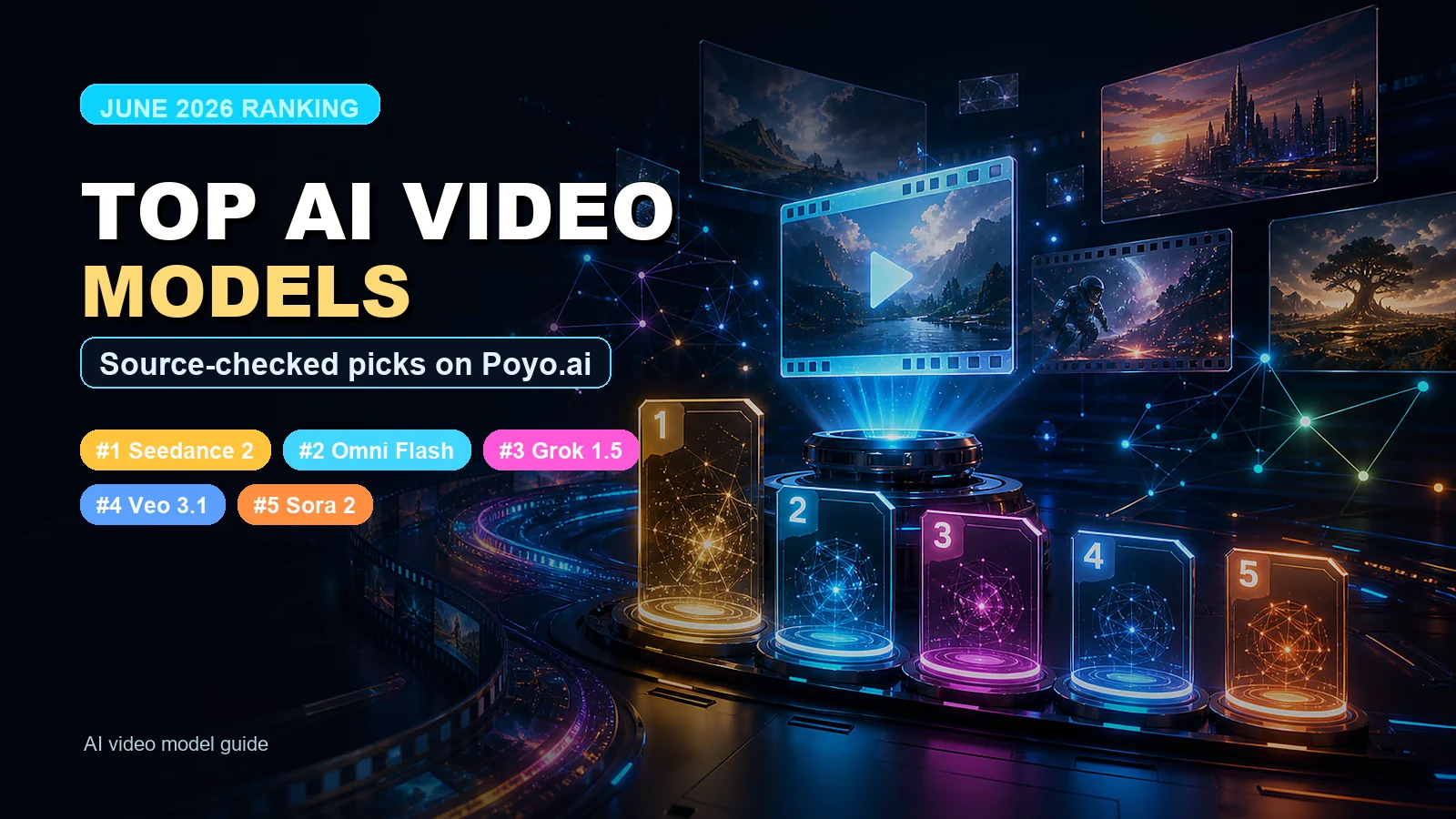
AI video changed quickly again in late May and early June 2026. Google introduced Gemini Omni Flash for Flow and Flow Music, xAI published the Grok Imagine Video 1.5 preview model, and the public image-to-video leaderboard shifted again. At the same time, Sora 2 remains technically important but now carries a clear sunset timeline from OpenAI.
This June 2026 list is a Poyo.ai recommendation ranking, not a claim that a public source has measured global usage share across every provider. There is no single public market-share dataset that proves which AI video model is "most popular" everywhere. We ranked these models by three practical signals:
- Publicly documented model capability.
- Current developer or product availability.
- How useful the model is for real production workflows on Poyo.ai.
Quick Answer
The best AI video model for most teams in June 2026 is Seedance 2 because it has the strongest mix of multimodal inputs, native audio options, duration control, and production-ready API fit. Grok Imagine Video 1.5 is the most exciting new image-to-video model to test, while Omni Flash is the Google model to watch for any-input video creation and conversational editing.
If you need a simple decision:
- Choose Seedance 2 for the best all-around production workflow.
- Choose Omni Flash for Google's newest multimodal video direction.
- Choose Grok Imagine Video 1.5 for fast image-to-video from one source frame.
- Choose Veo 3.1 for mature Google video with realism and audio.
- Choose Sora 2 Official only when Sora-style output is worth the sunset planning.
June 2026 Ranking
| Rank | Model | Best For | Public Evidence Checked | Available on Poyo.ai |
|---|---|---|---|---|
| 1 | Seedance 2 | Best overall production video workflow | ByteDance Seed launch notes, Seedance 2.0 paper, Poyo API docs | Yes |
| 2 | Omni Flash | Best new any-input video creation and editing model to watch | Google DeepMind model card, Google Flow announcement, Poyo integration | Yes |
| 3 | Grok Imagine Video 1.5 | Best fast image-to-video model to test right now | xAI docs, Arena I2V leaderboard, Poyo docs | Yes |
| 4 | Veo 3.1 | Best Google video model for realism, audio, and cinematic controls | Google DeepMind Veo page, Poyo docs | Yes |
| 5 | Sora 2 Official | Best Sora-style realism during the remaining API window | OpenAI Sora 2 announcement, OpenAI discontinuation notice, Poyo docs | Yes |
Model Comparison by Workflow
| Workflow | Best Pick | Why |
|---|---|---|
| Text-to-video | Seedance 2 | Strong default for structured prompts, duration control, and production pricing. |
| Image-to-video | Grok Imagine Video 1.5 | xAI's preview model is ranked highly on the public Arena I2V leaderboard and is simple to test from one image. |
| Multimodal references | Seedance 2 | Supports reference image, video, and audio workflows through one API surface on Poyo.ai. |
| Conversational video editing | Omni Flash | Google's model card positions Omni Flash around any-input creation and natural conversational video editing. |
| Native audio realism | Veo 3.1 | Google publishes strong public claims around audio-video alignment, realistic physics, and prompt adherence. |
| Transition-period Sora output | Sora 2 Official | Still useful for Sora-style realism, but OpenAI's API discontinuation date creates production risk. |
What Changed in June 2026?
Three things make this ranking different from a generic "best AI video generator" list:
- Grok Imagine Video 1.5 became worth testing immediately. xAI's docs show the new preview model, and Arena's May 29, 2026 image-to-video leaderboard places the 720p preview model at the top of its I2V ranking at the time checked.
- Omni Flash gives Google a new media direction beyond Veo. Google DeepMind describes Gemini Omni Flash as a model for creating and editing video from text, image, audio, and video inputs, while also noting that fuller public evaluations will arrive with developer and enterprise API rollout.
- Sora 2 moved from default recommendation to migration-aware recommendation. OpenAI says Sora web and app experiences were discontinued on April 26, 2026, and the Sora API will be discontinued on September 24, 2026.
1. Seedance 2: Best Overall AI Video Model for Production
Seedance 2 ranks first because it combines strong public capability claims with a practical API surface. ByteDance Seed says Seedance 2.0 is built with a unified multimodal audio-video joint generation architecture and supports text, image, audio, and video inputs. The Seedance 2.0 paper also describes it as a native multimodal audio-video generation model released in early 2026.
On Poyo.ai, Seedance 2 is useful because it is not limited to one prompt-to-video path. The current API supports:
- Text-to-video.
- First and last frame control with up to 2 images.
- Reference images, reference videos, and reference audio.
- Optional generated audio.
- 480p, 720p, and 1080p on the standard model.
- 480p and 720p on
seedance-2-fast. - 4 to 15 second duration.
Seedance 2 is the safest default when a team needs one model for repeated production: ads, product motion, social clips, music concepts, storyboard tests, and multimodal reference workflows.
2. Omni Flash: Best New Any-Input Video Model to Watch
Omni Flash ranks second because Google is positioning Gemini Omni Flash as a new model for creating and editing video from broad input types. Google DeepMind's model card says Gemini Omni Flash accepts text, images, audio, and video files, and outputs high-quality, high-resolution video with audio. Google also says it is distributed through Gemini App, YouTube, Google Flow, and Google Flow Music.
The important limitation: Google says detailed evaluations for T2VA, I2VA, R2VA, video editing, and image generation will be shared when developer and enterprise APIs roll out. That means Omni Flash should not be treated as a benchmark-proven winner yet.
On Poyo.ai, the current Omni Flash workflow is designed for compact API calls:
- Prompt-only text-to-video.
- One-image image-to-video.
- Three-image reference fusion.
- One-video input generation.
- 720p and 1080p output controls.
- 4, 6, 8, or 10 second duration for no-video-input jobs.
- 16:9, 9:16, 1:1, 4:3, and 3:4 aspect ratios.
Choose Omni Flash when you want Google-style multimodal video creation, conversational editing direction, and a model that is likely to matter more as Google expands developer and enterprise access.
3. Grok Imagine Video 1.5: Best Fast Image-to-Video Model to Test
Grok Imagine Video 1.5 ranks third because it is one of the most interesting new image-to-video releases in June 2026. xAI's official docs list grok-imagine-video-1.5-preview, show image and video modalities, and explicitly say the model currently does not support text-to-video.
Public leaderboard data is also worth noting. Arena's Image-to-Video Arena page dated May 29, 2026 shows grok-imagine-video-1.5-preview-720p at rank 1 with a preliminary 1473 +/- 9 score, and dreamina-seedance-2.0-720p very close behind at rank 2 with 1467 +/- 11. That does not make Grok 1.5 the best model for every workflow, but it is a strong reason to test it.
On Poyo.ai, Grok Imagine Video 1.5 is focused and simple:
- Required prompt.
- Exactly one source image.
- 480p or 720p output.
- 1 to 15 second duration.
- Standard async task submission, polling, and webhook delivery.
Choose Grok Imagine Video 1.5 for product motion, creator assets, image animation, social loops, and fast concept tests where one strong source frame is available.
4. Veo 3.1: Best Mature Google Video Model for Realism and Audio
Veo 3.1 remains one of the most important AI video models in 2026. Google DeepMind publishes more public evaluation language for Veo than for Omni Flash today. Its Veo page reports preference results for image-to-video text alignment, image-to-video visual quality, text-to-video with audio, audio-video alignment, and visually realistic physics.
Veo 3.1 is strongest when the output needs cinematic realism, native audio, camera control, reference images, or scene continuation. Google also highlights character consistency, scene extension, camera controls, and first/last frame workflows.
On Poyo.ai, Veo 3.1 supports:
veo3.1-lite,veo3.1-fast, andveo3.1-quality.- 8-second generation.
- Text-to-video on all models.
- Image-to-video on
veo3.1-fastandveo3.1-quality. - Up to 4K output.
- Frame mode with two images and reference mode with three images where supported.
Choose Veo 3.1 when you want a mature Google video model with strong public evaluation support and practical cinematic controls.
5. Sora 2 Official: Still Powerful, But Time-Limited
Sora 2 Official is still an important benchmark for cinematic realism, controllability, synchronized audio, and world-state persistence. OpenAI described Sora 2 as a flagship video and audio generation model that can create background soundscapes, speech, and sound effects.
The production risk is availability. OpenAI's help center says the Sora web and app experiences were discontinued on April 26, 2026, and that the Sora API will be discontinued on September 24, 2026. As of June 6, 2026, this makes Sora 2 useful for transition-period generation and comparison, but risky as a long-term default model.
On Poyo.ai, Sora 2 Official currently supports:
- Text-to-video.
- Optional single-image guided generation.
- Fixed 4, 8, 12, 16, and 20 second durations.
- 16:9 and 9:16 aspect ratios.
- Standard async task workflow.
Choose Sora 2 Official only when Sora-style realism and audio are worth the sunset planning.
Which Model Should You Use?
| Use Case | Recommended Model |
|---|---|
| General production workflow | Seedance 2 |
| New Google multimodal editing workflows | Omni Flash |
| Fast image-to-video tests from one source frame | Grok Imagine Video 1.5 |
| Realistic video with stronger public Google evaluation support | Veo 3.1 |
| Sora-style realism during the remaining API window | Sora 2 Official |
For most teams, the practical answer is not one model forever. Use Seedance 2 as the default production model, Omni Flash for new Google-style multimodal workflows, Grok Imagine Video 1.5 for fast image-to-video tests, Veo 3.1 for cinematic Google output, and Sora 2 Official only where its specific realism advantage is worth the API sunset risk.
FAQ
What is the best AI video model in June 2026?
For most production teams, the best overall AI video model in June 2026 is Seedance 2. It supports the broadest practical workflow mix on Poyo.ai: text-to-video, image-to-video, reference image/video/audio workflows, optional audio generation, and 4 to 15 second duration.
Is Grok Imagine Video 1.5 better than Seedance 2?
Not universally. Grok Imagine Video 1.5 is excellent to test for image-to-video from a single source frame, and Arena's I2V leaderboard gives it a strong public signal. Seedance 2 is still the better all-around production pick because it supports more workflow types on Poyo.ai.
Is Omni Flash better than Veo 3.1?
There is no public apples-to-apples score that proves Omni Flash is categorically better than Veo 3.1. Google DeepMind says Omni Flash evaluations for T2VA, I2VA, R2VA, editing, and image generation will be shared when developer and enterprise APIs roll out. Veo 3.1 currently has stronger public benchmark language from Google.
Should developers still build on Sora 2?
Use Sora 2 Official only when Sora-style realism is specifically needed. OpenAI says the Sora API will be discontinued on September 24, 2026, so new long-term products should plan around alternatives such as Seedance 2, Veo 3.1, Omni Flash, and Grok Imagine Video 1.5.
Sources Checked
- ByteDance Seed: Seedance 2.0 Official Launch
- Seedance 2.0 paper on arXiv
- Google DeepMind: Gemini Omni Flash model card
- Google Blog: Gemini Omni for Google Flow and Flow Music
- xAI Docs: Grok Imagine Video 1.5 Preview
- Arena.ai Image-to-Video Arena
- Google DeepMind: Veo 3.1
- OpenAI: Sora 2 is here
- OpenAI Help: Sora discontinuation
- Poyo.ai Seedance 2 API docs
- Poyo.ai Grok Imagine Video 1.5 API docs
- Poyo.ai Veo 3.1 API docs
- Poyo.ai Sora 2 Official API docs