
Key takeaways
- Start with Opus 5.5 for most work. Anthropic's own guidance: use Opus 5.5 as the default, and move to Fable 5.2 for demanding reasoning, long-horizon agents, or when Opus 5.5 at higher effort still falls short.
- Fable 5.2 is the stronger model. On Anthropic's launch table it beats Opus 5.5 on 12 of 13 shared benchmarks, with the biggest gaps on real paid tasks (RLI 41.3% vs 21.3%) and robotics (RoboDojo 64.9% vs 39.4%).
- Per token, Fable costs exactly 2×. $8 / $40 per million input/output tokens vs $4 / $20 for Opus 5.5. Cache reads cost the same ($0.20).
- Per task, Fable can be cheaper. Anthropic reports Fable 5.2 at lower effort matching Opus 5.5's best scores for roughly 10–50% of the cost per task.
- Independent tests agree. On routine coding both models pass and Opus 5.5 costs 1.6× to 6.5× less; Fable 5.2 pulls ahead on formal proofs, large one-shot builds and code review.
- Watch the default effort. Fable 5.2 defaults to
high; Opus 5.5 defaults tomedium. Seteffortexplicitly when you compare them.
Claude Fable 5.2 vs Opus 5.5 at a glance
| Claude Fable 5.2 | Claude Opus 5.5 | |
|---|---|---|
| API model ID | claude-fable-5-2 | claude-opus-5-5 |
| Released | November 9, 2026 | September 22, 2026 |
| Tier | Top tier (above Opus) | Anthropic's recommended default |
| Context window | 1M tokens | 1M tokens |
| Max output | 128K tokens | 128K tokens (300K via Batches beta) |
| Input → output | Text and images → text | Text and images → text |
| Default effort | high | medium |
| Input / output (official, per 1M) | $8 / $40 | $4 / $20 |
| Cache read (official, per 1M) | $0.20 | $0.20 |
| Knowledge cutoff | June 2026 | June 2026 |
| Data retention | 30-day retention | Standard Claude API terms |
Opus 5 vs Fable 5: which versions are you comparing?
"Opus 5 vs Fable 5" covers five models released in 2026. Fable is the top tier; Opus is the cheaper, everyday tier. Each new Opus has landed close to the previous Fable.
| Model | Released | Tier | Official input / output (per 1M) |
|---|---|---|---|
| Claude Fable 5 | June 9, 2026 | Top tier | $10 / $50 |
| Claude Opus 5 | July 24, 2026 | Everyday tier | $5 / $25 |
| Claude Fable 5.1 | September 1, 2026 | Top tier | $10 / $50 |
| Claude Opus 5.5 | September 22, 2026 | Everyday tier | $4 / $20 |
| Claude Fable 5.2 | November 9, 2026 | Top tier | $8 / $40 |
Opus 5 vs Fable 5: the July 2026 matchup
When Opus 5 launched, Anthropic reported it ahead of Fable 5 on its headline coding, knowledge-work and computer-use benchmarks, at half the price:
| Benchmark | Opus 5 | Fable 5 |
|---|---|---|
| Frontier-Bench v0.1 | 43.3% | 33.7% |
| GDPval-AA v2 (Elo) | 1,861 | 1,747 |
| OSWorld 2.0 | 70.6% | 66.1% |
| Official input / output (per 1M) | $5 / $25 | $10 / $50 |
That is why many early "Opus 5 vs Fable 5" threads concluded the cheaper model won. The current generation shifts the balance: Fable 5.2 leads Opus 5.5 on 12 of 13 shared benchmarks and is the first price cut in the Fable tier, 20% below Fable 5.1.
The current pair is Opus 5.5 and Fable 5.2, and the rest of this article compares those two. For related comparisons, see GPT-6.1 Sol vs Claude Opus 5.5 and the Claude Sonnet 5 pricing guide.
What the two models share
Opus 5.5 and Fable 5.2 are closer in shape than their prices suggest:
- Same context and output limits. Both read up to 1M tokens and write up to 128K tokens in a single request, with no long-context surcharge.
- Same thinking model. Adaptive thinking is always on for both. You control depth with
effort(low,medium,high,xhigh,max) rather than a token budget. - Same API rules. Both accept
tool_choiceofautoornoneand usecomputer_toolset_20260801for computer use. - Same knowledge cutoff. June 2026.
The practical difference is how much capability you get per request and what each request costs.
Pricing: 2× per token, not always 2× per task
Official rates (USD per 1M tokens)
| Charge | Fable 5.2 | Opus 5.5 | Fable vs Opus |
|---|---|---|---|
| Input | $8.00 | $4.00 | 2× |
| Output | $40.00 | $20.00 | 2× |
| Cache read | $0.20 | $0.20 | Same |
| Cache write (5-minute) | $10.00 | $5.00 | 2× |
| Cache write (1-hour) | $16.00 | $8.00 | 2× |
| Fast mode input / output | $16 / $80 | $8 / $40 | 2× |
The equal cache-read price matters for agents. A long coding session re-reads the same repository context on every turn, so a large share of its input can be billed at $0.20 per million on either model. For Sonnet, Haiku and every other Claude model, see our Claude API pricing guide.
Worked examples
Both examples assume the two models use the same number of tokens, which is the worst case for Fable.
| Scenario | Fable 5.2 | Opus 5.5 |
|---|---|---|
| Single request: 50K input + 8K output | 0.05×8 + 0.008×40 = $0.72 | 0.05×4 + 0.008×20 = $0.36 |
| Agent session: 2M cached reads + 300K fresh input + 150K output | 2×0.2 + 0.3×8 + 0.15×40 = $8.80 | 2×0.2 + 0.3×4 + 0.15×20 = $4.60 |
In the agent session, caching narrows the gap from 2× to about 1.9×. Output tokens still dominate the bill, which is why effort is the main cost lever.
Cost per completed task
Token price is only half of the equation. Anthropic's launch post compares cost per task at matched scores:
| Benchmark | Fable 5.2 setting | Result vs Opus 5.5 | Reported cost |
|---|---|---|---|
| FrontierCode 2.0 | high effort: 45.3% | About the same as Opus 5.5's best (45.5%) | About half the cost per task |
| WANDR | medium effort | Matches Opus 5.5's top score | About 40% of the cost |
| Humanity's Last Exam | low effort | Matches Opus 5.5 | Under one-tenth of the cost |
| Chartography | medium effort: 66.4% | Beats Opus 5.5 at max (64.4%) | Under one-tenth of the cost |
The pattern: on hard tasks where Opus 5.5 needs max effort and many tokens to get there, Fable 5.2 at a lower effort can reach the same score with far fewer output tokens. On easy tasks, both models finish quickly and the cheaper per-token model wins.
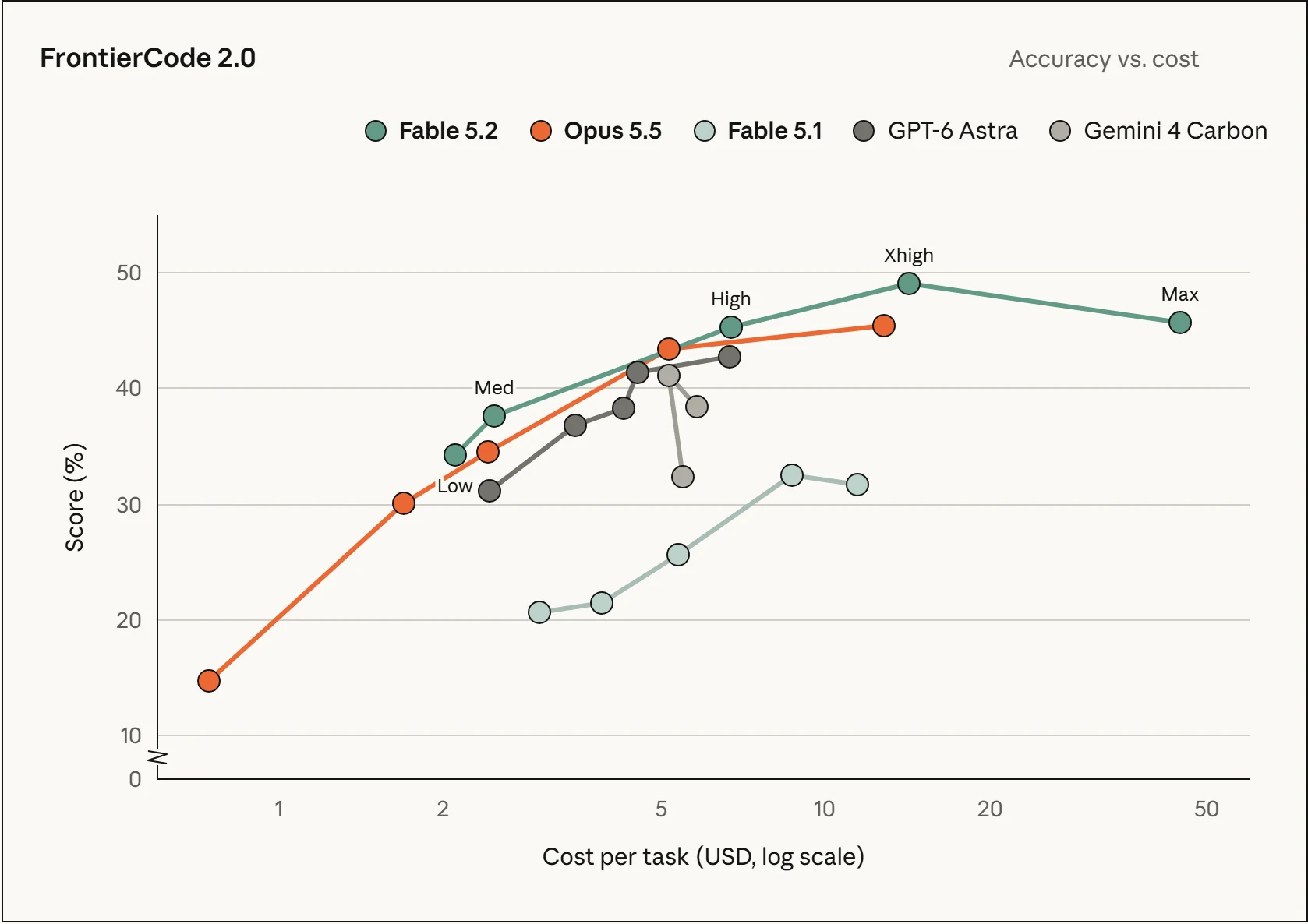
FrontierCode 2.0 accuracy against cost per task, from Anthropic's Fable 5.2 launch materials.
Benchmarks: where Fable 5.2 pulls ahead
Anthropic's launch table (each model at its highest available effort unless noted):
| Benchmark | What it measures | Fable 5.2 | Opus 5.5 | Gap |
|---|---|---|---|---|
| FrontierCode 2.0 | Agentic coding | 49.1% (xhigh) | 45.5% | +3.6 |
| FrontierSWE v2 | Software engineering | 69.9% | 62.3% | +7.6 |
| AutomationBench | Business workflows | 51.4% | 42.5% | +8.9 |
| Terminal-Bench-Science 0.1 | Agentic science | 74.6% | 58.7% | +15.9 |
| WANDR (relaxed score) | Long-horizon agents | 82.1% | 72.3% | +9.8 |
| OSWorld 2.1 (offline set, partial) | Computer use | 89.3% | 87.2% | +2.1 |
| RoboDojo Sim | Robotics | 64.9% | 39.4% | +25.5 |
| AA-Briefcase v1.1 (rubric) | Knowledge work | 66.1% | 61.2% | +4.9 |
| AA-Briefcase v1.1 (Elo) | Knowledge work | 1785 | 1800 | −15 |
| Remote Labor Index (RLI) | Real paid tasks | 41.3% (high) | 21.3% | +20.0 |
| Humanity's Last Exam (with tools) | Hard reasoning | 74.2% | 67.7% | +6.5 |
| Chartography (no tools) | Chart reasoning | 73.4% | 64.4% | +9.0 |
| BenchCAD 2.1 (with tools) | CAD | 83.5 | 65.3 | +18.2 |
How to read the table:
- Large gaps sit on long, open-ended work. Remote Labor Index, RoboDojo, BenchCAD and Terminal-Bench-Science all involve many steps, tools, or physical/visual reasoning. That is where Fable 5.2 is worth its price.
- Small gaps sit on everyday agent work. OSWorld (+2.1) and FrontierCode (+3.6) are close. For typical coding and computer-use tasks, Opus 5.5 delivers most of the capability at half the token price.
- Opus 5.5 holds its own on knowledge work. It edges Fable 5.2 on AA-Briefcase Elo (1800 vs 1785).
Test settings change between launches. For example, the Fable 5.2 table reports Chartography without tools, while the Opus 5.5 launch post reported it with tools, so compare scores within a single table.
What independent hands-on tests found
Several developers published head-to-head tests in the first days after launch. They used different tasks, tools and effort levels, so read each result on its own terms.
| Test | Setup | Fable 5.2 | Opus 5.5 |
|---|---|---|---|
| paddo.dev: real changes from a production TypeScript monorepo | 52 runs per model in Claude Code, medium effort, graded by the tests shipped with each change | 40 of 52 passed; $127.93 total | 44 of 52 passed; $78.44 total |
| Atomic Agent: Python library with 13 planted bugs and one missing feature | 59 hidden tests, 3 runs per setting | medium: 59/59, 4.2 min, $1.87high: 59/59, 26.6 min, $7.70 | medium: 59/59, 4.2 min, $0.97high: 59/59, 9.6 min, $1.70 |
| ContextBolt: three everyday jobs | Claude Code, medium effort: CSV dashboard, four-bug fix, keyword research | Bug fix: 9/9 tests, $0.32 Dashboard: 2 of 2 pages worked, $0.90–$1.23 | Bug fix: 9/9 tests, $0.19 Dashboard: 1 of 2 pages worked, $0.19–$0.24 |
| Overchat: five competition math proofs | One reply per problem, checked by the Lean proof assistant | 5 of 5 verified | 4 of 5 verified |
| MindStudio: KingBench 4, six large one-shot app builds | Rubric scoring, high effort | 70% | 57.8% |
Three patterns run through these results:
- On routine coding, both models get there and Opus 5.5 is cheaper. In the paddo.dev, Atomic Agent and ContextBolt tests, both models passed the same tasks while Fable 5.2 cost 1.6× to 6.5× as much. Token usage explains much of the gap: on ContextBolt's dashboard job, Fable wrote about 2.4× as many output tokens as Opus. The paddo.dev author adds that five of Fable's "failed" bug fixes were correct but returned an extra field that an exact-match test rejected.
- On the hardest work, Fable 5.2 pulls ahead. It verified all five competition proofs, led KingBench by 12 points, and in paddo.dev's review round caught a defect in a passing Opus fix in 4 of 4 reviews, against 1 of 4 for Opus.
- Effort changes the bill more than the model does. On the same Atomic Agent task, Fable 5.2 at its default
hightook 26.6 minutes and $7.70; atmediumit matched Opus 5.5's 4.2 minutes for $1.87, with the same 59/59 score.
These are small samples run at list prices, and several authors sell agent tools or model access. Use them as a guide to which tasks to test yourself.
Which should you choose?
| Your workload | Start with | Why |
|---|---|---|
| Everyday coding, code review, refactors | Opus 5.5 | Small benchmark gap, half the token price |
| Writing, documents, knowledge work | Opus 5.5 | Ties or leads on AA-Briefcase Elo |
| High-volume chat, extraction, classification | Opus 5.5 (or a smaller model) | Per-token price dominates on short tasks |
| Long-running autonomous coding agents | Fable 5.2 | +9.8 on WANDR, +7.6 on FrontierSWE |
| Research, science, hard math | Fable 5.2 | +15.9 on Terminal-Bench-Science, +6.5 on HLE |
| End-to-end task automation | Fable 5.2 | Nearly 2× on Remote Labor Index |
| Charts, CAD, dense visual reasoning | Fable 5.2 at medium | Beats Opus at max for a fraction of the cost |
Opus 5.5 at xhigh/max still fails your evals | Fable 5.2 at low/medium | Often cheaper per task than maxed-out Opus |
A practical routing setup: send everything to Opus 5.5 at medium, track which requests fail your checks or need retries, and route those task types to Fable 5.2. Re-measure cost per accepted task after a week rather than comparing token prices.
How to switch between them on PoYo
Both models are available through the same PoYo API key. On PoYo they are priced 20% below Anthropic's official rates:
| Charge (per 1M tokens) | Fable 5.2 on PoYo | Opus 5.5 on PoYo |
|---|---|---|
| Input | $6.40 | $3.20 |
| Output | $32.00 | $16.00 |
| Cache read | $0.16 | $0.16 |
| Cache write (5m / 1h) | $8.00 / $12.80 | $4.00 / $6.40 |
Switching is a one-line change of the model field. Set effort explicitly so the comparison is fair:
curl https://api.poyo.ai/v1/messages \
  -H "x-api-key: $POYO_API_KEY" \
  -H "anthropic-version: 2023-06-01" \
  -H "content-type: application/json" \
  -d '{
    "model": "claude-fable-5-2",
    "max_tokens": 16000,
    "output_config": {"effort": "medium"},
    "messages": [{"role": "user", "content": "Review this diff for concurrency bugs: ..."}]
  }'
Change "model" to "claude-opus-5-5" to run the same request on Opus 5.5. The Anthropic SDKs work by setting the base URL to https://api.poyo.ai, and an OpenAI-compatible /v1/chat/completions endpoint is also available.
Model pages: Claude Fable 5.2 · Claude Opus 5.5.
FAQ
Is Opus 5 as powerful as Fable 5?
It depends on the generation. In July 2026, Anthropic reported Opus 5 ahead of Fable 5 on its headline benchmarks at half the price, for example 43.3% vs 33.7% on Frontier-Bench v0.1. In the current generation, Fable 5.2 scores higher than Opus 5.5 on 12 of the 13 benchmarks Anthropic reported for both, while the gap on everyday coding and computer use stays small (2–4 points).
Which one is better, Opus or Fable?
Fable 5.2 is the more capable model; Opus 5.5 is the better default. Anthropic recommends starting with Opus 5.5 for most workloads and moving to Fable 5.2 for demanding reasoning and long-horizon agentic work, or when Opus 5.5 at higher effort is still not good enough.
Is Opus 5 more expensive than Fable 5?
No. Fable is always the more expensive tier. Opus 5 costs $5 / $25 per million input/output tokens, against $10 / $50 for Fable 5. In the current generation, Opus 5.5 costs $4 / $20 and Fable 5.2 costs $8 / $40, with cache reads at the same $0.20 per million on both. Per completed task, Fable 5.2 at a lower effort can still cost less than Opus 5.5 at max on hard problems.
Is Claude Opus 5 better?
Opus 5 was a large step over Opus 4.8, more than doubling its Frontier-Bench v0.1 score (43.3% vs 18.7%). Opus 5.5 has since replaced it as Anthropic's recommended default at a lower price ($4 / $20 vs $5 / $25), so start new projects on Opus 5.5.
What is the difference between Fable 5.2 and Mythos 5.2?
They are the same underlying model. Fable 5.2 ships with cybersecurity and biology safeguards and is available to all developers through the Claude API and major cloud platforms. Mythos 5.2 runs without certain of those safeguards and is available to vetted organizations through Anthropic's Cyber Verification and Life Sciences Verification programs, and to Claude Enterprise customers through Claude Security. For most developers, Fable 5.2 is the model to use.
Where does Sonnet fit in Opus vs Fable vs Sonnet?
Sonnet is the lower-cost tier below Opus. Sonnet 5 lists at $2 / $10 per million tokens, and Sonnet 5.5 targets well-scoped coding and multi-step professional work. A common setup: Sonnet for high-volume, well-defined tasks, Opus 5.5 as the default, and Fable 5.2 for the hardest problems. See our Claude Sonnet 5 pricing guide.
What effort level should I use for Fable 5.2?
Start at medium. Fable 5.2 defaults to high, which uses more output tokens. In Atomic Agent's test, Fable 5.2 scored 59/59 at both levels, but medium took 4.2 minutes and $1.87 against 26.6 minutes and $7.70 at high. Raise effort only for tasks that need it.
Do Fable 5.2 and Opus 5.5 have the same context window?
Yes. Both support a 1M-token context window and 128K output tokens per request, with no long-context surcharge.
Can I switch from Opus 5.5 to Fable 5.2 mid-conversation?
Yes. Anthropic's guidance is to change model and keep sending the whole conversation. Each thinking block records the model that produced it: on the Claude API, Fable 5.2 can read Opus 5.5's thinking, while Fable 5.2's thinking is read only by Fable 5.2 and Mythos 5.2. When the current model can't read a block, the API drops it and the request still succeeds, and dropped blocks aren't billed. Keep earlier messages, the system prompt and tools unchanged when you switch: editing that history is what triggers a 400 error.