
Key takeaways
- MAI Image 2.6 is Microsoft AI's flagship image model for text-to-image and editing. MAI Image 2.6 Flash is the faster, lower-cost version with the same request fields.
- Microsoft prices both models per million tokens: $5 / $8 / $38 for text input, image input and image output on MAI Image 2.6, and $1.75 / $2.50 / $19 on Flash.
- On PoYo, an image uses about one output token per 1,024 pixels. A 1024×1024 image is about 1,024 output tokens, and the largest image (2,359,296 pixels, such as 1536×1536) is 2,304 tokens.
- That puts a 1K square image at about $0.039 on MAI Image 2.6 and $0.019 on Flash at Microsoft's rates. On PoYo the same images cost about $0.031 and $0.016.
- Output tops out at 2,359,296 pixels, and each request accepts up to 5 reference images and an optional web grounding switch.
- MAI Image 2.7 is an editing-first preview announced on October 27, 2026. You can try it on Arena, Artificial Analysis and MAI Playground, and its API details are still to be announced.
MAI Image 2.6 at a glance
| MAI Image 2.6 | MAI Image 2.6 Flash | |
|---|---|---|
| Microsoft's positioning | Flagship for "maximum precision" | Same quality level for "latency-sensitive, high-throughput production workloads" |
| PoYo model ID | mai-image-2.6 | mai-image-2.6-flash |
| Official price per 1M tokens (text in / image in / image out) | $5 / $8 / $38 | $1.75 / $2.50 / $19 |
| PoYo price per 1M tokens | $4 / $6.40 / $30.40 | $1.40 / $2 / $15.20 |
| Cost of a 1024×1024 image (official → PoYo) | ~$0.039 → ~$0.031 | ~$0.019 → ~$0.016 |
| Maximum output | 2,359,296 pixels (1536×1536 equivalent) | 2,359,296 pixels |
| Reference images | Up to 5 | Up to 5 |
| Web grounding | Yes | Yes |
| Output format | PNG | PNG |
Microsoft announced MAI Image 2.6 on August 10, 2026, added Flash on September 4, and made both models generally available in Microsoft Foundry on October 27, 2026.
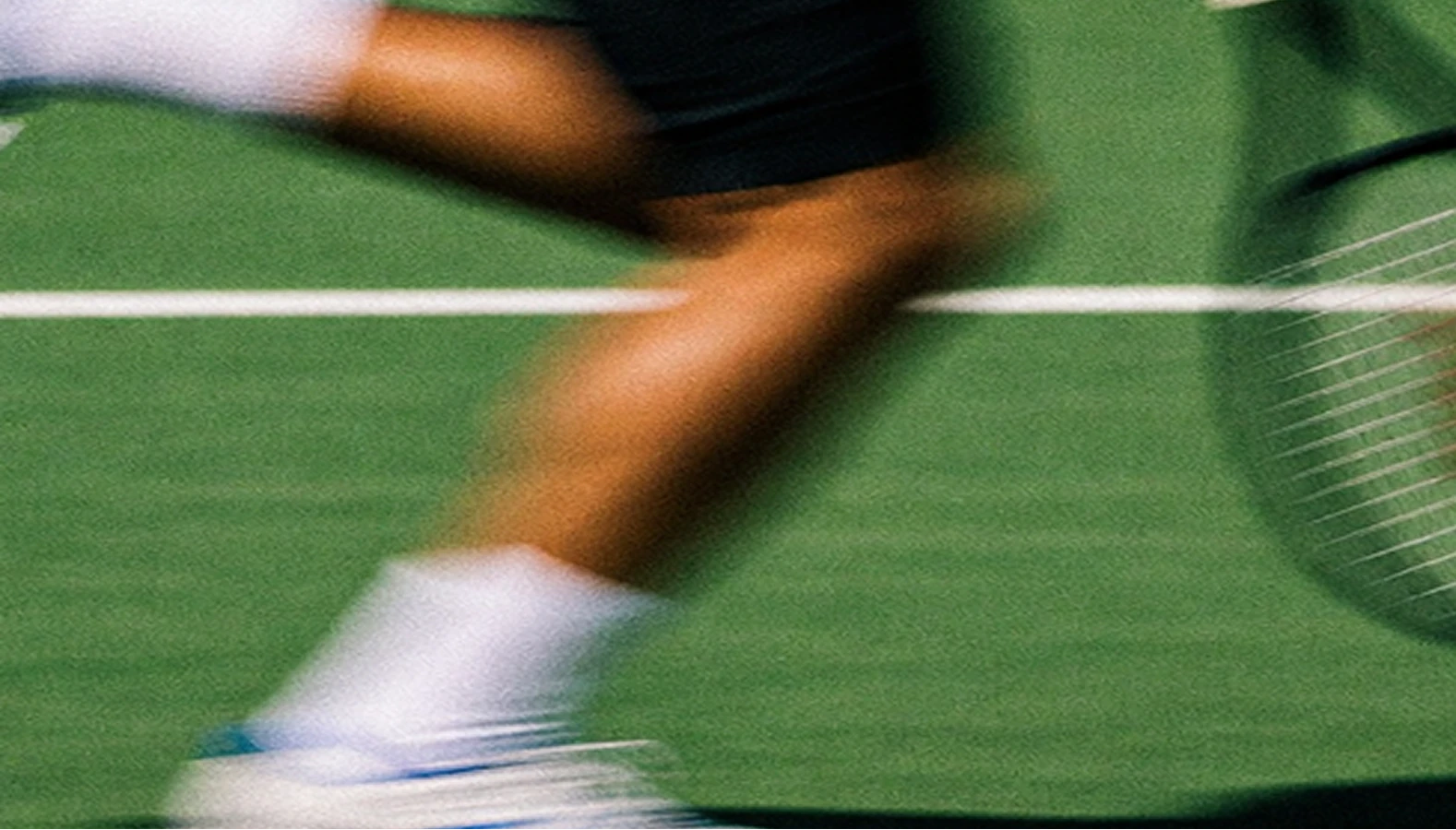
Photorealism with camera effects such as motion blur. Example from Microsoft AI's MAI Image page.
MAI Image 2.5, 2.6 and 2.7: which version is which?
Searches for "MAI Image" mix three generations, and their prices and limits differ, so check which one a page is describing.
| MAI Image 2.5 family | MAI Image 2.6 family | MAI Image 2.7 | |
|---|---|---|---|
| Announced | June 2, 2026 | August 10, 2026 (Flash on September 4) | October 27, 2026 |
| Models | MAI-Image-2.5, 2.5 Flash, 2.5 Pro | MAI-Image-2.6, 2.6 Flash | MAI Image 2.7 (preview) |
| Maximum output | 1,048,576 pixels (1024×1024 equivalent) | 2,359,296 pixels (1536×1536 equivalent) | To be announced |
| Official image output price | $47 / 1M tokens (2.5), $19.50 (2.5 Flash) | $38 / 1M tokens (2.6), $19 (2.6 Flash) | To be announced |
| Status | Preview in Foundry | Generally available in Foundry | Preview: Arena, Artificial Analysis and MAI Playground |
MAI Image 2.5 launched at No. 2 on Arena's image edit leaderboard and No. 3 for text-to-image. Microsoft priced it at $5 / $8 / $47 per 1M text input, image input and image output tokens, and 2.5 Flash at $1.75 / $1.75 / $19.50.
MAI Image 2.6 improved on 2.5 by +79 Elo overall, and by +91 Elo for text rendering alone, according to Microsoft. It also raised the pixel limit to 2,359,296 and cut the flagship's output price from $47 to $38 per 1M tokens. As of September 4, 2026, Microsoft reported it at No. 2 for both text-to-image and image editing on Arena, and No. 2 for text-to-image and No. 1 for image editing on Artificial Analysis.
MAI Image 2.7 is described by Microsoft as "our latest image editing model". It launched in preview at No. 3 on Arena Edit and No. 2 on the Artificial Analysis image editing leaderboard, and Microsoft says it "improves on 2.6 across all 10 use cases and all 7 editing actions evaluated by Artificial Analysis." Editing comes first, with "text-to-image generation coming soon." API access and pricing for 2.7 are still to be announced; follow the MAI Image 2.7 page for its arrival on PoYo. For production work today, MAI Image 2.6 is the API model to use.
How MAI Image pricing works
Each request is billed in three token types:
- Text input tokens: your prompt.
- Image input tokens: the reference images you send for editing.
- Image output tokens: the generated image.
The cost of one request is:
cost = text_tokens × text_rate + image_input_tokens × image_input_rate + output_tokens × output_rate
with each rate in USD per 1M tokens. Output tokens dominate the bill: a 300-token prompt adds $0.0015 on MAI Image 2.6, while the image itself costs $0.03 to $0.09.
How many tokens does one image use?
On PoYo, every MAI Image 2.6 and 2.6 Flash task is billed by the token counts the model reports. Based on PoYo's billing records from November 2026, a request uses about:
| What | Tokens counted |
|---|---|
| Generated image | width × height ÷ 1,024 (1024×1024 = 1,024 tokens; 2,359,296 pixels = 2,304 tokens) |
| Edited or composed image | About 1,020–1,024 tokens, because edit outputs are about 1 megapixel |
| Reference image | Its pixels ÷ 1,024, so about 1,024 tokens once PoYo has resized it to 1 megapixel |
| Prompt | Billed as text tokens; each reference image adds roughly 110–195 extra text tokens |
Two consequences matter for budgets. First, cost follows pixel count, so two sizes with the same number of pixels cost the same whatever their aspect ratio or 1K/2K label. Second, reference images are priced by their pixels: at $8 per 1M tokens, a 4096×4096 reference would cost about $0.13 on its own. PoYo downscales any reference image above 1 megapixel before generation, so each reference counts at most about 1,024 image tokens and stays well under a cent.
The exact charge for every task appears in the credits_amount field of the status response (1 credit = $0.005).
MAI Image 2.6 cost per image by size
Image output cost for each preset size on PoYo, at Microsoft's official rates and at PoYo's rates. Prompt tokens add roughly $0.001 or less.
| Size | Pixels | Output tokens | 2.6 official | 2.6 on PoYo | Flash official | Flash on PoYo |
|---|---|---|---|---|---|---|
| 1:1, 1K (1024×1024) | 1,048,576 | 1,024 | $0.0389 | $0.0311 | $0.0195 | $0.0156 |
| 16:9, 1K (1344×768) | 1,032,192 | 1,008 | $0.0383 | $0.0306 | $0.0192 | $0.0153 |
| 4:3, 1K (1152×864) | 995,328 | 972 | $0.0369 | $0.0296 | $0.0185 | $0.0148 |
| 3:2, 2K (1856×1248) | 2,316,288 | 2,262 | $0.0860 | $0.0688 | $0.0430 | $0.0344 |
| 1:1, 2K (1536×1536) | 2,359,296 | 2,304 | $0.0876 | $0.0700 | $0.0438 | $0.0350 |
| 16:9, 2K (2048×1152) | 2,359,296 | 2,304 | $0.0876 | $0.0700 | $0.0438 | $0.0350 |
| Custom 3072×768 | 2,359,296 | 2,304 | $0.0876 | $0.0700 | $0.0438 | $0.0350 |
In credits, a 1K square image is about 6.23 credits on MAI Image 2.6 and 3.11 on Flash; a 2K image at the pixel limit is about 14.01 and 7.00 credits.
Flash output tokens cost exactly half of MAI Image 2.6's, so Flash is half the price at every size. A 2K Flash image at the pixel limit costs less than half a cent more than a 1K MAI Image 2.6 image, while carrying 2.25 times the pixels.
Worked cost examples
Output and reference-image tokens follow the measured counts above; prompt sizes are illustrative.
| Scenario | Model | Tokens | Official cost | PoYo cost |
|---|---|---|---|---|
| Poster, 16:9 at 2K, 300-token prompt | MAI Image 2.6 | 300 text + 2,304 output | $0.0891 | $0.0712 |
| Social post, 1:1 at 1K, 300-token prompt | Flash | 300 text + 1,024 output | $0.0200 | $0.0160 |
| Product edit, 1 reference image | MAI Image 2.6 | 400 text + 1,024 image in + 1,024 output | $0.0491 | $0.0393 |
| Scene composition, 3 reference images | MAI Image 2.6 | 800 text + 3,072 image in + 1,024 output | $0.0675 | $0.0540 |
| Same composition on Flash | Flash | 800 text + 3,072 image in + 1,024 output | $0.0285 | $0.0228 |
| 1,000 social images, 1:1 at 1K | Flash | 1,000 × (300 + 1,024) | $19.98 | $15.98 |
The reference-image rows assume each reference is at most 1 megapixel, which is how PoYo prepares them. When calling Microsoft Foundry directly, larger references are counted at their full pixel size.
MAI Image 2.6 vs MAI Image 2.6 Flash: which to use
| If you need | Use | Why |
|---|---|---|
| Final campaign assets, posters with exact headlines | MAI Image 2.6 | Microsoft's top-quality model, with its +91 Elo text-rendering gain over 2.5 |
| Complex multi-reference edits | MAI Image 2.6 | Microsoft positions it for "maximum precision" |
| Drafts, previews and prompt exploration | Flash | Half the price per image |
| High-volume generation, personalization, interactive apps | Flash | Microsoft reports it 2.8× faster than GPT-Image-2-Medium with 72% greater efficiency |
A common pattern is to explore prompts and layouts on Flash, then render the chosen version on MAI Image 2.6. Both models accept the same fields, so switching is a one-word change in model.
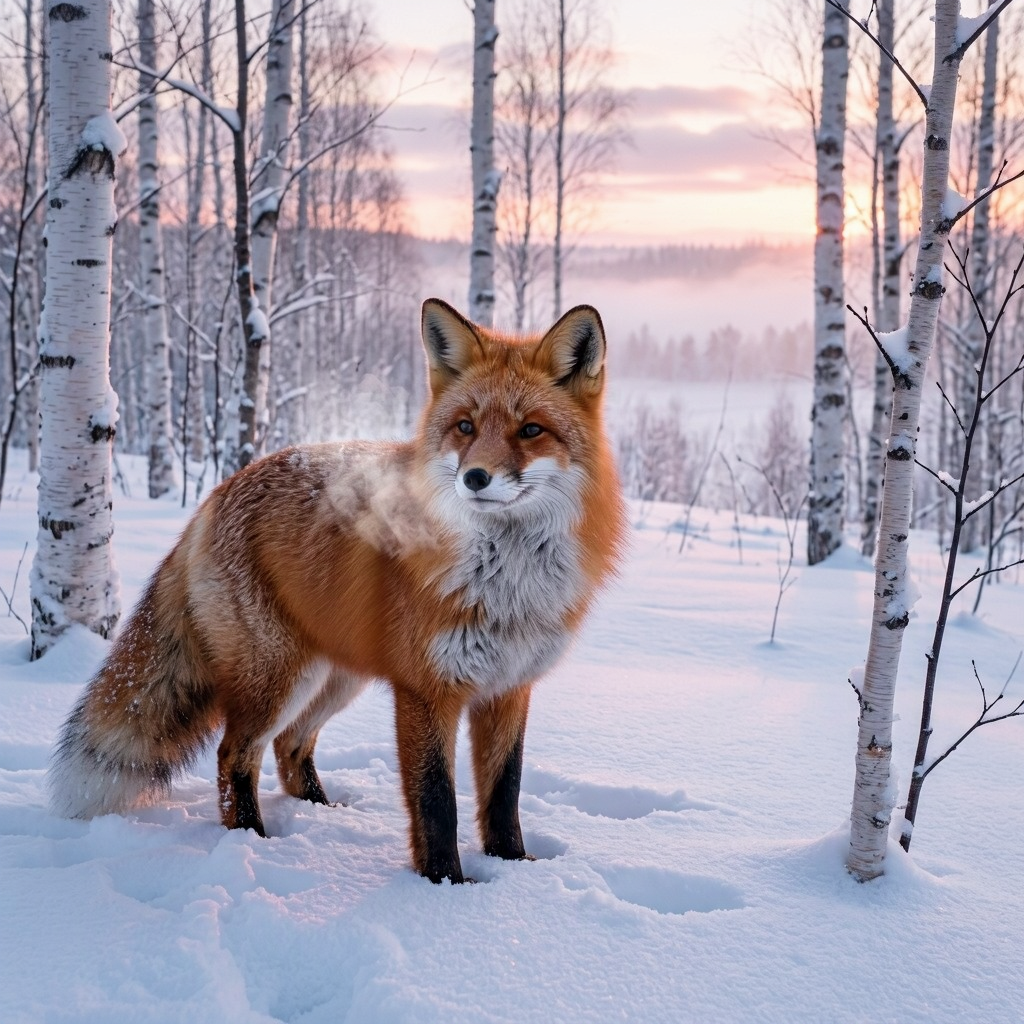
MAI Image 2.6, 1024×1024, about $0.031 on PoYo.
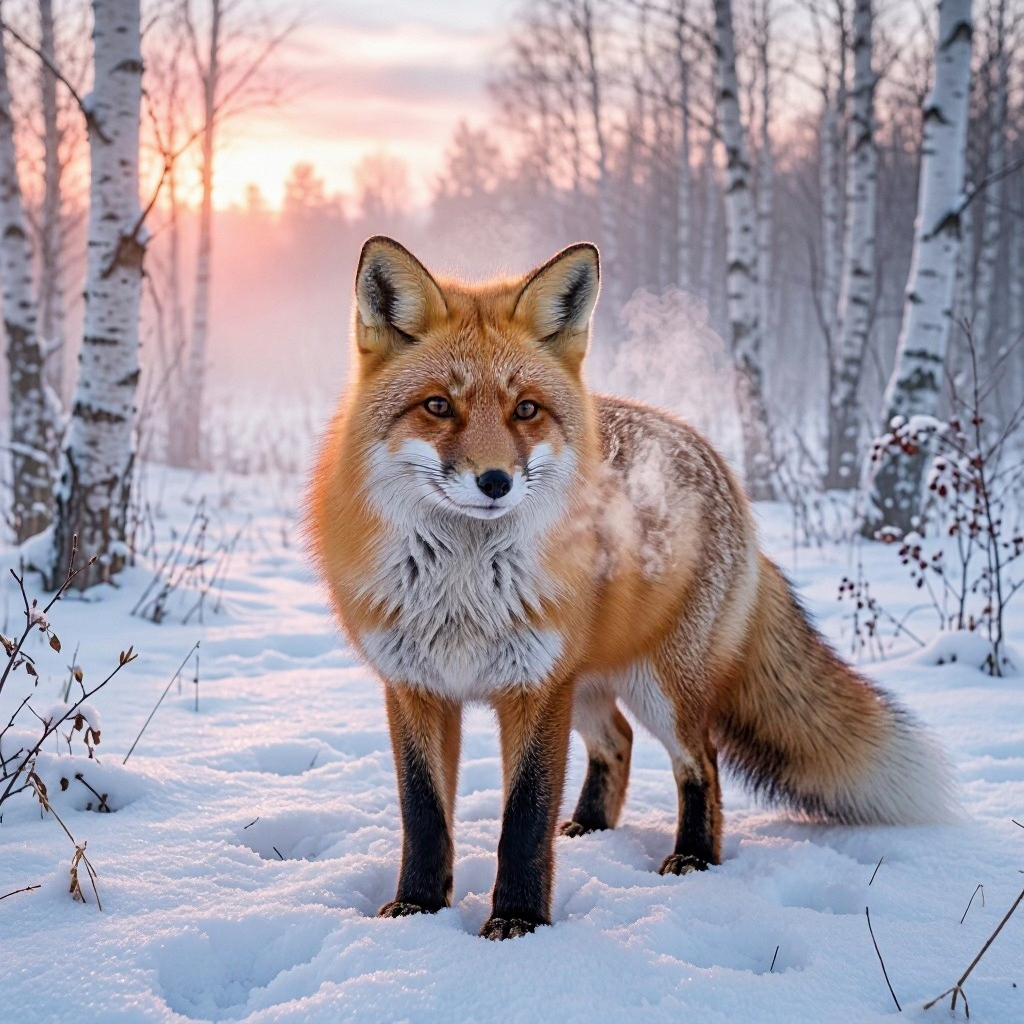
MAI Image 2.6 Flash, same prompt and size, about $0.016 on PoYo. Both images were generated on PoYo in November 2026.
How to use MAI Image 2.6 on PoYo
PoYo gives you both models through one API key with pay-as-you-go credits: create a key, add credits and send a request. Requests are asynchronous: you submit a task, get a task_id, then poll the status endpoint or receive a callback.
Parameters
| Field | Type | Values | Default |
|---|---|---|---|
model | string | mai-image-2.6 or mai-image-2.6-flash | Required |
input.prompt | string | 1–32,000 characters | Required |
input.image_urls | array | 1–5 public JPEG, PNG or WebP URLs; switches to editing / composition | None |
input.size | string | 1:1, 4:3, 3:4, 3:2, 2:3, 16:9, 9:16, or custom WIDTHxHEIGHT | 1:1 |
input.resolution | string | 1K or 2K, for aspect-ratio sizes | 1K |
input.enable_web_search | boolean | Grounds the image in current web information | false |
callback_url | string | URL that receives a POST when the task finishes or fails | None |
Aspect-ratio sizes map to fixed pixels:
size | 1K | 2K |
|---|---|---|
1:1 | 1024×1024 | 1536×1536 |
4:3 / 3:4 | 1152×864 / 864×1152 | 1760×1312 / 1312×1760 |
3:2 / 2:3 | 1248×832 / 832×1248 | 1856×1248 / 1248×1856 |
16:9 / 9:16 | 1344×768 / 768×1344 | 2048×1152 / 1152×2048 |
A custom WIDTHxHEIGHT needs both sides divisible by 32, each side at least 768 pixels, and at most 2,359,296 pixels in total, so a wide 3072x768 banner works. When you send image_urls, the output is about 1 megapixel and follows the reference images.
Submit a text-to-image task
curl --request POST "https://api.poyo.ai/api/generate/submit" \
  --header "Authorization: Bearer ${POYO_API_KEY}" \
  --header "Content-Type: application/json" \
  --data '{
    "model": "mai-image-2.6",
    "input": {
      "prompt": "A travel poster for a coastal town at golden hour, headline \"Lumen Bay\" in bold serif letters at the top, subtitle \"Summer Festival 2026\" below it, photorealistic harbor with sailboats",
      "size": "16:9",
      "resolution": "2K"
    }
  }'
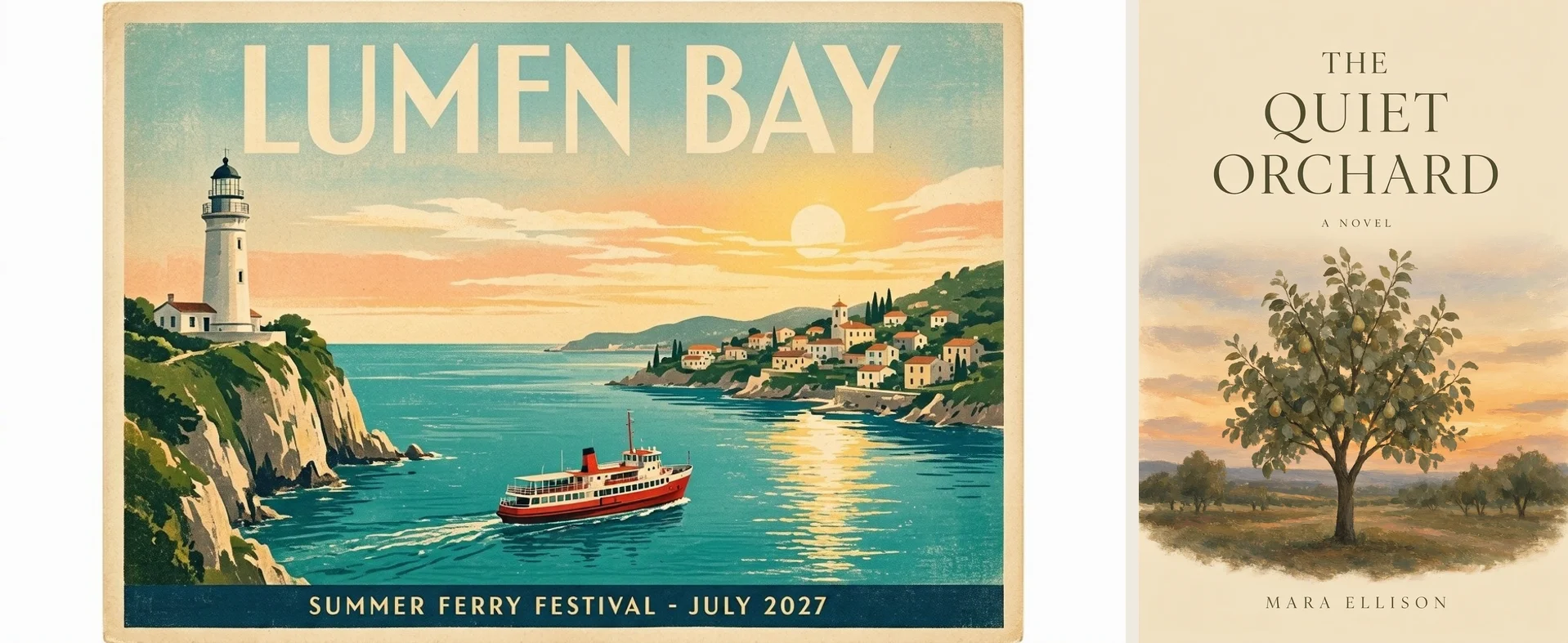
Quoted text in the prompt comes out as written in the headline, subtitle and author name. Generated with MAI Image 2.6 on PoYo.
The response returns a task ID right away:
{
  "code": 200,
  "data": {
    "task_id": "task-unified-1794383400-abcd1234",
    "status": "not_started",
    "created_time": "2026-11-14T10:30:00"
  }
}
Always check code in the body: validation errors can return HTTP 200 with code: 400.
Edit or combine reference images
Add image_urls and say what changes and what stays. Refer to inputs as image 1, image 2 and so on:
curl --request POST "https://api.poyo.ai/api/generate/submit" \
  --header "Authorization: Bearer ${POYO_API_KEY}" \
  --header "Content-Type: application/json" \
  --data '{
    "model": "mai-image-2.6-flash",
    "input": {
      "prompt": "Place the bottle from image 1 on the wet rock in image 2, beside the stream at golden hour. Keep the bottle shape, color and label unchanged.",
      "image_urls": [
        "https://example.com/bottle.png",
        "https://example.com/mountain-stream.png"
      ]
    }
  }'
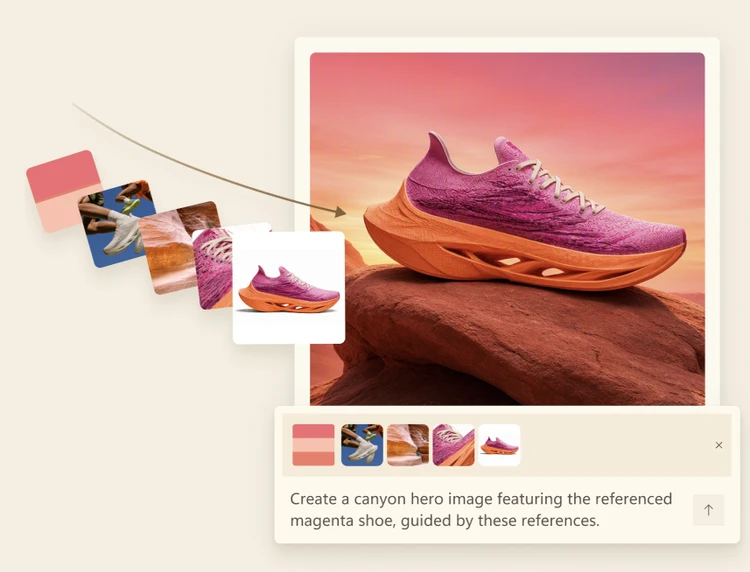
Up to 5 references combined into one image. Example from Microsoft's Foundry launch materials for MAI Image 2.6.
Poll the task status
curl --request GET "https://api.poyo.ai/api/generate/status/${TASK_ID}" \
  --header "Authorization: Bearer ${POYO_API_KEY}"
data.status | Meaning | Next step |
|---|---|---|
not_started | Queued | Poll again |
running | Generating | Poll again |
finished | Done | Read data.files[0].file_url and data.credits_amount |
failed | Failed, free of charge | Read data.error_message |
A short Python loop that waits for the image:
import os, time, requests

BASE_URL = "https://api.poyo.ai"
HEADERS = {"Authorization": f"Bearer {os.environ['POYO_API_KEY']}"}

def wait_for_image(task_id, interval=5, max_checks=60):
    for _ in range(max_checks):
        resp = requests.get(f"{BASE_URL}/api/generate/status/{task_id}", headers=HEADERS, timeout=30)
        task = resp.json()["data"]
        if task["status"] == "finished":
            print("Charged credits:", task["credits_amount"])
            return task["files"][0]["file_url"]
        if task["status"] == "failed":
            raise RuntimeError(task["error_message"])
        time.sleep(interval)
    raise TimeoutError(f"Still running; keep {task_id} and check again later")
In PoYo's tests in November 2026, most tasks finished in about 15 to 50 seconds, depending on size, reference images and queue load. Download the image soon after it finishes and store it yourself. PoYo reserves credits for the largest possible token count when you submit, then charges the tokens actually used, and failed tasks are free.
Tips for better results and lower cost
- Put exact on-image text in quotes and say where it goes. Text rendering is MAI Image 2.6's biggest gain over 2.5, and quoting the copy keeps headlines and titles spelled as written.
- Draft on Flash, finish on 2.6. Flash is half the price at every size and takes the same fields.
- Pick the pixel count you need. A 1K image costs less than half of a 2K one, because 1K sizes use about 1,000 output tokens and 2K sizes about 2,300.
- Keep reference images near 1 megapixel. Reference tokens scale with pixels; PoYo downscales larger files for you.
- Give each reference a role. Say "image 1 is the product, image 2 is the background" and list what must stay the same.
- Turn on
enable_web_searchfor real places, products and recent events, then check names and details before you publish. On PoYo, web grounding is included in the regular token price. - Use a custom size for banners such as
3072x768; the size rule counts total pixels, so one side can be long.
For other image model costs, see our GPT Image 2.5 pricing guide and GPT Image 2.6 API guide. To try MAI Image 2.6 in the browser first, open the MAI Image 2.6 playground.
FAQ
What is MAI Image 2.6?
MAI Image 2.6 (MAI-Image-2.6) is Microsoft AI's flagship image generation and editing model, announced on August 10, 2026. It creates photorealistic images, portraits, product visuals and posters with legible text, and edits or combines up to 5 reference images. It launched at No. 2 on the Arena text-to-image leaderboard.
How much does MAI Image 2.6 cost per image?
At Microsoft's rates, a 1024×1024 image costs about $0.039 on MAI Image 2.6 and $0.019 on Flash, and an image at the 2,359,296-pixel limit costs about $0.088 and $0.044. On PoYo the same images cost about $0.031 / $0.016 at 1K and $0.070 / $0.035 at the limit. Prompt and reference-image tokens add a little on top.
How is MAI Image 2.6 pricing calculated?
Microsoft charges per 1M tokens: $5 for text input, $8 for image input and $38 for image output on MAI Image 2.6, and $1.75, $2.50 and $19 on Flash. Multiply each token count by its rate. On PoYo, an image uses about one output token per 1,024 pixels, so a 1024×1024 image is about 1,024 output tokens.
What is the difference between MAI Image 2.6 and MAI Image 2.6 Flash?
Flash is the faster, lower-cost version for high-volume and latency-sensitive work. Microsoft says it is 2.8× faster than GPT-Image-2-Medium with 72% greater efficiency, at "less than half the price" of the flagship. Both take the same request fields and support editing with up to 5 references and web grounding.
What is the difference between MAI Image 2.5 and 2.6?
MAI Image 2.6 scores +79 Elo over 2.5 overall and +91 Elo on text rendering, per Microsoft. It raises the maximum output from 1,048,576 to 2,359,296 pixels and lowers the flagship image output price from $47 to $38 per 1M tokens. MAI Image 2.5 Flash costs $19.50 per 1M output tokens, against $19 for 2.6 Flash.
Is MAI Image 2.7 available through an API?
Microsoft launched MAI Image 2.7 on October 27, 2026 as an editing-first preview that you can try on Arena, Artificial Analysis and MAI Playground. API access and pricing are still to be announced, and text-to-image is "coming soon." For API work today, use MAI Image 2.6.
What is the maximum resolution of MAI Image 2.6?
2,359,296 pixels in total, the equivalent of 1536×1536. Either side can be longer as long as the total stays within the limit and each side is at least 768 pixels, for example 2048×1152 or 3072×768.
How many reference images can MAI Image 2.6 use?
Up to 5. With one image, the model edits it; with several, it combines products, people, styles and scenes into one image. Refer to them as image 1, image 2 and so on in the prompt.
Does web grounding cost extra?
On PoYo, web grounding is included in the regular token price on both models, so turning on enable_web_search keeps the cost of the image the same.
Can I try MAI Image 2.6 for free?
Microsoft offers its MAI models in MAI Playground for trying prompts. API access is paid per token, on Microsoft Foundry and on PoYo. On PoYo you pay as you go, for finished images only, with one API key for every model.
Is MAI Image 2.6 open source?
MAI Image 2.6 is Microsoft's proprietary model, offered through Microsoft Foundry and MAI Playground. To build with it, call it through an API such as PoYo, where the same key also works for every other image, video and audio model.