
Key takeaways
- MAI Image 2.6 is Microsoft's 20-billion-parameter image model. It generates and edits images with up to 5 references, adds optional web grounding, and outputs up to 2,359,296 pixels (1536×1536 or an equal area). MAI Image 2.6 Flash offers the same features at half the output-token price.
- All three charge by tokens at the source; PoYo turns that into a clear price per image. A 1024×1024 image costs about $0.031 on MAI Image 2.6, $0.016 on Flash, $0.02 on Nano Banana 2.1 and $0.0085 on
gpt-image-2.6-fixedon PoYo, each below the vendor's own price. - MAI Image 2.6 launched near the top of the leaderboards. Microsoft reported it at No. 2 on Arena's text-to-image leaderboard at launch, and in September at No. 1 for image editing on Artificial Analysis.
- GPT Image 2.6 leads on quality and controls. At
maxquality, Sunburst ranks first in both Artificial Analysis arenas, and the API adds masks, transparent backgrounds and sizes up to 3840 px. - Nano Banana 2.1 is the 4K all-rounder. It sits in the top ten of both Artificial Analysis arenas, outputs up to 4K, and costs $0.02 per 1K image on PoYo.
- MAI Image 2.7 is Microsoft's new editing model. Announced on October 27, 2026 as a preview, it is coming soon to PoYo; MAI Image 2.6 and 2.6 Flash cover editing on PoYo today.
MAI Image 2.6 vs GPT Image 2.6 vs Nano Banana 2.1 at a glance
| MAI Image 2.6 / 2.6 Flash | GPT Image 2.6 | Nano Banana 2.1 | |
|---|---|---|---|
| Developer | Microsoft AI | OpenAI | |
| Released | 2.6: August 2026 (model card: August 14) Flash: September 4, 2026 | November 4, 2026 | October 6, 2026 |
| Status at the vendor | Generally available in Microsoft Foundry since October 27, 2026 | Image API | Gemini API |
| PoYo model IDs | mai-image-2.6, mai-image-2.6-flash | gpt-image-2.6-fixed, gpt-image-2.6-flare, gpt-image-2.6-sunburst | nano-banana-2.1 |
| Official pricing | Per token: $5 text input, $8 image input, $38 image output per 1M (Flash: $1.75 / $2.50 / $19) | Per token: $5 text input, $8 image input, $30 image output per 1M | Per token: $1.50 input, $30 image output per 1M |
| Max output | 2,359,296 pixels (1536×1536 equivalent) | 3840 px long edge, 8,294,400 pixels | 4K (4096×4096) |
| Reference images | Up to 5 | Up to 16 on PoYo | Up to 14 at Google (10 objects, 4 characters); up to 10 on PoYo |
| Output format | PNG | PNG, JPEG, WebP (Flare / Sunburst on PoYo) | Image |
| Notable extras | Web grounding, custom WIDTHxHEIGHT | Masks, transparent backgrounds, quality up to max, complexity | Thinking levels, Google Search grounding, extreme ratios up to 8:1 at Google |
Where MAI Image 2.6 fits in Microsoft's lineup
Microsoft AI builds its own image models under the MAI name. MAI Image 2.6 follows the 2.5 series (MAI Image 2.5, 2.5 Flash and 2.5 Pro), which caps output at 1,048,576 pixels. Version 2.6 more than doubles that limit.
| Model | Microsoft's description | Status |
|---|---|---|
| MAI Image 2.6 | "Best Overall": high-quality generation and precise, controllable editing | Available on PoYo and in Microsoft Foundry |
| MAI Image 2.6 Flash | "Fastest & Lowest Cost": production-ready quality at less than half the flagship's price | Available on PoYo and in Microsoft Foundry |
| MAI Image 2.7 | Latest image editing model, announced October 27, 2026 | Preview on MAI Playground, Arena and Artificial Analysis; coming soon to PoYo |
According to Microsoft's model card, MAI Image 2.6 is a diffusion-based model with 20 billion non-embedding parameters and a 32K-token prompt context. Flash is an optimized version of the same model, and Microsoft's Foundry documentation lists the two with identical generation and editing capabilities.
How token pricing turns into a price per image
All three vendors bill images by tokens, but they count tokens differently. Here is how each one converts.
MAI Image 2.6 and Flash
Microsoft publishes token rates per million tokens. On PoYo, every MAI request is billed by its actual token counts, which follow a simple rule: an image uses about width × height ÷ 1,024 tokens (one token per 32×32 block), for both the output image and each reference image.
output tokens ≈ width × height ÷ 1,024
cost per image ≈ output tokens × output rate
                 + reference tokens × image input rate
                 + prompt tokens × text input rate
Artificial Analysis lists MAI Image 2.6 at $38.91 per 1,000 images at 1024×1024, which matches 1,024 output tokens × $38 per million ($0.0389), plus a short prompt.
| Output size | Output tokens | MAI Image 2.6 (official) | MAI Image 2.6 Flash (official) |
|---|---|---|---|
| 1024×1024 (1K, 1:1) | 1,024 | 1024 × $38/1M = $0.0389 | 1024 × $19/1M = $0.0195 |
| 1344×768 (1K, 16:9) | 1,008 | $0.0383 | $0.0192 |
| 1536×1536 (2K, 1:1) | 2,304 | 2304 × $38/1M = $0.0876 | 2304 × $19/1M = $0.0438 |
| 2048×1152 (2K, 16:9) | 2,304 | $0.0876 | $0.0438 |
A 100-token prompt adds $0.0005 on MAI Image 2.6 and under $0.0002 on Flash. On PoYo, reference images are downscaled to about 1 megapixel first, so each one costs at most about 1,024 image input tokens, and an edit returns an image of about 1 megapixel.
GPT Image 2.6
OpenAI also bills by tokens ($30 per million output tokens), and the token count depends on both size and the quality setting. Artificial Analysis lists GPT Image 2.6 Flare and Sunburst at $210.72 per 1,000 images at max quality and 1024×1024, which is about $0.21 per image. Lower quality settings use fewer tokens and cost less.
On PoYo you can skip the token math: gpt-image-2.6-fixed charges a flat price per image.
Nano Banana 2.1
Google publishes the token counts. At $30 per million output tokens:
| Resolution | Output tokens | Official price |
|---|---|---|
| 1K | 1,120 | $0.0336 |
| 2K | 1,680 | $0.0504 |
| 4K | 3,780 | $0.113 |
Text and image input cost $1.50 per million tokens on top.
Price per image on PoYo
| Model | 1K (1024×1024) | 2K | Top tier | Notes |
|---|---|---|---|---|
| MAI Image 2.6 | ~$0.0311 (6.23 credits) | ~$0.0700 at 1536×1536 | 2K (2,359,296 px) | $4 / $6.40 / $30.40 per 1M text input / image input / output tokens |
| MAI Image 2.6 Flash | ~$0.0156 (3.11 credits) | ~$0.0350 at 1536×1536 | 2K (2,359,296 px) | $1.40 / $2 / $15.20 per 1M |
| GPT Image 2.6 fixed | $0.0085 (1.7 credits) | $0.03 (6 credits) | 4K: $0.04 (8 credits) | Reference images included |
| GPT Image 2.6 Flare / Sunburst | By tokens | By tokens | 4K, by tokens | $4 / $6.40 / $24 per 1M; about $0.17 at max, 1024×1024 |
| Nano Banana 2.1 | $0.02 (4 credits) | $0.03 (6 credits) | 4K: $0.05 (10 credits) | Reference images included |
MAI and GPT Image 2.6 token rates on PoYo are 80% of the official rates. PoYo shows the maximum charge before each MAI request, bills the tokens actually used, and failed tasks are free.
Worked examples on PoYo
| Job | MAI Image 2.6 | MAI Image 2.6 Flash | GPT Image 2.6 fixed | Nano Banana 2.1 |
|---|---|---|---|---|
| 10,000 square thumbnails at 1K | 10000 × 0.0311 ≈ $311 | 10000 × 0.0156 ≈ $156 | 10000 × 0.0085 = $85 | 10000 × 0.02 = $200 |
| 500 wide banners at 2K | 500 × 0.0700 ≈ $35 | 500 × 0.0350 ≈ $17.50 | 500 × 0.03 = $15 | 500 × 0.03 = $15 |
| 300 product edits, 2 references each | 300 × (2048 × 6.4 + 1024 × 30.4) / 1M ≈ $13.27 | 300 × (2048 × 2 + 1024 × 15.2) / 1M ≈ $5.90 | 300 × 0.0085 ≈ $2.55 | 300 × 0.02 = $6 |
Prompt tokens add less than $0.001 per MAI image and are left out. The 2K images differ in size: MAI's 2K tier covers up to 2,359,296 pixels (2048×1152 at 16:9), while Nano Banana 2.1's 2K at 16:9 is 2752×1536. If the output must be larger than about 2.4 megapixels, use Nano Banana 2.1 or GPT Image 2.6 for that job.
Leaderboards: what each model is known for
MAI Image 2.6 search results lead with leaderboard claims. Here is what Microsoft reported and when:
- August 10, 2026 (launch): Microsoft reported MAI Image 2.6 at No. 2 on the Arena text-to-image leaderboard, ahead of leading models from Google, Meta and xAI, with +79 Elo over MAI Image 2.5 overall and +91 Elo for text rendering.
- September 4, 2026 (Flash launch): Microsoft said MAI Image 2.6 ranked No. 2 for both text-to-image and image editing on Arena, and No. 2 for text-to-image and No. 1 for image editing on Artificial Analysis.
The other two models have their own highlights on Artificial Analysis as of November 14, 2026:
- GPT Image 2.6 Sunburst at
maxquality ranks No. 1 for both text-to-image (1261 Elo) and image editing (1210 Elo), with Flare at No. 2 for editing. - Nano Banana 2.1 sits in the top ten of both arenas (1176 and 1152 Elo) about a month after its October 6 launch.
- MAI Image 2.6 Flash lands within 5 Elo of MAI Image 2.6 in the editing arena (1145 vs 1150) at half the output-token price, which makes it the value pick for editing pipelines.
Leaderboards update every time a new model arrives, and they measure average preference on mixed prompts. Use them to shortlist, then test your own briefs.
MAI Image 2.6 vs GPT Image 2.5
Many comparison pages pit MAI Image 2.6 against GPT Image 2.5, the OpenAI model of its launch period. GPT Image 2.5 (September 8, 2026) has the same token rates as 2.6: $5, $8 and $30 per million text input, image input and output tokens, with xhigh and max quality settings and Sunburst recommended by OpenAI for editing precision. MAI Image 2.6 brings web grounding and custom sizes such as 3072×768, and Microsoft's newer MAI Image 2.7 preview, by Microsoft's report, debuted above GPT Image 2.5 Flare on Artificial Analysis's editing leaderboard. Both GPT Image 2.5 and MAI Image 2.6 run on PoYo with the same API key. For OpenAI's generation-to-generation changes, see the GPT Image 2.6 overview.
Speed
- MAI Image 2.6 Flash: Microsoft says it generates images 2.8× faster than GPT-Image-2-Medium while delivering 72% greater efficiency.
- GPT Image 2.6: OpenAI says Images 2.6 generates images 50% faster than before, and Flare can return an image in as little as six seconds at
lowquality. - Nano Banana 2.1: Google says it maintains Flash-level speed and cost efficiency.
In PoYo's tests in November 2026, most MAI Image 2.6 tasks finished in about 15 to 50 seconds, depending on size, reference images and queue load. All three run as asynchronous tasks on PoYo, so your application gets a task_id at once.
Features that change the choice
Sizes. MAI Image 2.6 offers seven ratios (1:1, 4:3, 3:4, 3:2, 2:3, 16:9, 9:16) at 1K or 2K on PoYo, or a custom WIDTHxHEIGHT: both sides divisible by 32, each at least 768, and up to 2,359,296 pixels in total. Because the limit is on area, a 3072×768 website banner works. GPT Image 2.6 Flare and Sunburst accept custom sizes up to 3840 px on the long edge. Nano Banana 2.1 goes to 4K, and Google's API adds panoramic 1:4, 4:1, 1:8 and 8:1 ratios.

GPT Image 2.6: three crowded, multi-subject scenes from the same prompt.
References and editing. MAI Image 2.6 takes 1 to 5 images: one is edited, several are combined, and you refer to them as image 1, image 2 and so on. Microsoft's own example combines a color swatch, an action shot, a rock texture, a knit close-up and a product photo into one canyon hero image of a running shoe. GPT Image 2.6 takes up to 16 on PoYo and adds mask_url for region edits. Nano Banana 2.1 takes up to 10 on PoYo (Google's limit is 14) and keeps characters and products consistent across multi-turn edits.
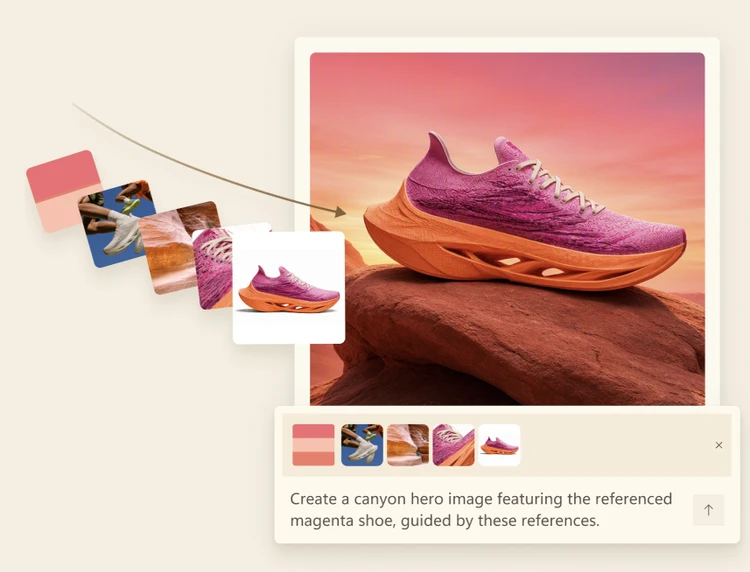
MAI Image 2.6 combining five references into one campaign image. Example from Microsoft's Foundry Blog post on MAI Image 2.6 and 2.6 Flash.
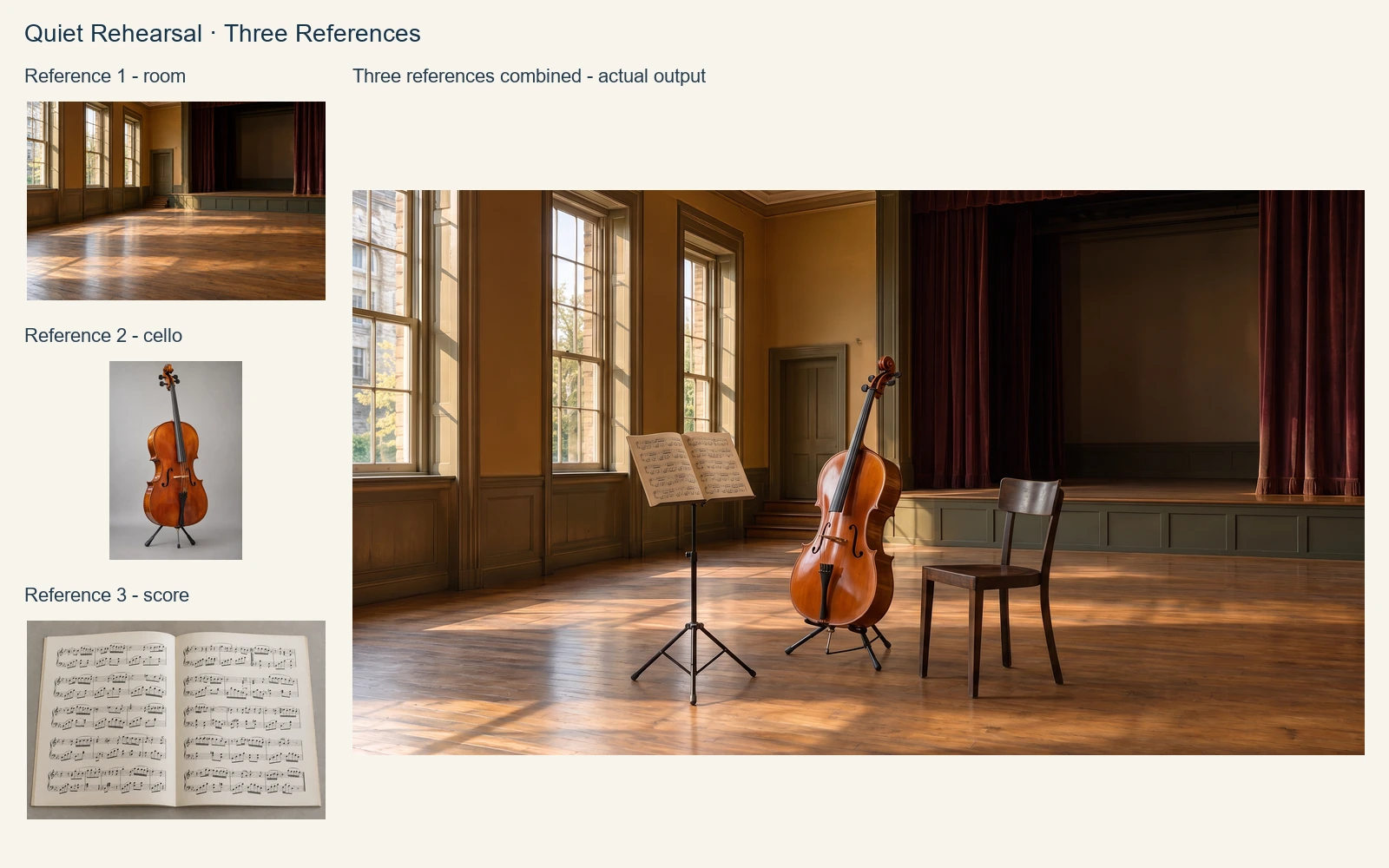
Nano Banana 2.1 combining a room, an instrument and a score into one scene.
Grounding. MAI Image 2.6 and Flash look up current web content before generating when you set enable_web_search: true on PoYo, with no extra charge. That helps with real landmarks, products and recent events. Nano Banana 2.1 has Google Search and Image Search grounding in the Gemini API.
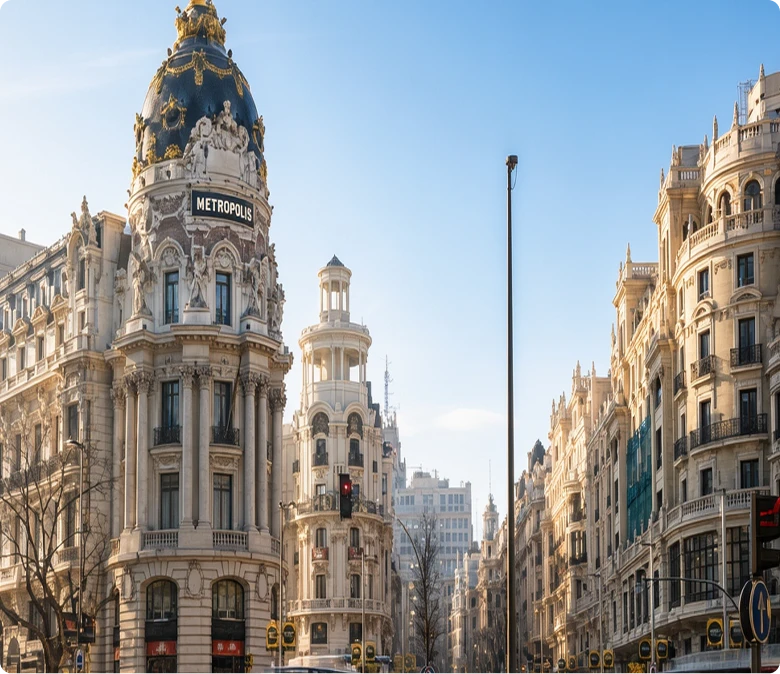
A real landmark "as it stands today", generated with web grounding. Example from Microsoft AI's MAI Image page.
Output controls. GPT Image 2.6 has the most controls: quality from low to max, transparent backgrounds, JPEG or WebP compression, and a complexity setting. MAI Image 2.6 returns lossless PNG files. For a broader look at transparency and layers, including Seedream 5.5, see Seedream 5.5 vs Nano Banana Pro vs GPT Image 2.6.
MAI Image 2.7: what Microsoft has announced
Microsoft AI announced MAI Image 2.7 on October 27, 2026 as its latest image editing model. What is confirmed so far:
- Editing first. It edits existing images: restyling or relighting a scene, restoring and enhancing assets, and changing text and symbols. Microsoft says it is "starting with editing, with text-to-image generation coming soon".
- Leaderboards. At launch, Microsoft reported it at No. 2 on Artificial Analysis's image editing leaderboard, above GPT Image 2.5 Flare, and No. 3 on Arena Edit, with a 24 Elo lead in scene and style editing.
- Over MAI Image 2.6. Microsoft says it improves on 2.6 across all 10 use cases and all 7 editing actions evaluated by Artificial Analysis.
- Availability. You can try the preview on MAI Playground, Arena and Artificial Analysis, and PoYo will add it as soon as Microsoft opens API access. For editing in production today, MAI Image 2.6 and 2.6 Flash are ready on PoYo.
Which should you choose?
| Your job | Start with | Why |
|---|---|---|
| High-volume drafts, previews, personalization | MAI Image 2.6 Flash | About $0.016 per 1K image on PoYo, within 5 Elo of 2.6 on editing |
| Real places, products or recent events | MAI Image 2.6 with enable_web_search | Web grounding at no extra charge on PoYo |
| Photoreal portraits, product shots, posters with headlines | MAI Image 2.6 or Nano Banana 2.1 | Both strong at photorealism and in-image text; test both on your prompts |
| Wide banners in a custom size | MAI Image 2.6 | Any WIDTHxHEIGHT within 2.36 MP, such as 3072×768 |
| Highest preference scores, final hero images | GPT Image 2.6 Sunburst at max | No. 1 for text-to-image and editing on Artificial Analysis |
| Masks, transparent backgrounds, compression | GPT Image 2.6 Flare / Sunburst | The widest set of output controls |
| Fixed, low price per image | GPT Image 2.6 fixed | $0.0085 per 1K image, reference images included |
| 4K output or more than 5 references | Nano Banana 2.1 | Up to 4K and up to 10 references on PoYo |
| Scene restyling, relighting and restoration | MAI Image 2.7 (coming soon to PoYo) | Microsoft's strongest editing model so far |
How to use them on PoYo
One API key covers MAI Image 2.6, GPT Image 2.6 and Nano Banana 2.1. This request asks MAI Image 2.6 for a grounded travel poster:
curl --request POST \
  --url https://api.poyo.ai/api/generate/submit \
  --header 'Authorization: Bearer YOUR_API_KEY' \
  --header 'Content-Type: application/json' \
  --data '{
    "model": "mai-image-2.6",
    "input": {
      "prompt": "A modern travel poster of the Sagrada Familia in Barcelona as it looks today, seen from the park in front at golden hour, flat graphic illustration style, the word \"BARCELONA\" in large clean letters at the bottom",
      "size": "2:3",
      "resolution": "2K",
      "enable_web_search": true
    }
  }'
The response contains data.task_id. Poll the status endpoint until data.status is finished, then read the image URL from data.files:
curl --request GET \
  --url https://api.poyo.ai/api/generate/status/YOUR_TASK_ID \
  --header 'Authorization: Bearer YOUR_API_KEY'
To compare models with the same brief, change model and adjust input:
| Model | model value | Typical input fields |
|---|---|---|
| MAI Image 2.6 | mai-image-2.6 | prompt, image_urls (1–5), size (7 ratios or WIDTHxHEIGHT), resolution (1K/2K), enable_web_search |
| MAI Image 2.6 Flash | mai-image-2.6-flash | Same fields as MAI Image 2.6 |
| GPT Image 2.6 fixed | gpt-image-2.6-fixed | prompt, version (flare/sunburst), size, image_urls (up to 16) |
| GPT Image 2.6 tokens | gpt-image-2.6-flare / gpt-image-2.6-sunburst | Adds quality, background, mask_url, complexity, output_compression |
| Nano Banana 2.1 | nano-banana-2.1 | prompt, image_urls (1–10), size, resolution (1K/2K/4K) |
Add a top-level callback_url to receive a webhook instead of polling. Model pages: MAI Image 2.6 · GPT Image 2.6 · Nano Banana 2.1. For Nano Banana 2.1 prompts and examples, see the Nano Banana 2.1 guide.
FAQ
What is MAI Image 2.6?
MAI Image 2.6 is Microsoft AI's image generation and editing model, announced on August 10, 2026. It is a diffusion model with 20 billion parameters that creates photorealistic images, portraits, product visuals and posters with legible text, and edits images using up to 5 references. MAI Image 2.6 Flash, released on September 4, 2026, is its faster, lower-cost version. Both became generally available in Microsoft Foundry on October 27, 2026.
Is MAI Image 2.6 better than GPT Image 2.6?
They shine in different places. GPT Image 2.6 Sunburst at max quality holds No. 1 on Artificial Analysis for text-to-image and editing, and offers masks and transparent backgrounds, so it suits final hero images. MAI Image 2.6 costs about $0.031 per 1024×1024 image on PoYo, against about $0.17 for GPT Image 2.6 at max, and adds web grounding, so it suits high-volume photoreal work and current-events imagery. Test both with your own prompts.
Is MAI Image 2.6 better than Nano Banana 2.1?
Both are strong all-rounders. MAI Image 2.6 brings custom sizes within 2.36 megapixels, web grounding on PoYo and Microsoft's focus on photorealism, portraits and product visuals. Nano Banana 2.1 brings 4K output and up to 10 reference images on PoYo at $0.02 per 1K image. Run the same brief on both and keep the one you prefer.
How much does MAI Image 2.6 cost per image?
On PoYo, an image uses about width × height ÷ 1,024 output tokens. A 1K square image costs about 6.23 credits ($0.031) on MAI Image 2.6 and 3.11 credits ($0.016) on Flash; a 1536×1536 image costs about $0.070 and $0.035. That is 80% of Microsoft's rates, which work out to about $0.039 and $0.019 for a 1024×1024 image.
What is the difference between MAI Image 2.6 and MAI Image 2.6 Flash?
Flash is an optimized version of MAI Image 2.6 for speed and volume. It accepts the same fields and supports the same features: text-to-image, up to 5 references, custom sizes and web grounding. Its token prices are half of 2.6's or less, and Microsoft says it generates images 2.8× faster than GPT-Image-2-Medium. In Artificial Analysis's editing arena it lands within 5 Elo of MAI Image 2.6.
Is MAI Image 2.6 ranked No. 2 on Arena?
Microsoft reported MAI Image 2.6 at No. 2 on the Arena text-to-image leaderboard at its August 2026 launch, and in September at No. 2 for both text-to-image and editing on Arena and No. 1 for editing on Artificial Analysis. Rankings update as new models arrive, so check the live leaderboards and test with your own prompts.
When will MAI Image 2.7 be available on PoYo?
MAI Image 2.7 is in preview on MAI Playground, Arena and Artificial Analysis. PoYo will add it as soon as Microsoft opens API access, and its model page will list the model ID and price. MAI Image 2.6 and 2.6 Flash are available on PoYo today.
Can I use MAI Image 2.6 through an API without Azure?
Yes. Microsoft offers it through Microsoft Foundry, which needs an Azure subscription and a model deployment. On PoYo you only need an API key: send a request to https://api.poyo.ai/api/generate/submit with "model": "mai-image-2.6" or "mai-image-2.6-flash", and use the same key for GPT Image 2.6, Nano Banana 2.1 and other models.