
Key takeaways
- Seedream 5.5 is the layout and cut-out specialist. It returns native transparent PNGs from a text prompt or from up to 10 reference images, and it splits an image into a base plus up to 99 transparent layers with text OCR. Its 1K, 1.5K and 2K tiers are sized for web, social and e-commerce work.
- Nano Banana Pro is the 4K and grounding pick. Google's premium image model renders up to 4K (5504×3072 at 16:9), takes up to 14 reference images, and can ground a prompt in Google Search results before it draws.
- GPT Image 2.6 leads the public leaderboards. On Artificial Analysis, GPT Image 2.6 Sunburst at
maxquality ranks No. 1 for both text-to-image and image editing. It also offers masks, transparent backgrounds and custom sizes up to 3840 px on the long edge. - On PoYo, all three start at or below $0.04 per image. Seedream 5.5 from $0.02, the Nano Banana Pro Standard tier from $0.04 (Google lists $0.134 per 1K/2K image), and
gpt-image-2.6-fixedfrom $0.0085 per 1K image.
Seedream 5.5 vs Nano Banana Pro vs GPT Image 2.6 at a glance
| Seedream 5.5 | Nano Banana Pro | GPT Image 2.6 | |
|---|---|---|---|
| Developer | ByteDance Seed | OpenAI | |
| Released | November 9, 2026 | November 2025 | November 4, 2026 |
| Official model ID | dola-seedream-5-5-261028 | gemini-3-pro-image | gpt-image-2.6-flare, gpt-image-2.6-sunburst |
| PoYo model IDs | seedream-5.5, seedream-5.5-layerize | Standard: nano-banana-2, nano-banana-2-editOfficial: nano-banana-pro, nano-banana-pro-edit | gpt-image-2.6-fixed, gpt-image-2.6-flare, gpt-image-2.6-sunburst |
| Max output | 2K presets (2048×2048); custom up to 4,624,220 px | 4K (4096×4096; 5504×3072 at 16:9) | 3840 px long edge, up to 8,294,400 px |
| Reference images | Up to 10 | Up to 14 (6 objects, 5 characters, 3 styles) | Up to 16 on PoYo |
| Output formats | Transparent or opaque PNG, JPEG | PNG or JPG (Official tier) | Transparent or opaque PNG, WebP, JPEG |
| Signature feature | Layer decomposition: base + up to 99 layers, with text OCR | 4K output and Google Search grounding | Masks, quality up to max, complexity; SVG and GIF in OpenAI's API |
| Other extras | 100-round editing demo, 1.5K tier | Thinking always on, 14 references | Up to 16 references on PoYo |
| PoYo price per image | $0.02 (1K/1.5K), $0.035 (2K) | Standard $0.04 (1K/2K), $0.07 (4K) Official $0.09 / $0.175 | Fixed $0.0085 (1K), $0.03 (2K), $0.04 (4K) |
PoYo prices are listed on each model page. The official prices for Nano Banana Pro and GPT Image 2.6 are compared in the pricing section below.
Nano Banana vs Seedream: which versions are you comparing?
Most pages that rank for "nano banana vs seedream" compare older pairs: Seedream 4.0 against the original Nano Banana (2025), Seedream 4.5 or Seedream 5 Lite against Nano Banana Pro, or a recent Seedream 5 against Nano Banana 2.1. Both families have moved on, so check the version before you trust a verdict.
| Family | Model | Position today |
|---|---|---|
| Seedream (ByteDance) | Seedream 5.5 | Current model, released November 9, 2026. ByteDance says a Pro version of the 5.5 series will follow |
| Seedream 5.0 Pro / 5.0 Flash | Previous generation; layer decomposition up to 16 layers | |
| Seedream 5.0 Lite | Earlier 5.0 model with 2K–4K output and 14 reference images | |
| Nano Banana (Google) | Nano Banana Pro (Gemini 3 Pro Image) | Google's "premium choice for complex visual tasks" |
| Nano Banana 2.1 | Google's efficient, Flash-tier model since October 6, 2026, recommended for new projects | |
| Nano Banana 2 (Gemini 3.1 Flash Image) | Previous Flash-tier model; Google points users to 2.1 | |
| Nano Banana (Gemini 2.5 Flash Image) | The original model that started the nickname |
This article compares the newest Seedream with Google's premium Nano Banana Pro, and adds GPT Image 2.6 because "Is ChatGPT or Nano Banana better?" is one of the most common follow-up questions. Where Nano Banana 2.1 changes the answer (mainly on price), it is noted. For older matchups, see Seedream 5.0 Pro vs Nano Banana Pro and Nano Banana 2.1 vs GPT Image 2.5.
What the three models share
- Generation and editing in one model. All three create images from text and edit or combine images you send. On PoYo, Seedream 5.5 and GPT Image 2.6 switch to editing when you add
image_urls; Nano Banana Pro uses a separate-editmodel ID. - Several reference images per request. 10 for Seedream 5.5, 14 for Nano Banana Pro and 16 for GPT Image 2.6 on PoYo, enough to combine a product, a model, a background and a style reference.
- Readable in-image text. Each vendor names text rendering as a strength. Put the exact words in quotes in the prompt and say where they go.
The differences are in output size, transparency, layers, extra controls and cost.
Resolution and aspect ratios
| Seedream 5.5 | Nano Banana Pro | GPT Image 2.6 | |
|---|---|---|---|
| Resolution tiers | 1K, 1.5K, 2K (default 2K) | 1K, 2K, 4K | 1K, 2K, 4K on PoYo |
| Largest square | 2048×2048 | 4096×4096 | 2880×2880 (custom, within 8,294,400 px) |
| Widest preset | 21:9 at 3136×1344 | 21:9 at 6336×2688 | 21:9 preset, or custom up to 3:1 |
| Custom pixel sizes (official API) | 921,600 to 4,624,220 px, aspect ratio 1:16 to 16:1 | 10 preset ratios from 21:9 to 9:16 | Multiples of 16, edge ≤3840, 655,360 to 8,294,400 px |
| Sizes on PoYo | 8 ratios (1:1 to 21:9), plus auto for edits | auto plus 10 ratios | auto plus 10 ratios; Flare and Sunburst also take WIDTHxHEIGHT |
Nano Banana Pro is the clear choice when the deliverable must be 4K: a 16:9 image at 4K is 5504×3072, about 16.9 million pixels. GPT Image 2.6 goes up to about 8.3 million pixels with free-form custom sizes. Seedream 5.5's 2K presets (2048×2048, or 2816×1584 at 16:9) fit social, web and e-commerce work, and its 1.5K tier costs the same as 1K.
Editing and reference images
Seedream 5.5 focuses on stable multi-turn editing. ByteDance says it preserves unedited regions "at the pixel level", eliminates color shifts there, and showed one image edited across 100 consecutive rounds. Up to 10 reference images can go into one request, and you refer to them as image 1, image 2 and so on.
Nano Banana Pro accepts up to 14 images in total. Google's breakdown is up to 6 object images, 5 character images and 3 style references, with high-fidelity resemblance for 5 images. Thinking is always on, so the model plans complex compositions before it renders. On PoYo, the Official tier also exposes enable_web_search and output_format.
GPT Image 2.6 takes up to 16 reference images on PoYo. The first image is the scene to edit; the rest guide it. The token-billed Flare and Sunburst models add a mask_url for region edits and a complexity setting (low, medium, high) that controls how much the model plans before rendering. OpenAI suggests a lower complexity for most edits, which keeps changes fast and targeted. Markup-guided edits are available in OpenAI's own API.
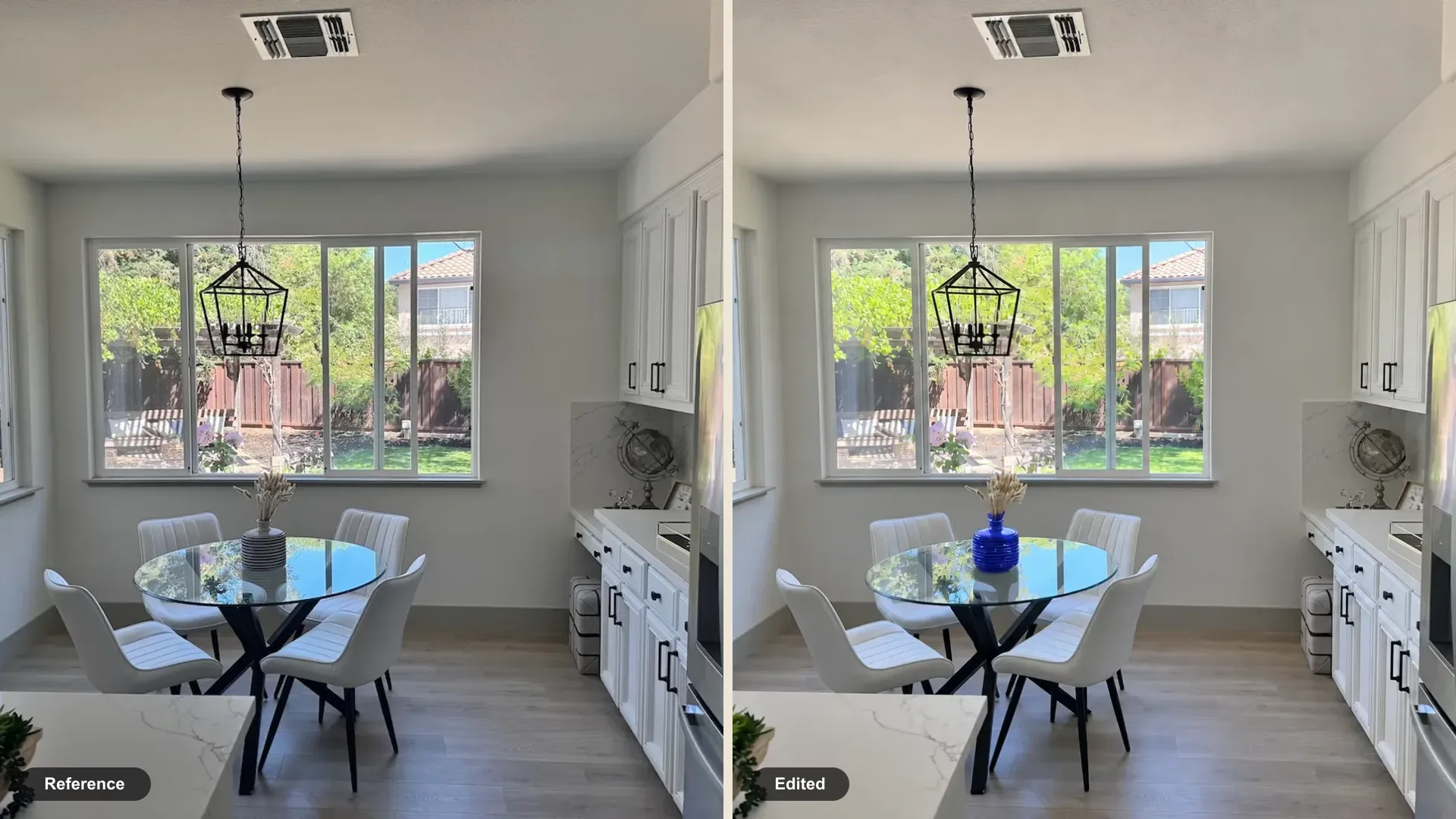
GPT Image 2.6 reference edit: only the vase changes; the rest of the room is preserved.
Transparent backgrounds, layers and special features
This is where the three models differ most.
- Seedream 5.5 transparency. Set
background: "transparent"withoutput_format: "png"and the model returns an RGBA image with full or partial transparency. It works from a text prompt or from up to 10 reference images, and ordinary RGB photos work as inputs. ByteDance's examples include stickers, icons, an acrylic standee and product materials. - Seedream 5.5 layers.
seedream-5.5-layerizetakes one image and returns a base image plus up to 99 transparent PNG layers (2 to 100 images in total, default 30). Each layer comes with a name, a description, a z-index and a bounding box, and text layers can return OCR data: the text, line positions and an approximate font, color and style. Design tools can use this to edit text, localize a poster or reuse a template. - GPT Image 2.6 transparency and formats. Flare and Sunburst return transparent PNG or WebP with
background: "transparent", and JPEG or WebP withoutput_compression. In OpenAI's own API, GPT Image 2.6 can also output SVG and looping animated GIFs from image generation requests. - Nano Banana Pro grounding. With Google Search grounding, Nano Banana Pro can use real-time information such as weather, stock charts or recent events. For cut-outs and layered files, pair it with Seedream 5.5 or GPT Image 2.6.
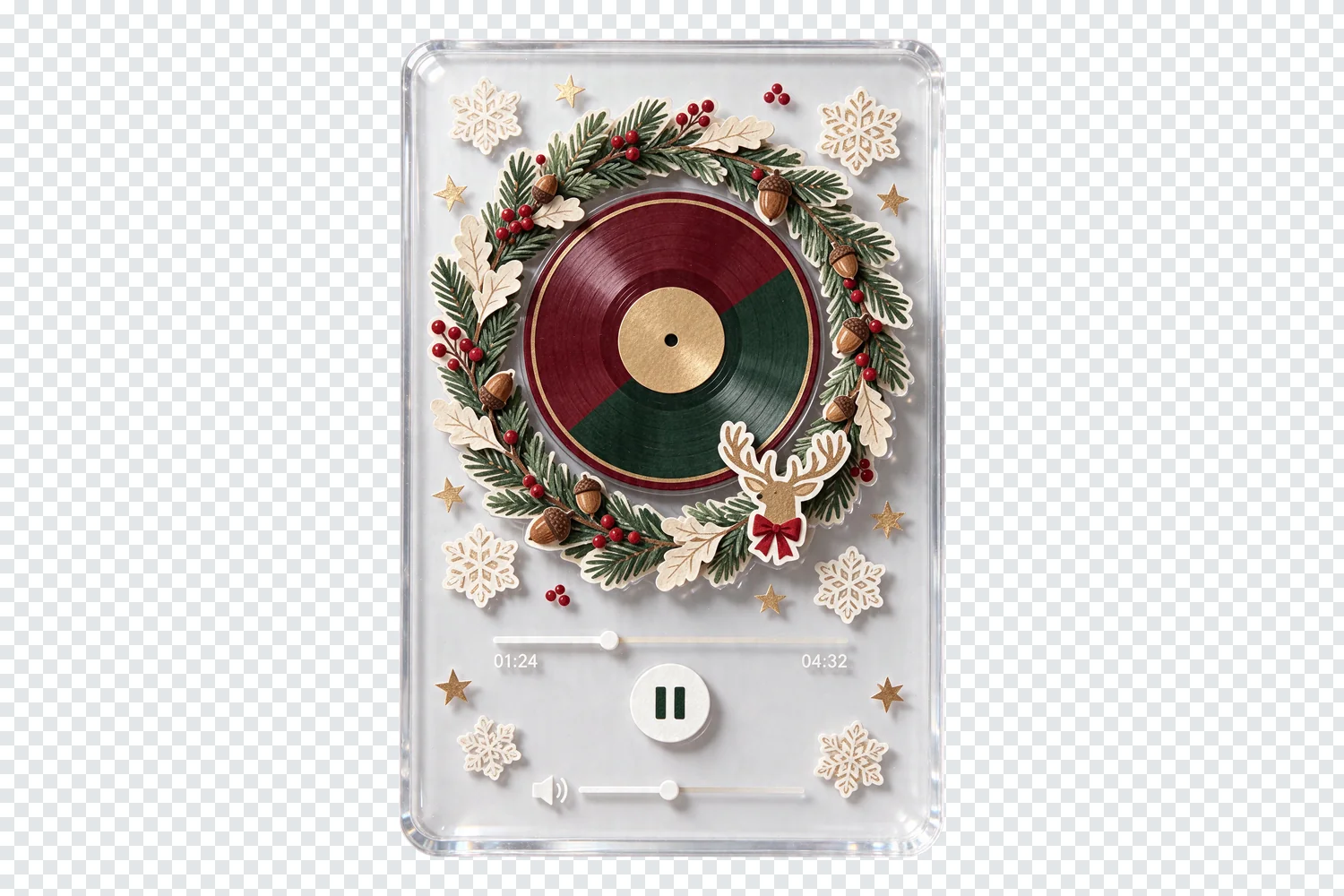
Native RGBA output from a text prompt. Example from ByteDance's Seedream 5.5 documentation.
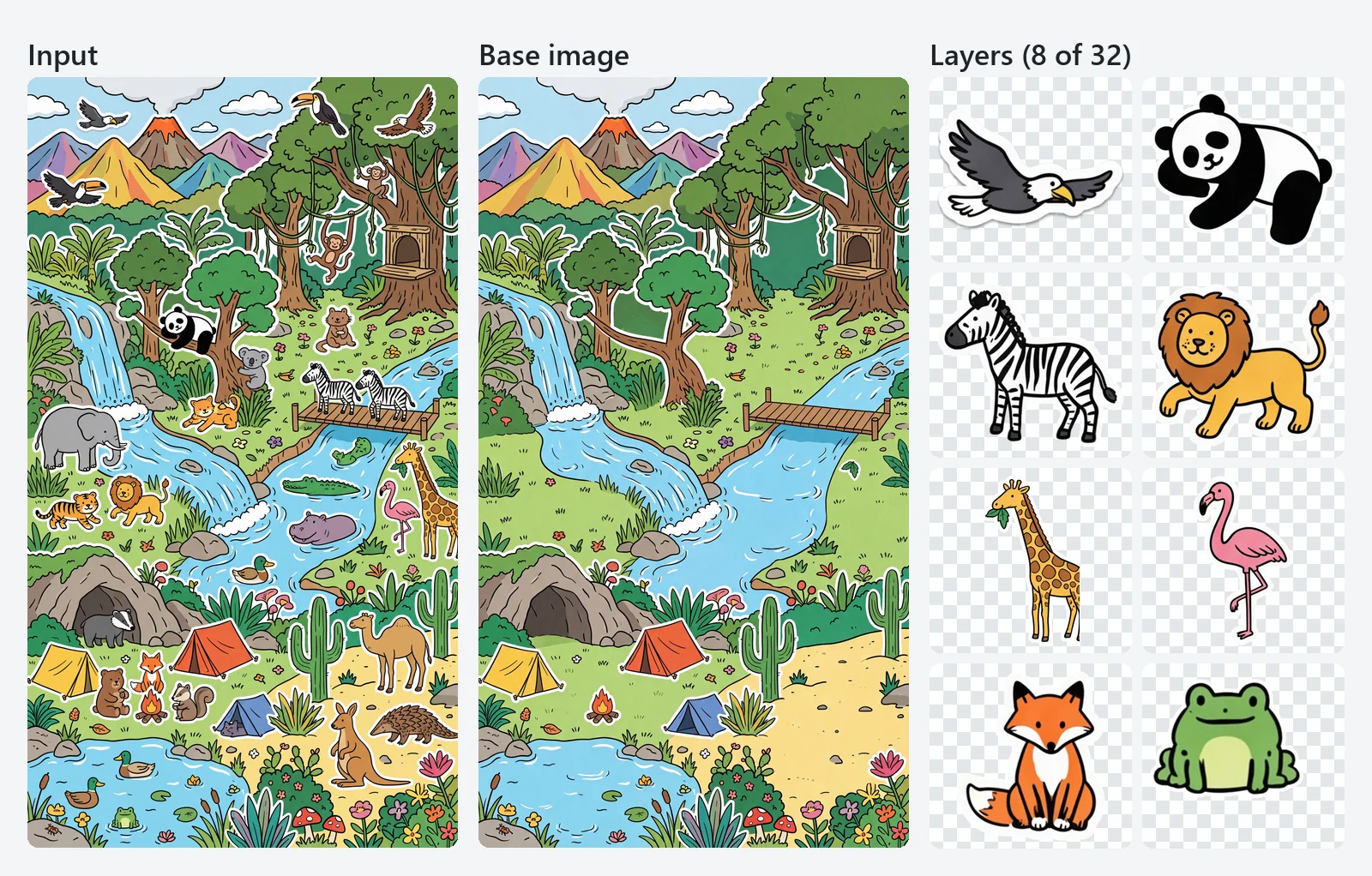
One illustration split into a base image and 32 animal layers. Example from ByteDance's Seedream 5.5 documentation.
Text rendering
All three vendors make specific claims:
- ByteDance reports that Seedream 5.5's severe text corruption rate fell to 0.4% and its minor corruption rate to 1.7%, in its own MagicArena evaluation across e-commerce, marketing, film, gaming, office and fashion use cases. It also claims "leading results in text structure and text-to-image realism" against other major models.
- Google recommends Gemini 3 Pro Image (Nano Banana Pro) "for professional asset production" in its guide to accurate text in images.
- OpenAI recommends quoting the required words, describing position and typography, spelling unusual brand names letter by letter, and comparing
mediumorhighquality for small or dense text.
These are vendor statements. For any text-heavy asset, run your exact copy through each model and proofread the output before publishing.
Speed
OpenAI says Images 2.6 generates images 50% faster than before, and that Flare can return an image in as little as six seconds at low quality. For Seedream 5.5 and Nano Banana Pro, time a few requests with your own prompts and sizes. On PoYo, every request runs as an asynchronous task, so long renders never block your application.
Independent leaderboard results
Artificial Analysis runs blind human-preference arenas for text-to-image and image editing. Highlights on November 14, 2026:
| Model (as listed) | Where it stands out |
|---|---|
| GPT Image 2.6 Sunburst (max) | No. 1 for text-to-image (1261 Elo) and No. 1 for image editing (1210 Elo) |
| GPT Image 2.6 Flare (max) | No. 2 for image editing (1206 Elo), No. 3 for text-to-image (1227 Elo) |
| Seedream 5.5 | No. 7 for image editing (1160 Elo), in the top ten within a week of launch |
| Nano Banana 2.1 | Top ten in both arenas (1176 and 1152 Elo) |
How to read it:
- GPT Image 2.6 sets the bar at
maxquality. On PoYo, choose Flare or Sunburst withquality: "max"for final hero images, orgpt-image-2.6-fixedfor a flat per-image price. - Seedream 5.5 is especially strong at editing, which fits its focus on stable multi-turn edits.
- Nano Banana Pro's strengths sit outside these arenas: 4K output, 14 reference images, always-on thinking and Google Search grounding.
Leaderboards measure average preference on mixed prompts. Transparency, layers, 4K output and your brand's text are best checked with a small test set of your own, so use rankings to shortlist models.
Price per image
Official prices vs PoYo
| Nano Banana Pro | GPT Image 2.6 | |
|---|---|---|
| Official output price | $0.134 per 1K/2K image $0.24 per 4K image | $30 per 1M image output tokens (about $0.21 per 1024×1024 image at max) |
| Official input price | $2 per 1M text tokens, about $0.0011 per reference image, thinking output at $12 per 1M | $5 per 1M text tokens, $8 per 1M image tokens |
| PoYo price | Standard $0.04 (1K/2K), $0.07 (4K) Official $0.09 (1K/2K), $0.175 (4K) References included | Fixed $0.0085 (1K), $0.03 (2K), $0.04 (4K), references included Flare / Sunburst at 80% of OpenAI's token rates |
Nano Banana Pro's official per-image price comes from its image output rate of $120 per million tokens: a 1K or 2K image uses 1,120 tokens and a 4K image 2,000 tokens. The GPT Image 2.6 figure at max is Artificial Analysis's cost for 1,000 images on OpenAI's API, divided by 1,000; lower quality settings use fewer tokens.
PoYo prices
| Model and tier | 1K | 1.5K | 2K | 4K | Reference images |
|---|---|---|---|---|---|
Seedream 5.5 seedream-5.5 | $0.02 (4 credits) | $0.02 | $0.035 (7 credits) | — | +$0.008 each |
Nano Banana Pro Standard nano-banana-2 | $0.04 (8 credits) | — | $0.04 | $0.07 (14 credits) | Included |
Nano Banana Pro Official nano-banana-pro | $0.09 (18 credits) | — | $0.09 | $0.175 (35 credits) | Included |
GPT Image 2.6 gpt-image-2.6-fixed | $0.0085 (1.7 credits) | — | $0.03 (6 credits) | $0.04 (8 credits) | Included |
| GPT Image 2.6 Flare / Sunburst | Billed by tokens: $4 text input, $6.40 image input, $24 image output per 1M | ||||
Nano Banana 2.1 nano-banana-2.1 (for reference) | $0.02 (4 credits) | — | $0.03 (6 credits) | $0.05 (10 credits) | Included |
The two Nano Banana Pro tiers use different model IDs on the Nano Banana Pro page: the Standard tier runs under nano-banana-2 / nano-banana-2-edit, and the Official tier under nano-banana-pro / nano-banana-pro-edit, which also accepts output_format and enable_web_search. Flare and Sunburst are billed at 80% of OpenAI's token rates.
Worked examples on PoYo
| Job | Seedream 5.5 | Nano Banana Pro Standard | Nano Banana Pro Official | GPT Image 2.6 fixed |
|---|---|---|---|---|
| 1,000 social images at 2K | 1000 × 0.035 = $35 | 1000 × 0.04 = $40 | 1000 × 0.09 = $90 | 1000 × 0.03 = $30 |
| 200 product edits at 2K, 2 references each | 200 × (0.035 + 2 × 0.008) = $10.20 | 200 × 0.04 = $8 | 200 × 0.09 = $18 | 200 × 0.03 = $6 |
| 100 posters at each model's top tier | 2K: 100 × 0.035 = $3.50 | 4K: 100 × 0.07 = $7 | 4K: 100 × 0.175 = $17.50 | 4K: 100 × 0.04 = $4 |
List price is only part of the cost. A model that gets your brief right in fewer attempts, or delivers a ready-made cut-out, can cost less per accepted image. Track the share of outputs you keep for each model.
Which should you choose?
| Your job | Start with | Why |
|---|---|---|
| Stickers, icons, product cut-outs | Seedream 5.5 | Native RGBA from text or up to 10 references, delivered as ready-made cut-outs |
| Editable posters and templates | Seedream 5.5 layerize | Base + up to 99 layers with text OCR |
| Many rounds of edits on one image | Seedream 5.5 | Pixel-level preservation of unedited regions |
| 4K print, large banners | Nano Banana Pro | Up to 5504×3072 at 16:9 |
| Real places, products or current events | Nano Banana Pro Official | Google Search grounding with enable_web_search |
| Complex scenes with many references | Nano Banana Pro or GPT Image 2.6 | 14 references with always-on thinking, or 16 references on PoYo |
| Highest preference scores, final hero images | GPT Image 2.6 Sunburst | No. 1 on both Artificial Analysis arenas at max |
| Region edits with a mask | GPT Image 2.6 Flare / Sunburst | mask_url plus complexity control |
| High-volume drafts at a fixed price | GPT Image 2.6 fixed or Seedream 5.5 | $0.0085 per 1K image, or $0.02 up to 1.5K |
| Lowest-cost Google option | Nano Banana 2.1 | $0.02 at 1K and top ten in both arenas |
A practical setup: draft with gpt-image-2.6-fixed or Seedream 5.5, send transparent and layered assets to Seedream 5.5, and reserve Nano Banana Pro for 4K and grounded images.
How to use all three on PoYo
One API key covers all three models. This request generates a transparent sticker with Seedream 5.5:
curl --request POST \
  --url https://api.poyo.ai/api/generate/submit \
  --header 'Authorization: Bearer YOUR_API_KEY' \
  --header 'Content-Type: application/json' \
  --data '{
    "model": "seedream-5.5",
    "input": {
      "prompt": "A die-cut sticker of a smiling orange cat holding a coffee cup, thick white outline, flat colors, the word \"MONDAY\" in bold letters under the cat",
      "size": "1:1",
      "resolution": "2K",
      "background": "transparent",
      "output_format": "png"
    }
  }'
The response contains data.task_id. Poll the status endpoint until data.status is finished, then read the image URL from data.files:
curl --request GET \
  --url https://api.poyo.ai/api/generate/status/YOUR_TASK_ID \
  --header 'Authorization: Bearer YOUR_API_KEY'
To run the same brief on the other models, change model and the input fields:
| Model | model value | Typical input fields |
|---|---|---|
| Seedream 5.5 | seedream-5.5 | prompt, image_urls (1–10), size, resolution (1K/1.5K/2K), background, output_format |
| Seedream 5.5 layers | seedream-5.5-layerize | One input image, max_images (2–100), optional text_recognition |
| Nano Banana Pro Official | nano-banana-pro / nano-banana-pro-edit | prompt, image_urls (up to 14 for edit), size, resolution (1K/2K/4K), output_format, enable_web_search |
| Nano Banana Pro Standard | nano-banana-2 / nano-banana-2-edit | prompt, image_urls (edit), size, resolution |
| GPT Image 2.6 fixed | gpt-image-2.6-fixed | prompt, version (flare/sunburst), size, image_urls (up to 16) |
| GPT Image 2.6 tokens | gpt-image-2.6-flare / gpt-image-2.6-sunburst | Adds quality (low–max), background, mask_url, complexity, output_compression |
Add a top-level callback_url to receive a webhook instead of polling. Model pages: Seedream 5.5 · Nano Banana Pro · GPT Image 2.6 · Nano Banana 2.1. For what changed in OpenAI's release, see the GPT Image 2.6 overview.
FAQ
Is Seedream better than Nano Banana?
Each is better at different jobs. Seedream 5.5 is the pick for transparent cut-outs, layered and editable files, and long multi-turn edits, starting at $0.02 per image on PoYo. Nano Banana Pro is the pick for 4K output, Google Search grounding and briefs with up to 14 references. Nano Banana 2.1 is Google's efficient everyday model at $0.02 per 1K image on PoYo. Run your own brief on two of them and keep the one whose output you accept most often.
Are Nano Banana Pro and Nano Banana 2 different?
Yes. Nano Banana Pro is Gemini 3 Pro Image, Google's premium model for complex visual tasks and professional assets. Nano Banana 2 is Gemini 3.1 Flash Image, the earlier efficient model, which Google has since followed with Nano Banana 2.1. One naming detail on PoYo: the Standard tier of the Nano Banana Pro page uses the model IDs nano-banana-2 and nano-banana-2-edit, while the separate Nano Banana 2 page uses nano-banana-2-new. Check the model page before you copy an ID.
Is ChatGPT or Nano Banana better?
ChatGPT creates images with OpenAI's Images 2.6, the same generation as GPT Image 2.6 in the API. On Artificial Analysis, GPT Image 2.6 Sunburst at max quality ranks first for both text-to-image and editing. Nano Banana Pro offers larger 4K output and Google Search grounding, and Nano Banana 2.1 delivers top-ten quality at $0.02 per 1K image on PoYo. Choose by the job, not the brand.
What is better, Midjourney or Nano Banana?
They suit different work. Nano Banana models follow detailed instructions, edit with several reference images and render readable text, and you can call them from your own application through an API such as PoYo. Midjourney is known for its distinctive artistic style and is used mainly through its own app. For programmatic generation and editing, compare Nano Banana, Seedream 5.5 and GPT Image 2.6 on your own prompts.
What happened to Nano Banana?
The name grew into a family. "Nano Banana" began as the nickname of Gemini 2.5 Flash Image. Google then released Nano Banana Pro (Gemini 3 Pro Image), Nano Banana 2 (Gemini 3.1 Flash Image) and, on October 6, 2026, Nano Banana 2.1, which Google now recommends for new projects. Nano Banana Pro remains its premium option.
What resolution does Seedream 5.5 output?
On PoYo, Seedream 5.5 offers 1K, 1.5K and 2K in eight aspect ratios, up to 2048×2048 for a square and 3136×1344 at 21:9. ByteDance's API also accepts custom sizes up to 4,624,220 pixels. For 4K deliverables, choose Nano Banana Pro or GPT Image 2.6.
Which is the cheapest?
On PoYo, gpt-image-2.6-fixed at 1K is the lowest at $0.0085 per image, followed by Seedream 5.5 (1K or 1.5K) and Nano Banana 2.1 (1K) at $0.02.
When is Seedream 5.5 Pro coming?
ByteDance's launch post says "A Pro version of the Seedream 5.5 series will follow." Seedream 5.5 is the current model and is available on PoYo now.