









Model icon
gemini-4-carbon
Model:
Use the Gemini 4 Carbon API at $1.60 input / $8.00 output per 1M tokens, 20% off Google. 1M context, 64K output, OpenAI & Gemini formats.
Chat

This Playground is for demo purposes. Data is only valid in the current window and will be cleared on refresh.

Type a message...

Configuration
1.0
1.0
Pricing details

Pay as you go. No subscription, no hidden fees.

1 credit = $0.005
ModelInput /1M tokensCache read /1M tokensOutput /1M tokens
Gemini 4 Carbon
100K input + 20K output tokens: $0.320
$1.60/1M tokens
320 credits/1M tokens
$2.00/1M tokensSave 20%
$0.080/1M tokens
16 credits/1M tokens
$8.00/1M tokens
1600 credits/1M tokens
$10.00/1M tokensSave 20%
How it's billed: Input and output tokens are billed separately, per 1M tokens.

Charges are based on the final output.

GEMINI 4 CARBON · AVAILABLE NOW ON POYO

Google's strongest Gemini 4 reasoning model for long-horizon agentic coding, dense knowledge work, scientific reasoning, and cyber defense

Gemini 4 Carbon API: Google's Strongest Reasoning Model, 20% Below Official Price

Gemini 4 Carbon is the model Google calls its strongest reasoning model, built for complex software engineering, multimodal knowledge work, scientific reasoning, and cybersecurity defense. Google DeepMind's model card says Carbon is based on Gemini 4 Argon and targets frontier performance in long-horizon agentic workflows. Google announced it on October 28, 2026, and opened it to developers on the Gemini API paid tier on November 10, 2026.

Key Capabilities of the Gemini 4 Carbon API

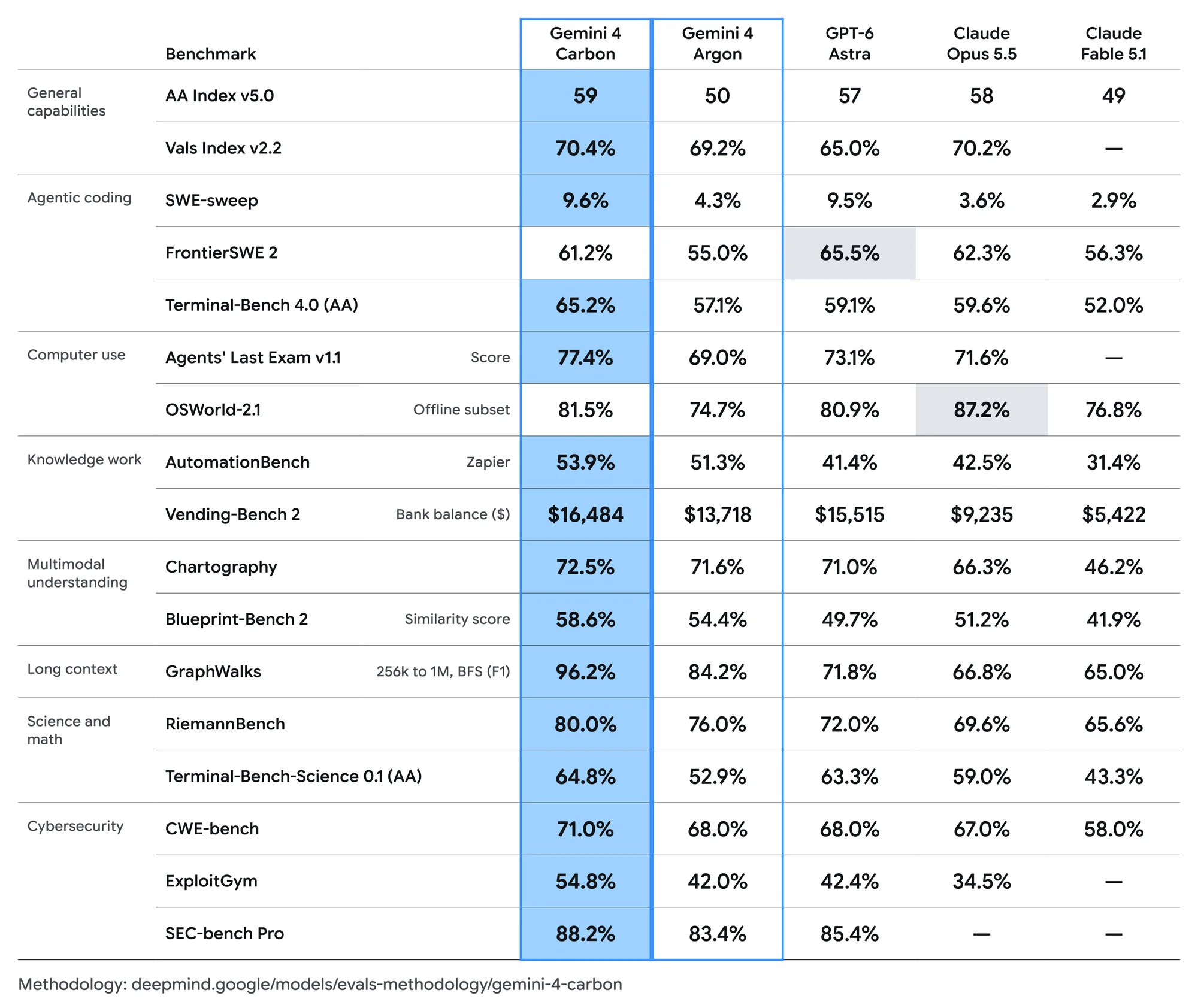
Based on Google's official benchmark table and launch posts, comparing Gemini 4 Carbon with Gemini 4 Argon and other frontier models across coding, knowledge work, long context, science, and cyber defense.

01

Long-Horizon Agentic Coding

Google built Gemini 4 Carbon for sustained agentic workflows such as root-causing and patching bugs, multi-agent coding, and migrations. In Google's benchmark table Carbon scores 65.2% on Terminal-Bench 4.0 (AA) versus 57.1% for Argon, and 9.6% on SWE-sweep versus 4.3%. Google also reports it ranks #1 on CursorBench 4.0.

  • 65.2% on Terminal-Bench 4.0 (AA) vs 57.1% for Argon
  • 9.6% on SWE-sweep vs 4.3% for Argon
  • 61.2% on FrontierSWE 2 vs 55.0% for Argon

Official Google artwork for Gemini 4 Carbon, Google's strongest Gemini 4 reasoning model

02

Ahead of Argon Across Google's Benchmark Table

Gemini 4 Carbon is the more capable model; Argon is the more token-efficient sibling at the same price. Carbon scores 59 on the Artificial Analysis Intelligence Index v5.0 (Argon: 50), 53.9% on Zapier's AutomationBench (51.3%), 77.4% on Agents' Last Exam v1.1 (69.0%), and 96.2% on GraphWalks 256K to 1M long-context recall (84.2%).

  • 59 vs 50 on the AA Intelligence Index v5.0
  • 96.2% vs 84.2% on GraphWalks long context (256K to 1M)
  • 80.0% vs 76.0% on RiemannBench and 81.5% vs 74.7% on OSWorld-2.1
Google's official benchmark table comparing Gemini 4 Carbon with Gemini 4 Argon, GPT-6 Astra, Claude Opus 5.5 and Claude Fable 5.1

03

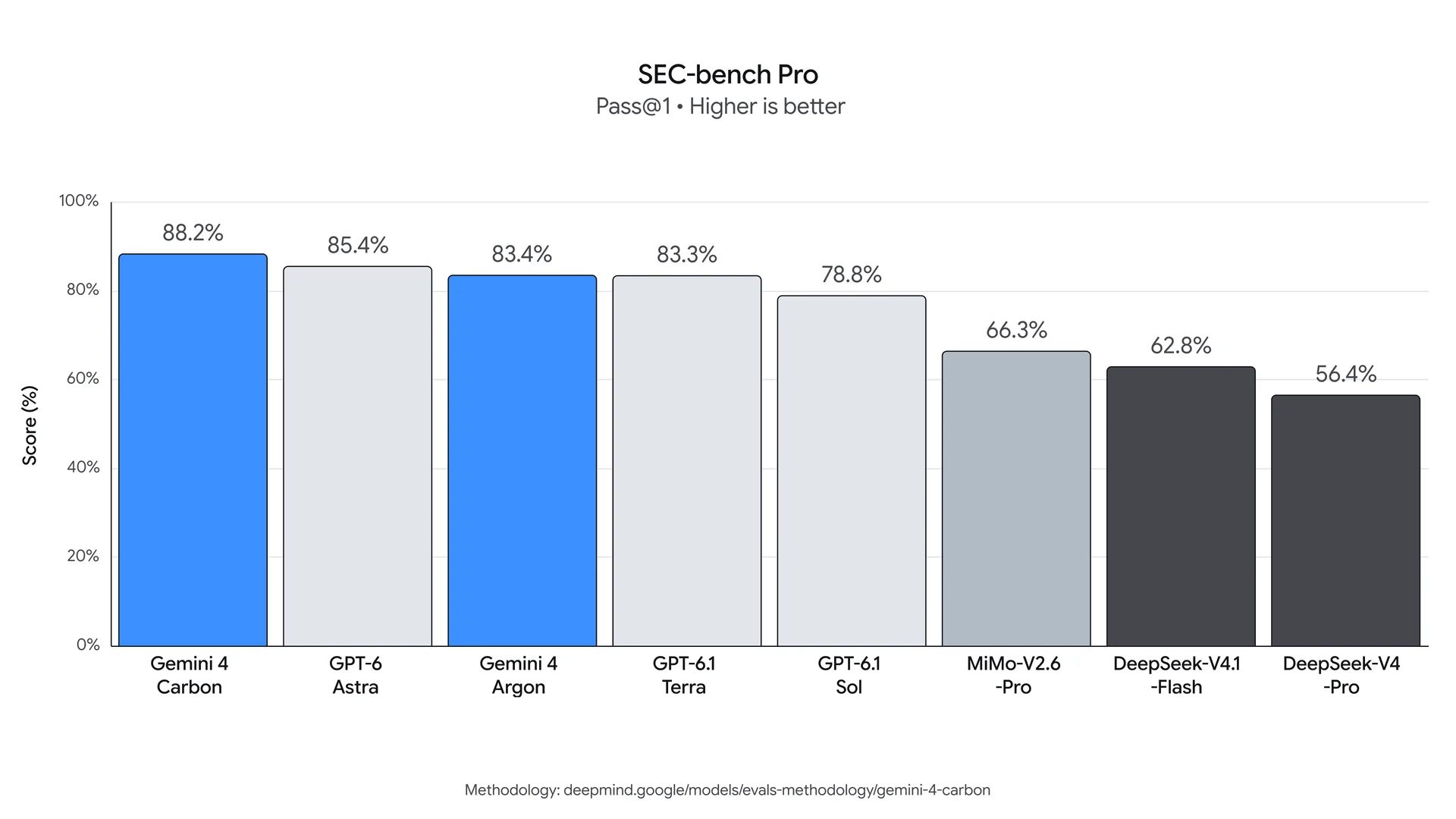
Finding Vulnerabilities: 88.2% on SEC-bench Pro

Google reports state-of-the-art results across vulnerability detection, validation, and remediation. On SEC-bench Pro, which measures finding vulnerabilities, Gemini 4 Carbon reaches 88.2% versus 83.4% for Argon. Google notes some cybersecurity capabilities are limited to verified defenders through its Fairwind Program.

  • 88.2% on SEC-bench Pro vs 83.4% for Argon
  • Built for defensive security teams
  • Some cyber features gated through Google's Fairwind Program
Official Google chart of SEC-bench Pro vulnerability-finding scores with Gemini 4 Carbon at 88.2%

04

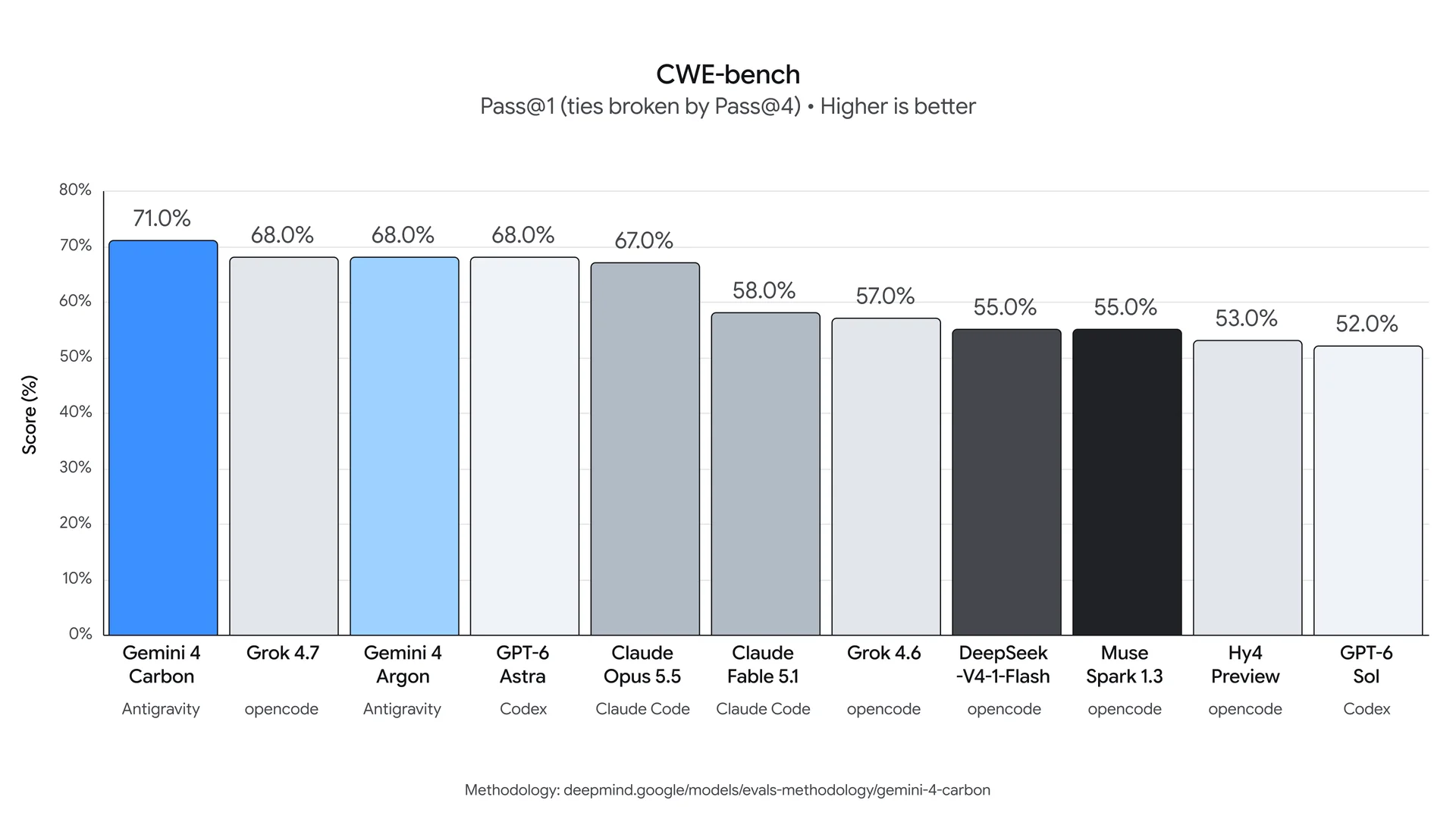
Patching Weaknesses: 71.0% on CWE-bench

For remediation, Gemini 4 Carbon scores 71.0% on CWE-bench, ahead of Argon and GPT-6 Astra at 68.0%. Google also reports more than 2x uplift over Argon in success rate for generating secure code.

  • 71.0% on CWE-bench vs 68.0% for Argon
  • More than 2x uplift in secure code generation vs Argon, per Google
  • Draft remediation patches for security review
Official Google chart of CWE-bench patching scores with Gemini 4 Carbon at 71.0%

05

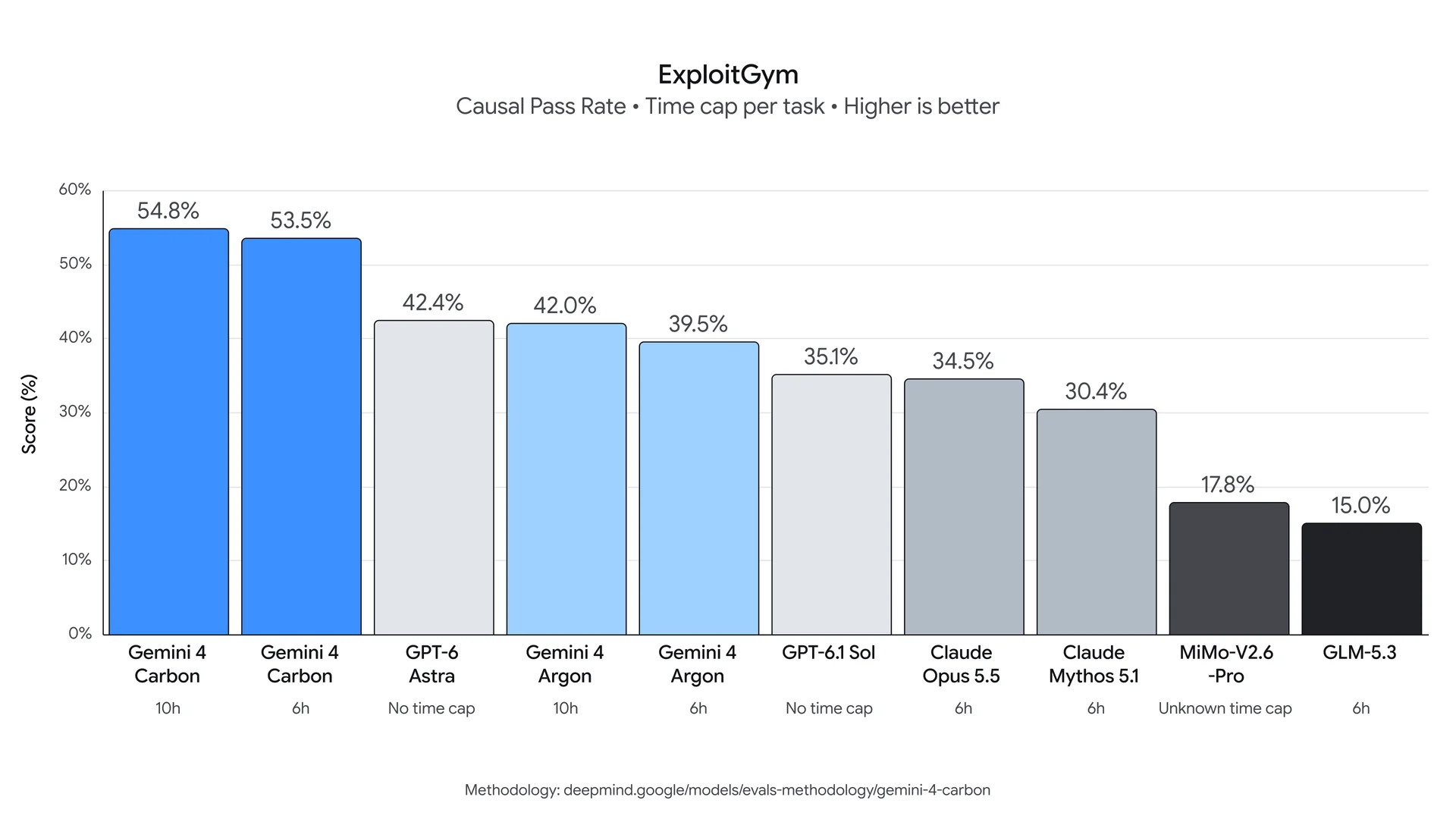
Validating Exploitability: 54.8% on ExploitGym

Defenders need to know which findings are real. Gemini 4 Carbon sets a new state of the art on ExploitGym at 54.8%, versus 42.0% for Argon, helping defenders confirm which findings are exploitable and prioritize fixes.

  • 54.8% on ExploitGym vs 42.0% for Argon
  • New state of the art, according to Google
  • Prompt injection success on Gray Swan IPI cut to 0.0% (Argon: 0.7%)
Official Google chart of ExploitGym scores with Gemini 4 Carbon at 54.8%

More Gemini 4 Carbon Capabilities

01

Knowledge Work over Dense Documents

Carbon leads Zapier's AutomationBench at 53.9% (Argon: 51.3%) and Vals Index v2.2 at 70.4%. Google says it ranks #1 on AutomationBench and Perplexity's WANDR at more than 2X lower cost per task than the next best external model.

02

Scientific and Mathematical Reasoning

Carbon scores 80.0% on RiemannBench and 64.8% on Terminal-Bench-Science 0.1 (AA), ahead of Argon's 76.0% and 52.9% on the same model card.

03

1M Context and Multimodal Input

Send up to 1M tokens of text, images, audio, video, and PDFs in one request. Carbon reaches 96.2% on GraphWalks (256K to 1M, BFS F1), compared with 84.2% for Argon.

04

More Honest, More Robust Agents

Google reports Carbon passed 92% of tasks on its honesty benchmark versus 70% for Argon, and cut indirect prompt injection success on Gray Swan IPI to 0.0%, from Argon's 0.7%.

What Can You Build with Gemini 4 Carbon?

01

Complex Debugging and Code Migrations

Let Carbon trace a bug across a large repository, propose a fix, and verify it in extended loops, or coordinate multi-agent refactors and migrations.

02

Autonomous Business Workflows

Run end-to-end automations across APIs, documents, and spreadsheets, the kind of work AutomationBench measures.

03

Vulnerability Discovery and Patching

Scan code for weaknesses, triage findings, and draft remediation patches for review by your security team.

04

Open-Ended Scientific Research

Work through physics, math, and life-sciences problems that need long reasoning chains and careful verification.

05

Multimodal Document and Video Analysis

Combine PDFs, charts, audio, and video in one 1M-token request to answer questions across dense source material.

06

Long-Running Agents

Power agents that plan, call tools, and keep context over many turns, with streaming responses for responsive UIs.

Gemini 4 Carbon vs Gemini 4 Argon vs GPT-6 Astra vs Claude Opus 5.5

Scores from Google's official Gemini 4 Carbon benchmark table (October 2026). Carbon and Argon cost the same per input and output token. Google positions Argon as its efficient model, with faster responses and lower token spend per turn. Carbon uses more tokens to explore thoroughly, reason deeply, and run extended verification loops, so pick Carbon for the hardest coding, research, and security tasks.

BenchmarkGemini 4 CarbonGemini 4 ArgonGPT-6 AstraClaude Opus 5.5
Artificial Analysis Intelligence Index v5.059 (#1)505758
Vals Index v2.270.4% (#1)69.2%65.0%70.2%
Terminal-Bench 4.0 (AA)65.2% (#1)57.1%59.1%59.6%
SWE-sweep9.6% (#1)4.3%9.5%3.6%
FrontierSWE 261.2%55.0%65.5%62.3%
Agents' Last Exam v1.177.4% (#1)69.0%73.1%71.6%
OSWorld-2.1 (Offline subset)81.5%74.7%80.9%87.2%
AutomationBench (Zapier)53.9% (#1)51.3%41.4%42.5%
GraphWalks 256K to 1M (BFS F1)96.2% (#1)84.2%71.8%66.8%
RiemannBench80.0% (#1)76.0%72.0%69.6%
CWE-bench71.0% (#1)68.0%68.0%67.0%
ExploitGym54.8% (#1)42.0%42.4%34.5%
SEC-bench Pro88.2% (#1)83.4%85.4%—

Source: Google's benchmark table in "Gemini 4 Carbon: our next frontier model" (blog.google, October 2026) and the Gemini 4 Carbon model card; methodology at deepmind.google/models/evals-methodology/gemini-4-carbon. Cybersecurity results reflect access through Google's Fairwind Program. "—" means no published score.

How to Use the Gemini 4 Carbon API on PoYo

1. Create an API key: Sign in to the PoYo dashboard and create a bearer key. The same key works across PoYo models.

2. Pick a request format: Send POST https://api.poyo.ai/v1/chat/completions to reuse the OpenAI SDK, or POST https://api.poyo.ai/v1beta/models/gemini-4-carbon:generateContent (and :streamGenerateContent) for Gemini-native multimodal payloads.

3. Set the model ID: Pass "model": "gemini-4-carbon" in the OpenAI format. Set "stream": true for server-sent events, or omit it for a single JSON response.

Frequently Asked Questions about Gemini 4 Carbon

What is Gemini 4 Carbon?

Gemini 4 Carbon is Google's strongest Gemini 4 reasoning model. Google DeepMind's model card says it is based on Gemini 4 Argon and is built for long-horizon agentic workflows across knowledge work, engineering, cybersecurity, and scientific reasoning. Its knowledge cutoff is March 2026.

Is Gemini 4 Carbon available via API?

Yes. Google announced Gemini 4 Carbon on October 28, 2026, first for a subset of cyber defenders, and made it available to developers on the Gemini API paid tier on November 10, 2026. On PoYo you can call it today with the model ID gemini-4-carbon.

How much does Gemini 4 Carbon cost?

Google's standard price is $2.00 per 1M input tokens, $10.00 per 1M output tokens (including thinking tokens), and $0.10 per 1M cached input tokens, with no free tier. On PoYo it costs $1.60 input (320 credits), $8.00 output (1,600 credits), and $0.08 cache read (16 credits) per 1M tokens, 20% below Google's price.

Is there a free tier for Gemini 4 Carbon?

Google's pricing page lists no free tier for Gemini 4 Carbon. On PoYo you pay as you go with credits and can test the model in the web Playground before integrating it.

What is the difference between Gemini 4 Carbon and Gemini 4 Argon?

Both share the same input and output token price. Google describes Argon as its efficient Gemini 4 model, with faster responses and lower token spend per turn than Carbon, and says Argon remains the ideal choice for most software engineering and knowledge work. Carbon uses more tokens to reason deeply and verify its work, and scores higher on Google's model card, for example 65.2% vs 57.1% on Terminal-Bench 4.0 (AA) and 96.2% vs 84.2% on GraphWalks.

What is the Gemini 4 Carbon context window and max output?

Gemini 4 Carbon has a 1M-token context window and can return up to 64K output tokens per response. It accepts text, image, audio, video, and PDF input and returns text.

How does Gemini 4 Carbon perform on benchmarks?

On Google DeepMind's model card, Carbon scores 59 on the Artificial Analysis Intelligence Index v5.0 (#1 among the models listed), 53.9% on AutomationBench, 88.2% on SEC-bench Pro, and 80.0% on RiemannBench. GPT-6 Astra leads on FrontierSWE 2 (65.5% vs 61.2%) and Claude Opus 5.5 leads on OSWorld-2.1 (87.2% vs 81.5%).

How do I call Gemini 4 Carbon with the OpenAI SDK?

Point the OpenAI SDK base URL to https://api.poyo.ai/v1, use your PoYo API key, and set model to gemini-4-carbon. For Gemini-native requests, call https://api.poyo.ai/v1beta/models/gemini-4-carbon:generateContent or :streamGenerateContent. Streaming is supported in both formats.

Why Use Gemini 4 Carbon Through PoYo?

01

20% Lower Token Costs

Pay $1.60 input, $8.00 output, and $0.08 cache read per 1M tokens with flexible pay-as-you-go credits.

02

OpenAI and Gemini Formats

Use /v1/chat/completions with existing OpenAI SDKs, or /v1beta/models/gemini-4-carbon:generateContent for native Gemini features.

03

Switch Between Carbon and Argon

Route the hardest tasks to Carbon and everyday work to Argon, or compare them with Claude and GPT models, all with one PoYo key.

04

Start in Minutes

Try gemini-4-carbon in the web Playground, then move the same request to production without a waitlist.