
Key takeaways
- Fable 5.2 suits the hardest work; GPT-6.1 Sol suits high-volume work. On the Artificial Analysis Intelligence Index, Fable 5.2 scores 65 and GPT-6.1 Sol 55 at max effort, and Sol completes each index task for a fraction of the cost.
- Official token prices: $8 / $40 per million input/output tokens for Fable 5.2 and $2 / $10 for Sol at short context, a 4× difference.
- One flat rate on PoYo. OpenAI raises Sol's whole request to $4 / $15 above 272K input tokens. On PoYo, GPT-6.1 Sol costs $1.60 / $8 across its full context window, and Fable 5.2 costs $6.40 / $32 across its full 1M window.
- Fable 5.2 puts more reasoning into each task. Artificial Analysis measured $26.54 per index task for Fable 5.2 at max effort and $1.27 for Sol.
- Fable 5.2 reaches strong scores quickly. At
loweffort it scores 54, close to Sol's 55 atmax, and finishes an index task in 5.8 minutes against 23.3. - Searching "GPT-5.6 Sol vs Fable 5"? That was the July 2026 matchup. Both lines have moved on; the section below covers the old pair separately.
Claude Fable 5.2 vs GPT-6.1 Sol at a glance
| Claude Fable 5.2 | GPT-6.1 Sol | |
|---|---|---|
| Developer | Anthropic | OpenAI |
| API model ID | claude-fable-5-2 | gpt-6.1-sol |
| Released | November 9, 2026 | September 29, 2026 |
| Position | Anthropic's top tier, above Opus | OpenAI's Sol tier, between GPT-6 Astra and GPT-6 Luna |
| Context window | 1M tokens | 1,050,000 tokens (max input 922,000) |
| Max output | 128K tokens | 128K tokens |
| Input → output | Text and images → text | Text and images → text |
| Reasoning control | output_config.effort | reasoning.effort |
| Effort levels | low to max, default high | low to max, default medium |
| Knowledge cutoff | June 2026 | April 30, 2026 |
| Official input / output (per 1M) | $8 / $40 | $2 / $10 (input ≤272K) $4 / $15 (input >272K) |
| Official cache read (per 1M) | $0.20 | $0.10 (≤272K) / $0.20 (>272K) |
| PoYo input / output (per 1M) | $6.40 / $32 | $1.60 / $8 |
| PoYo endpoints | /v1/messages, /v1/chat/completions | /v1/responses, /v1/chat/completions |
GPT-5.6 Sol vs Fable 5: which versions are you comparing?
Most pages that rank for "GPT-5.6 Sol vs Fable 5" were written in July 2026, when those two were the newest models. Since then each line has shipped newer versions:
| Model | Developer | Released | Official input / output at launch (per 1M, short context) |
|---|---|---|---|
| Claude Fable 5 | Anthropic | June 9, 2026 | $10 / $50 |
| GPT-5.6 Sol | OpenAI | July 9, 2026 | $5 / $30 |
| Claude Fable 5.1 | Anthropic | September 1, 2026 | $10 / $50 |
| GPT-6 Sol | OpenAI | September 22, 2026 | $2 / $10 |
| GPT-6.1 Sol | OpenAI | September 29, 2026 | $2 / $10 |
| Claude Fable 5.2 | Anthropic | November 9, 2026 | $8 / $40 |
GPT-5.6 Sol vs Claude Fable 5: the July 2026 matchup
At launch, GPT-5.6 Sol cost half as much as Fable 5 on input and 40% less on output ($5 / $30 vs $10 / $50, with cached input at $0.50 vs $1). Independent tests from that month split the verdict:
| Test | Setup | GPT-5.6 Sol | Claude Fable 5 |
|---|---|---|---|
| Kilo: three system-design plans | Kilo Code CLI, both at Max reasoning, graded on a rubric written in advance | Top score on all three tasks, after reviewing and revising each plan itself; 52 min 53 s per plan on average; $13.57 total | Plans the testers found easiest to build from; 15 min 27 s per plan on average; $12.02 total |
| Composio: Golden Eval, 47 multi-app tool workflows | Fable 5 in Claude Code; Sol in Codex CLI at high | 45 of 47 passed (95.7%); 223,779 tokens and 79.6 s per task on average | 47 of 47 passed (100%); 276,957 tokens and 84.4 s per task on average |
| Analytics Vidhya: web app, data analysis, investor deck | Same prompts, fresh chats, default reasoning | Comparable quality, with about twice the run time | Comparable quality and faster runs; the author's pick for long, complex work handed off in one go |
The pattern in July: GPT-5.6 Sol suited planning and coding at a lower token price and spent extra time checking its own work; Fable 5 suited long tool workflows and wrote plans that were easy to build from.
Those results describe the July models, which are now the previous generation. Since then the price gap has widened in Sol's favor: Fable 5.2 costs 4× GPT-6.1 Sol per token, where Fable 5 cost 2× GPT-5.6 Sol on input and about 1.7× on output. The rest of this article compares the current pair. On PoYo, GPT-5.6 Sol is available through the Responses API for integrations already tuned to it.
What the two models share, and where they differ
Shared:
- About 1M tokens of context and 128K output tokens per request.
- Text and image input, text output.
- Five effort levels,
lowthroughmax. Each vendor calibrates its own levels, so compare results rather than labels. - Prompt caching, streaming and structured outputs.
Different:
- Default effort. Fable 5.2 defaults to
high; Sol defaults tomedium. Set effort explicitly in side-by-side tests so both run at the level you intend. - Thinking controls. Fable 5.2 always thinks adaptively and accepts
tool_choiceofautoornone. Sol is configured throughreasoning.effort, and its hosted tools (web search, file search, code interpreter, hosted shell, apply patch, computer use, MCP, tool search) run through OpenAI's Responses API. - Knowledge cutoff. June 2026 for Fable 5.2; April 30, 2026 for Sol.
- Data retention. Fable 5.2 runs with 30-day data retention on Anthropic's API.
Pricing: 4× per token, 2× on long prompts
Official rates (USD per 1M tokens)
| Charge | Claude Fable 5.2 | GPT-6.1 Sol, input ≤272K | GPT-6.1 Sol, input >272K |
|---|---|---|---|
| Input | $8.00 | $2.00 | $4.00 |
| Output | $40.00 | $10.00 | $15.00 |
| Cache read | $0.20 | $0.10 | $0.20 |
| Cache write | $10 (5 min) / $16 (1 hour) | $2.50 (30 min) / $5.00 (12 hours) | $5.00 (30 min) / $10.00 (12 hours) |
OpenAI prices prompts with more than 272K input tokens at 2× the input and cache rates and 1.5× the output rate, for the full request. Anthropic bills Fable 5.2's full 1M window at standard rates. On PoYo, both models use one rate across their whole context window, so GPT-6.1 Sol stays at $1.60 / $8 however long the prompt is. For every Claude model's prices, see our Claude API pricing guide.
Cost per request
These examples assume both models use the same number of tokens; real usage differs by model (see the next section). Cache-write charges are left out for both.
| Scenario | Claude Fable 5.2 | GPT-6.1 Sol |
|---|---|---|
| Chat reply: 20K input + 4K output | Official: 0.02×8 + 0.004×40 = $0.32PoYo: $0.256 | Official: 0.02×2 + 0.004×10 = $0.08PoYo: $0.064 |
| Coding task: 100K input + 10K output | Official: 0.1×8 + 0.01×40 = $1.20PoYo: $0.96 | Official: 0.1×2 + 0.01×10 = $0.30PoYo: $0.24 |
| Long document: 500K input + 20K output | Official: 0.5×8 + 0.02×40 = $4.80PoYo: $3.84 | Official: 0.5×4 + 0.02×15 = $2.30PoYo: $0.96 |
| Agent session: 2M cache reads + 300K fresh input + 150K output, every request under 272K | Official: 2×0.2 + 0.3×8 + 0.15×40 = $8.80PoYo: $7.04 | Official: 2×0.1 + 0.3×2 + 0.15×10 = $2.30PoYo: $1.84 |
On a 500K-token prompt, Sol's official long-context rate narrows the gap from 4× to about 2.1×. On PoYo, the same request costs $0.96 on GPT-6.1 Sol, because PoYo bills Sol at one rate with no long-context multiplier.
Cost per completed task
Token prices are only half the bill. Artificial Analysis runs both models through the same Intelligence Index tasks and publishes the cost:
| Max effort | Claude Fable 5.2 | GPT-6.1 Sol |
|---|---|---|
| Cost per index task | $26.54 | $1.27 |
| Time per index task | 45.3 min | 23.3 min |
| Index score | 65 | 55 |
The cost gap is about 21×, against a 4× price gap: Fable 5.2 puts much more reasoning into each task, which is where its higher scores come from, while Sol finishes tasks with far fewer tokens. On real workloads, compare the total bill per accepted task alongside the token rate.
Benchmarks
Same setup: Artificial Analysis Intelligence Index
Artificial Analysis evaluates both models with the same tasks and harness, so its numbers can be compared directly. Intelligence Index v5.0.1, read on November 14, 2026:
| Effort | Fable 5.2 score | GPT-6.1 Sol score | Fable 5.2 time per task | Sol time per task |
|---|---|---|---|---|
low | 54 | 35 | 5.8 min | 2.0 min |
medium | 56 | 46 | 7.7 min | 4.6 min |
high | 62 | 50 | 16.2 min | 7.9 min |
xhigh | 62 | 52 | 27.9 min | 10.7 min |
max | 65 | 55 | 45.3 min | 23.3 min |
How to read it:
- Fable 5.2 scores higher at every level, by 10 to 19 points, which suits work where answer quality matters most.
- Fable 5.2 at
lowscores close to Sol atmax(54 vs 55) in a quarter of the time. - Sol delivers its scores at low cost: $1.27 per index task at max effort, which suits high-volume and budget-sensitive work.
- Fable generates tokens faster: about 94–102 output tokens per second against 47–49 for Sol.
- Artificial Analysis labels its Fable 5.2 runs "Default Fallback", meaning Anthropic's refusal fallback was enabled during testing.
Anthropic's launch results
Anthropic's Fable 5.2 table compares it with GPT-6 Astra, OpenAI's top tier. Each model ran at its highest available effort unless noted:
| Benchmark | What it measures | Fable 5.2 | GPT-6 Astra |
|---|---|---|---|
| FrontierCode 2.0 | Agentic coding | 49.1% (xhigh) | 42.8% |
| FrontierSWE v2 | Software engineering | 69.9% | 65.5% |
| AutomationBench | Business workflows | 51.4% | 41.4% |
| Terminal-Bench-Science 0.1 | Agentic science | 74.6% | 68.1% |
| OSWorld 2.1 (offline set, partial) | Computer use | 89.3% | 79.5% |
| Remote Labor Index | Real paid tasks | 41.3% (high) | 20.8% |
| Humanity's Last Exam (with tools) | Hard reasoning | 74.2% | 57.2% |
| Chartography (no tools) | Chart reasoning | 73.4% | 71.0% |
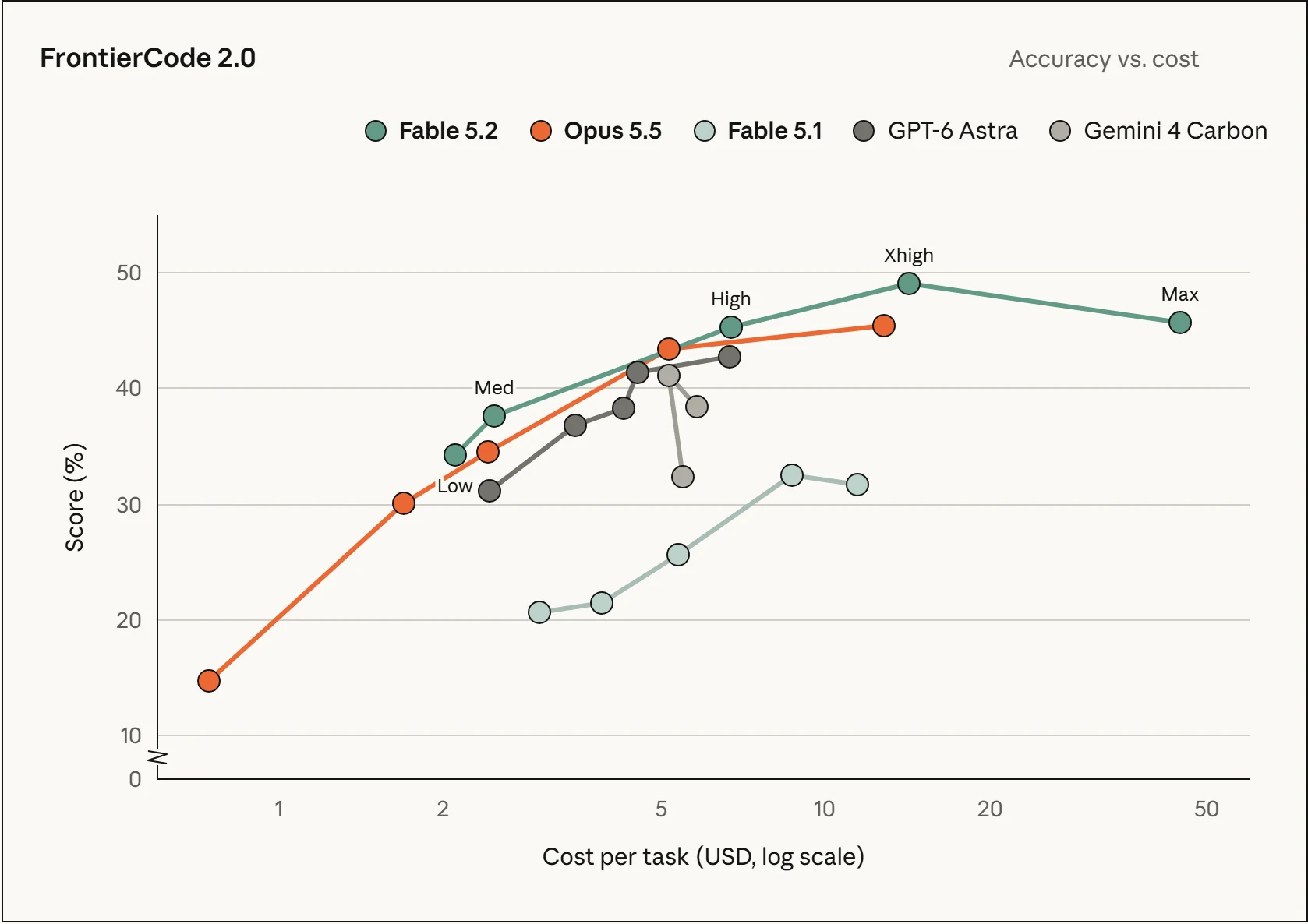
FrontierCode 2.0 score against cost per task at each effort level. Chart from Anthropic's Claude Fable 5.2 launch materials.
OpenAI's launch results
OpenAI launched GPT-6.1 Sol on September 29, 2026, six weeks before Fable 5.2, and compared it with its own GPT-6 models. OpenAI positions it for complex coding, computer use and professional work, with capability approaching GPT-6 Astra at a fifth of Astra's token price ($2 / $10 against $10 / $50). Its launch evaluations cover software engineering, document understanding, business automation and computer use.
Each vendor runs benchmarks in its own harness and test version, so compare scores within one vendor's table, and use the Artificial Analysis index above for a direct comparison.
Which should you choose?
| Your workload | Start with | Why |
|---|---|---|
| High-volume chat, extraction, routing | GPT-6.1 Sol at medium (or a smaller model) | Handles short tasks at a quarter of Fable's token price |
| Everyday coding and agent loops on a budget | GPT-6.1 Sol | Built for coding and agent work, at $2 / $10 official and $1.60 / $8 on PoYo |
| Hardest reasoning, research, long autonomous runs | Fable 5.2 | 65 vs 55 on the Intelligence Index; leads GPT-6 Astra across Anthropic's table |
| Hard problems where waiting is expensive | Fable 5.2 at low or medium | Scores close to Sol's max in a quarter of the time |
| Computer use, charts, dense visual documents | Fable 5.2 | 89.3% on OSWorld 2.1 and 73.4% on Chartography in Anthropic's table |
| Prompts regularly above 272K tokens | GPT-6.1 Sol on PoYo for cost, Fable 5.2 for depth | On PoYo both keep one rate across the whole window: $1.60 / $8 for Sol, $6.40 / $32 for Fable |
| Built on OpenAI's hosted tools (shell, web search, MCP) | GPT-6.1 Sol | Those tools run natively through the Responses API |
| Need Claude quality at a lower price | Claude Opus 5.5 | $4 / $20; see Claude Fable 5.2 vs Opus 5.5 |
Long autonomous runs suit Fable 5.2: its agents built this prototype operating system, shown running on a laptop. Video from Anthropic's Claude Fable 5.2 launch materials.
A practical routing setup: send routine traffic to GPT-6.1 Sol at medium, note which task types benefit from deeper reasoning, and route those to Fable 5.2 at medium. After a week, compare cost per accepted task rather than token prices. For the mid-priced Claude option against Sol, see GPT-6.1 Sol vs Claude Opus 5.5.
Use both on PoYo
PoYo makes it simple to run both:
- One API key for Fable 5.2, GPT-6.1 Sol and every other chat, image, video and audio model.
- Pay as you go, billed per token in credits, with no subscription.
- Both API formats: Anthropic Messages and OpenAI Chat Completions and Responses.
- One rate per model across the whole context window, 20% below each official short-context rate:
| Charge (per 1M tokens) | Claude Fable 5.2 on PoYo | GPT-6.1 Sol on PoYo |
|---|---|---|
| Input | $6.40 | $1.60 |
| Output | $32.00 | $8.00 |
| Cache read | $0.16 | $0.08 |
| Cache write | $8.00 (5 min) / $12.80 (1 hour) | $2.00 |
Fable 5.2 through the Anthropic Messages format:
curl https://api.poyo.ai/v1/messages \
  -H "x-api-key: $POYO_API_KEY" \
  -H "anthropic-version: 2023-06-01" \
  -H "content-type: application/json" \
  -d '{
    "model": "claude-fable-5-2",
    "max_tokens": 16000,
    "output_config": {"effort": "medium"},
    "messages": [{"role": "user", "content": "Review this diff for concurrency bugs: ..."}]
  }'
GPT-6.1 Sol through the Responses API:
curl https://api.poyo.ai/v1/responses \
  -H "Authorization: Bearer $POYO_API_KEY" \
  -H "Content-Type: application/json" \
  -d '{
    "model": "gpt-6.1-sol",
    "reasoning": {"effort": "medium"},
    "max_output_tokens": 16000,
    "input": "Review this diff for concurrency bugs: ..."
  }'
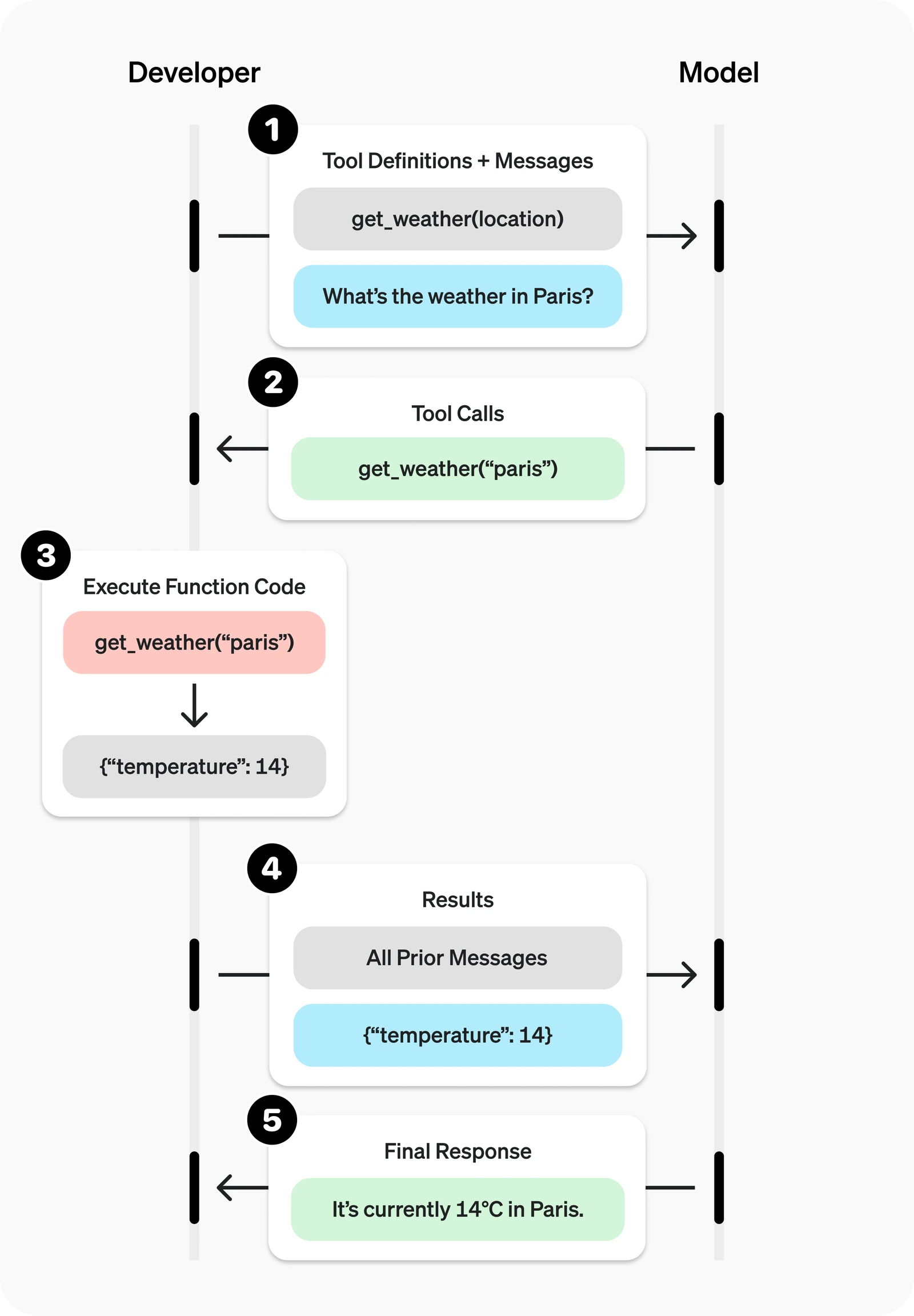
The function-calling loop GPT-6.1 Sol uses for tool work. Diagram from OpenAI's official documentation.
To A/B test both on one code path, send claude-fable-5-2 and gpt-6.1-sol to /v1/chat/completions and change only the model field. For SDK setup, effort and caching on Fable, see our Claude Fable 5.2 API guide; for Sol's limits and tools, see the GPT-6.1 Sol features guide.
Model pages: Claude Fable 5.2 · GPT-6.1 Sol · GPT-5.6.
FAQ
Is Fable 5 better than GPT-5.6 Sol?
Each suited different work. In July 2026 tests, Fable 5 passed all 47 of Composio's multi-app tool workflows (GPT-5.6 Sol passed 45), while GPT-5.6 Sol scored highest on all three of Kilo's system-design planning tasks at a lower token price. In the current generation, Fable 5.2 scores 65 and GPT-6.1 Sol 55 on the Artificial Analysis Intelligence Index, with Sol at a fraction of the cost per task.
Will GPT Astra be better than Fable?
GPT-6 Astra is already available, at $10 / $50 per million tokens. On Anthropic's Fable 5.2 launch table, Fable 5.2 scores higher than GPT-6 Astra on every benchmark both were run on, for example 74.6% vs 68.1% on Terminal-Bench-Science 0.1 and 89.3% vs 79.5% on OSWorld 2.1. These are Anthropic's own runs; test both on your tasks before you decide.
Is GPT-5.6 Luna better?
Luna is the smallest and most affordable GPT-5.6 tier, built for fast, high-volume work, while Sol suits harder tasks. Choose Luna for throughput and cost, Sol for depth. In the current generation, GPT-6 Luna lists at $0.10 / $0.50 per million tokens.
Is GPT-5.6 Sol worth it?
GPT-5.6 Sol is the previous generation. For new projects, GPT-6.1 Sol is OpenAI's current Sol model, at $2 / $10 per million tokens at short context, or $1.60 / $8 on PoYo across its whole context window. GPT-5.6 Sol remains a good fit for integrations already tuned to it.
Is Claude Fable 5.2 better than GPT-6.1 Sol?
For maximum capability, Fable 5.2 is the pick: it scores 10 to 19 points higher at every effort level on the Artificial Analysis Intelligence Index. For cost, GPT-6.1 Sol is the pick: it costs a quarter as much per token and, at max effort, about one-twentieth as much per index task.
Which is cheaper, Fable 5.2 or GPT-6.1 Sol?
GPT-6.1 Sol. Official prices are $2 / $10 per million input/output tokens against $8 / $40 for Fable 5.2. Above 272K input tokens, OpenAI raises Sol to $4 / $15 for the whole request while Fable stays at $8 / $40. On PoYo, Sol stays at $1.60 / $8 at any prompt length.
Which is better for coding?
The two vendors report coding results on different benchmarks. Anthropic reports Fable 5.2 at 49.1% on FrontierCode 2.0, ahead of GPT-6 Astra, and OpenAI built GPT-6.1 Sol for complex coding at a fifth of Astra's token price. A sensible default is Sol for routine coding at volume and Fable 5.2 for large, long-running changes. Run both on a sample of your own tickets.
Do both models have a 1M context window?
Yes, roughly. Fable 5.2 has a 1M-token window. GPT-6.1 Sol has a 1,050,000-token window with up to 922,000 input tokens. Both write up to 128K output tokens per request.