Model icon
claude-opus-5
Chat
Model:
Chat

This Playground is for demo purposes. Data is only valid in the current window and will be cleared on refresh.

Type a message...

Configuration
1.0
1.0
Pricing details

Transparent pricing with no hidden fees. Pay as you go.

Anthropicclaude-opus-5
Input
PoYo price
$2.00/1M tokens
400 credits
Official price
$5.00/1M tokens
Official
You save
60%
Anthropicclaude-opus-5
Output
PoYo price
$10.00/1M tokens
2000 credits
Official price
$25.00/1M tokens
Official
You save
60%

* Actual fees are based on the final output.

Flagship agentic intelligence

Complete guide to using Claude Opus 5 API: The Best Model for Proactive Agentic Work

Claude Opus 5 API: The Best Model for Proactive Agentic Work

Claude Opus 5 is Anthropic's flagship model for demanding agentic work. It combines powerful reasoning with proactive planning, execution, verification, and refinement to carry complex tasks from the first instruction to a polished result.

From multi-file software engineering and architecture evolution to deep research, computer use, and professional automation, Opus 5 delivers the intelligence and follow-through required for serious production workflows. Integrate it through the PoYo.ai API and bring best-in-class agentic performance to your product with one unified, developer-friendly platform.

Claude Opus 5 Improvements Over Claude Opus 4.8

Opus 5 advances every stage of demanding work with proactive execution, rigorous verification, and precise control over reasoning depth.

01

Claude Opus 5 API: Agentic Planning, Sustained Execution, and Complete Delivery

Claude Opus 5 API proactively drives complex agentic tasks from the first instruction to complete delivery. It breaks down objectives, plans each stage, uses tools, inspects intermediate results, adapts its execution path, and continuously refines the work through completion. Long-horizon coding, deep research, business automation, and enterprise workflows move from planning to verified production results in one sustained execution.

  • Agentic task planning and tool use
  • Sustained execution, verification, and adaptation
  • Production-ready delivery from one instruction
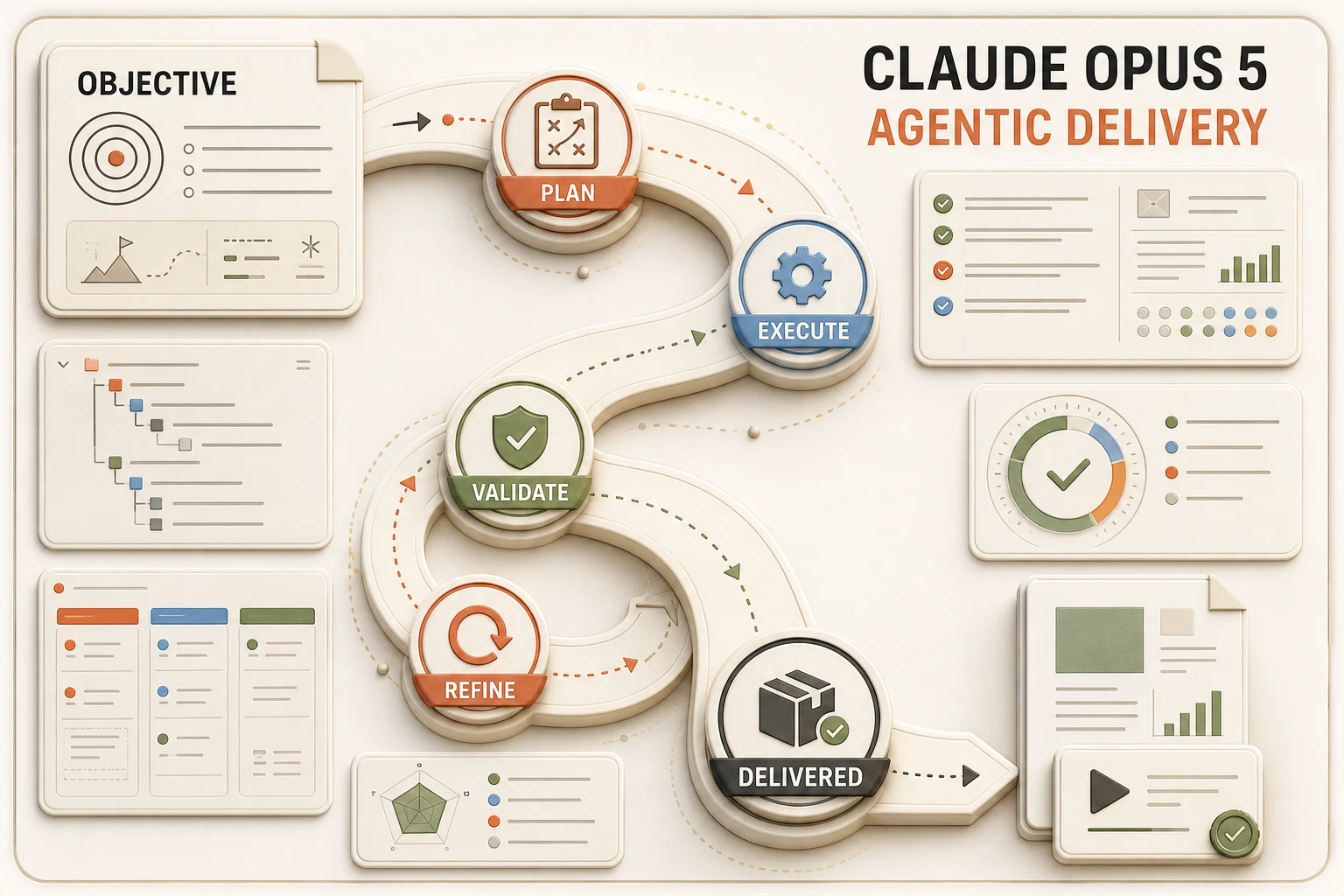
Claude Opus 5 agentic delivery infographic with an S-shaped route from objective through planning, execution, validation, refinement, and delivery

02

Claude Opus 5 API: End-to-End Multi-File Coding and Root-Cause Debugging

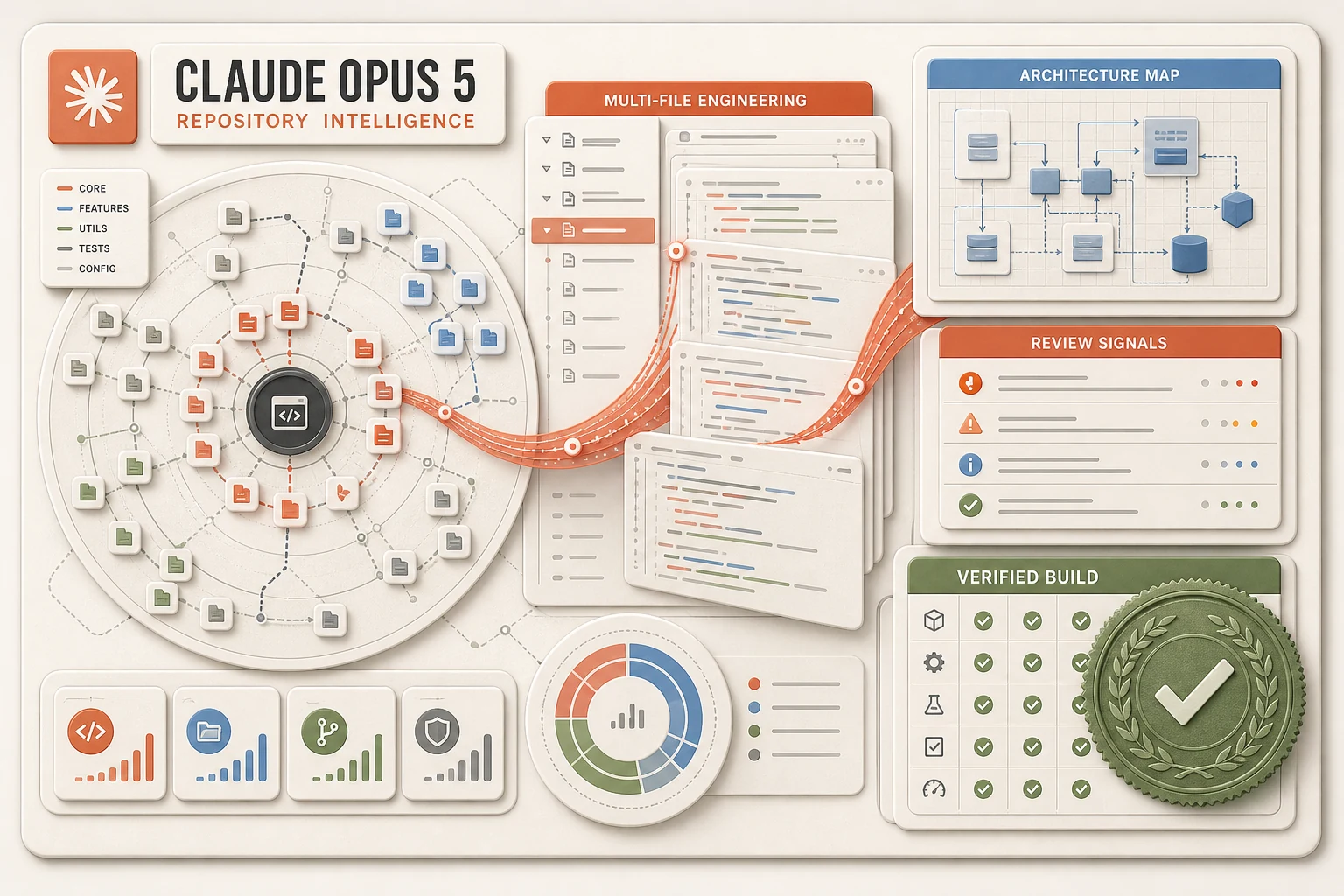
Claude Opus 5 API extends software engineering from implementation through repository-wide verification. It understands large codebases, maps cross-file dependencies, completes multi-file features, performs architectural refactors, conducts high-precision code reviews, and traces visible symptoms to root causes and hidden edge cases. Teams complete development, debugging, testing, and quality validation in one continuous workflow.

  • End-to-end multi-file feature development
  • Repository-wide refactoring and precise code review
  • Root causes, edge cases, and test validation
Claude Opus 5 repository intelligence infographic connecting a repository map, multi-file engineering, architecture review, and verified builds

03

Claude Opus 5 API: 1M-Token Long Context, 128K Output, and Adjustable Reasoning Effort

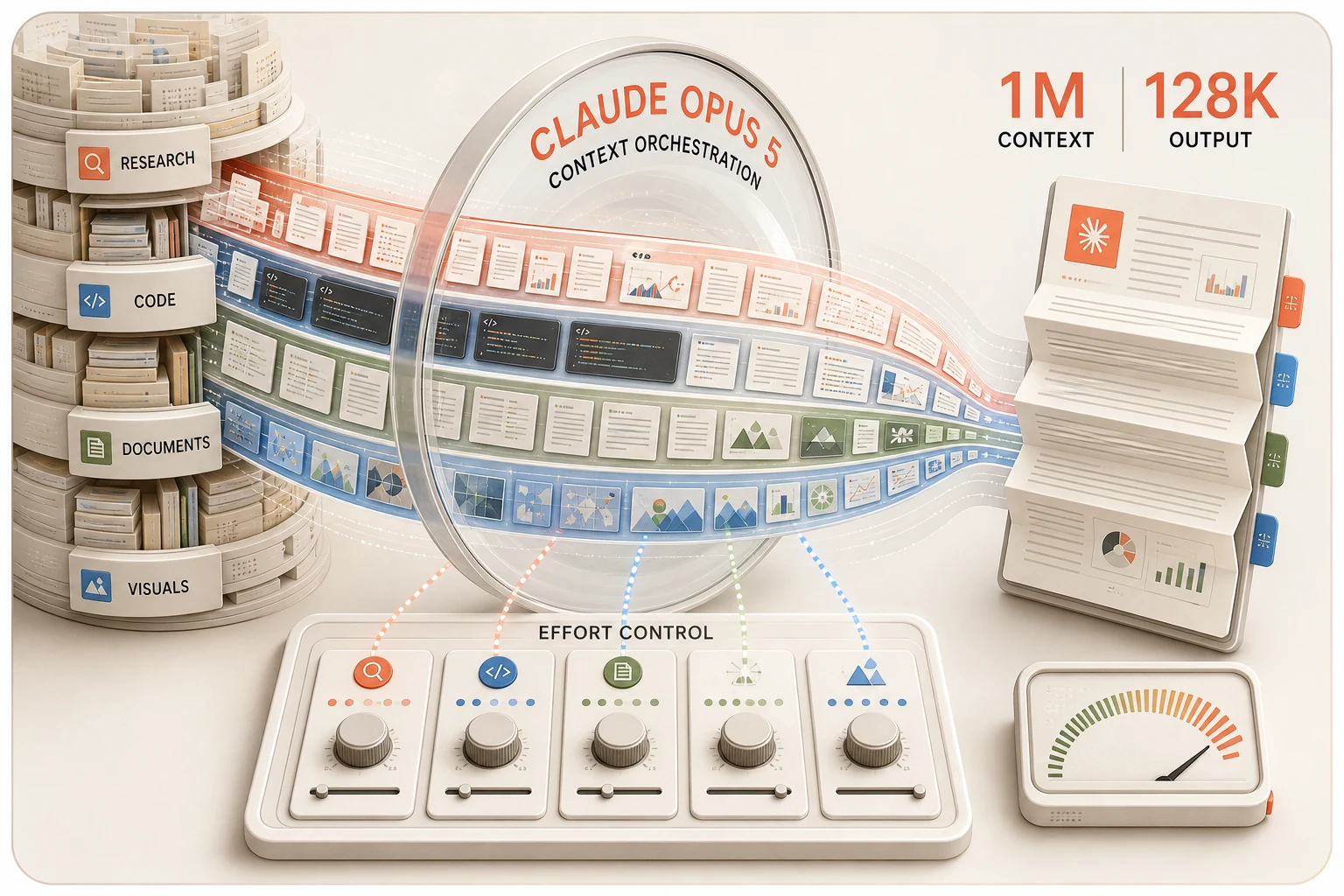
Claude Opus 5 API powers large-scale knowledge work with a one-million-token context window, up to 128K output tokens, and adjustable reasoning effort. It sustains powerful reasoning, instruction following, and tool use across extensive codebases, research collections, technical documents, and complex task chains while precisely matching reasoning depth to each workload. Teams gain the ideal combination of flagship intelligence, response speed, and token efficiency.

  • One-million-token long-context processing
  • Up to 128K output for extensive generation
  • Adjustable effort, speed, and token efficiency
Claude Opus 5 context orchestration infographic showing a one-million-token context river, 128K output, and effort controls

04

Claude Opus 5 API: Computer Use, Visual and Office Work, and Safety Guardrails

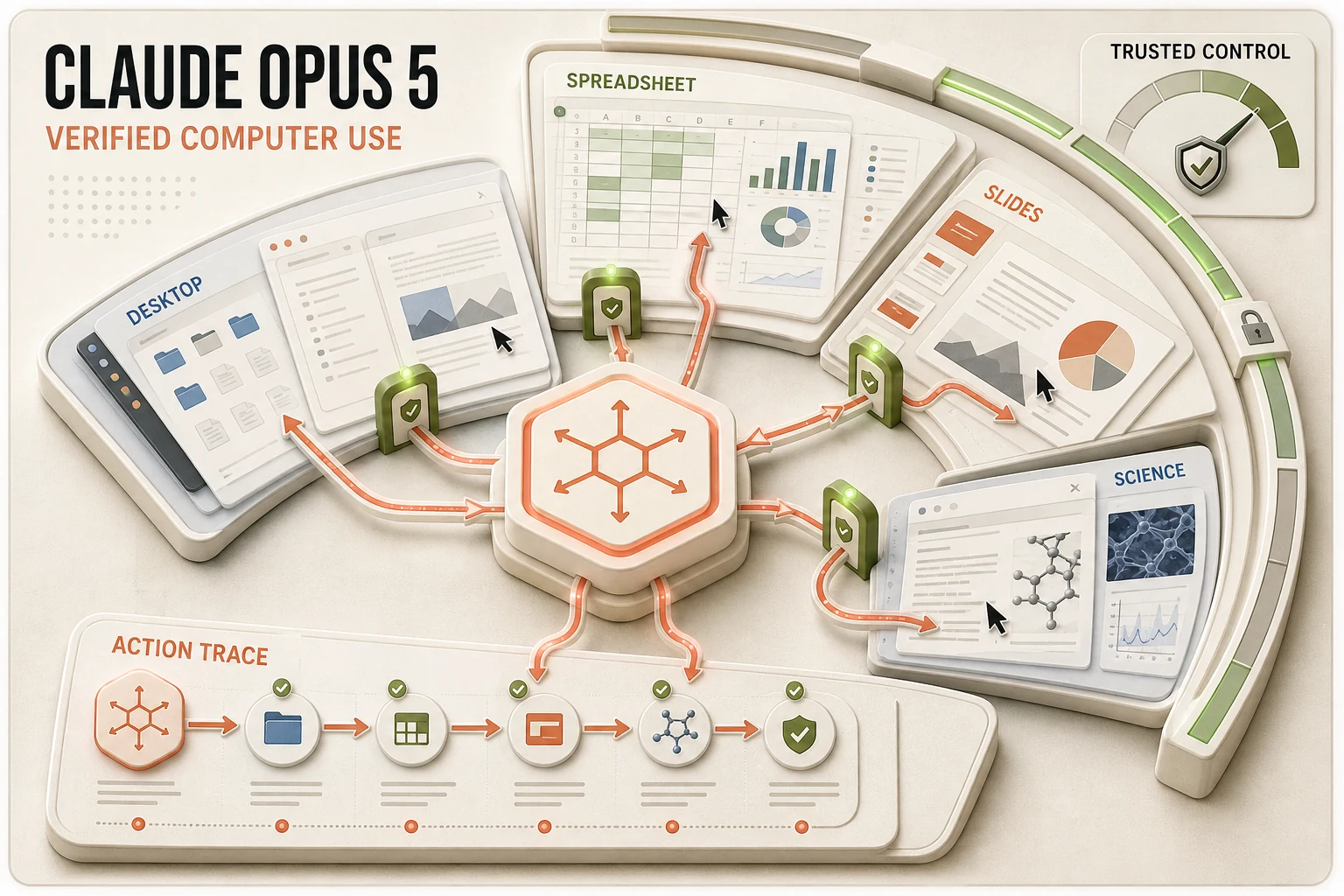
Claude Opus 5 API unifies computer use, visual understanding, professional office work, and safety verification in one powerful tool-execution system. It understands interfaces, charts, PDFs, technical drawings, spreadsheets, and presentations; coordinates file changes, tool calls, and scientific workflows; and proactively checks every critical action and intermediate result. Production-grade guardrails keep complex automation precise, stable, and controlled.

  • Computer use, visual analysis, and tool calling
  • Documents, spreadsheets, presentations, and science
  • Self-verification and production-grade guardrails
Claude Opus 5 verified computer-use infographic coordinating desktop, spreadsheet, slides, and science workflows through validation gates

Claude Opus 5 API Powers the Most Demanding Real-World Work

01

End-to-End Software Engineering

Master complex repositories, implement connected features, evolve shared systems, write comprehensive tests, integrate services, and validate the finished change as one sustained assignment.

02

Code Quality and Architecture Leadership

Elevate pull requests and large codebases through rigorous functional analysis, architectural insight, boundary-case coverage, and repository-wide quality validation.

03

Research and Professional Analysis

Synthesize reports, financial materials, scientific papers, policies, and long document collections into clear, decision-ready conclusions.

04

Documents, Spreadsheets, and Slides

Create and refine structured reports, formula-driven workbooks, presentations, and other professional artifacts while maintaining complete instruction fidelity across long workflows.

05

Computer Use and Business Automation

Coordinate visual interfaces, tools, files, and validation steps across multi-stage operational workflows with continuous precision at every critical action.

06

Life Sciences Research

Advance structural biology, organic chemistry, and bioinformatics research with performance that surpasses Opus 4.8 across every Anthropic life-science evaluation.

Claude Opus 5 vs Claude Fable 5, Opus 4.8, and GPT-5.6 Sol

Claude Opus 5 delivers the strongest all-around result in this comparison. It leads five of the six complete benchmarks across knowledge work, advanced problem-solving, computer use, browsing, and business automation, making it the standout choice for production agentic work.

BenchmarkClaude Opus 5Claude Fable 5Claude Opus 4.8GPT-5.6 Sol
Frontier-Bench v0.143.3%33.7%21.1%34.4%
GDPval-AA v21861174715931736
BrowseComp90.8%87.4%84.3%90.4%
OSWorld 2.070.6%66.1%55.7%62.6%
DeepSWE v1.168.8%69.7%59.0%72.7%
AutomationBench26.0%17.4%17.0%18.1%

Questions About the Claude Opus 5 API

What is Claude Opus 5?

Claude Opus 5 is Anthropic's flagship Opus-tier model, released on July 24, 2026. It delivers proactive intelligence, elite reasoning, and sustained execution at half the official price of Claude Fable 5, creating the best balance of capability and value for everyday production work.

How does Claude Opus 5 improve on Opus 4.8?

Opus 5 delivers major gains in sustained execution, verification, coding, computer use, knowledge work, and scientific reasoning while retaining the same official base price as Opus 4.8. Its Frontier-Bench v0.1 score more than doubles the Opus 4.8 result.

What advantages does Claude Opus 5 have over Claude Fable 5?

Opus 5 is the best choice for high-volume, everyday agentic work. It delivers flagship intelligence at half the official price of Fable 5 and leads Fable 5 across Frontier-Bench, GDPval-AA, BrowseComp, OSWorld 2.0, and AutomationBench.

How does Claude Opus 5 compare with GPT-5.6 Sol?

Opus 5 delivers broader benchmark leadership than GPT-5.6 Sol. It leads Frontier-Bench v0.1, GDPval-AA v2, BrowseComp, OSWorld 2.0, and AutomationBench, making it the stronger all-around model for production agentic work.

What context and output capacity does Claude Opus 5 provide?

Claude Opus 5 provides a one-million-token context window and up to 128K output tokens for synchronous requests, giving teams exceptional capacity for large codebases, extensive research collections, and long-form production workflows.

How do adjustable effort and Fast Mode accelerate Claude Opus 5?

Adjustable reasoning effort gives teams precise control over intelligence, response speed, and token use. Fast Mode accelerates Opus 5 for high-throughput production workflows while preserving its flagship intelligence.

How does Claude Opus 5 support secure production work?

Claude Opus 5 combines Anthropic's strongest alignment profile across its recent Claude evaluations with production-grade guardrails for sensitive cyber workflows. Teams gain powerful agentic execution with precise, dependable operational control.

How much does Claude Opus 5 cost on PoYo.ai?

PoYo pricing is $2 per 1M input tokens (400 credits) and $10 per 1M output tokens (2,000 credits), with no separate model subscription fee.

Which API endpoints support Claude Opus 5?

Use model ID claude-opus-5 with either the OpenAI-compatible /v1/chat/completions endpoint or the Anthropic-compatible /v1/messages endpoint. Both use the same published PoYo pricing.

Why Integrate the Claude Opus 5 API Through PoYo.ai?

01

One API, One Integration

One PoYo.ai API key unifies authentication, requests, billing, and model access in a consistent integration workflow.

02

A Faster Path to Production

Move from evaluation to application development with clear REST conventions and a familiar integration pattern that keeps engineering work focused on the product.

03

Centralized Usage and Cost Control

Manage model usage and billing in one place, making it easier to track spend, set operating expectations, and scale workloads with confidence.

04

Built for Multi-Model Products

Place Claude Opus 5 alongside other leading models in one AI stack and match every workload to the ideal model through shared infrastructure.