
Key takeaways
- MiniMax H3 Image (MiniMax-H3-Image) is MiniMax's image model, released on November 10, 2026. MiniMax H3 is a different model that makes video with audio. If you searched "can MiniMax H3 generate images", H3 Image is the answer.
- One model does text-to-image and editing with up to 16 reference images, at 1K, 2K or 4K, or at an exact size up to 20,000,000 pixels.
- 4K is native: about 16 megapixels at every aspect ratio, from 4096×4096 to 6272×2688, rendered directly at full size.
- PoYo charges a fixed price per image: $0.016 at 1K or 2K and $0.056 at 4K, 19–31% below MiniMax's per-token list price ($0.02179, $0.02333 and $0.06879 per Standard image).
- The weights are open on Hugging Face under the MiniMax-H3-Image Community License. Self-hosting calls for about 135 GB of weights and large GPUs, so for most teams the hosted API on PoYo is the quicker route: one key, pay as you go.
MiniMax H3 Image vs MiniMax H3: which one makes images?
MiniMax uses the H3 name for two models, and many searches mix them up.
| MiniMax H3 Image | MiniMax H3 (Hailuo 03) | |
|---|---|---|
| What it makes | Still images | Video with native audio |
| Tasks | Text-to-image, image editing, multi-reference composition | Text-to-video, first/last frame, image, video and audio references |
| Output | 1K, 2K or 4K images, up to 20 MP | 5–15 second 2K video |
| PoYo model ID | minimax-h3-image | hailuo-03 |
| PoYo price | From $0.016 per image | $0.105 per second of video |
| Guide | This article | MiniMax H3 API guide |
The two are related: MiniMax's model card describes H3 Image as the H3 architecture specialized for images, and it reuses the H3 text encoder as is. So can MiniMax H3 generate images? Yes, through MiniMax H3 Image, the still-image member of the H3 family. For video, use MiniMax H3; for images, use MiniMax H3 Image.
MiniMax H3 Image at a glance
| Item | Spec |
|---|---|
| Release | November 10, 2026 (license date) |
| Model | 33.1B-parameter diffusion transformer, distilled to 6 sampling steps for speed |
| Tasks | Text-to-image and image editing in one checkpoint |
| Native 4K sizes | 4096×4096 (1:1), 4736×3552 (4:3), 5024×3360 (3:2), 5472×3072 (16:9), 6272×2688 (21:9), plus portrait versions |
| Custom sizes (MiniMax API) | 655,360 to 20,000,000 pixels, aspect ratio 1:3 to 3:1 |
| Reference images | 1 to 16 per edit |
| Prompt expansion | Rewrites a short prompt in any language into a detailed English description of the whole image |
| Speed claim | A 4K (4096×4096) image "in under 10 seconds"; Standard runs 1.5–2× and Highspeed 3–4× "as fast as mainstream alternatives" |
| Hosted tiers on MiniMax | MiniMax-H3-Image (Standard) and MiniMax-H3-Image-Highspeed |
| Open weights | Yes, MiniMaxAI/MiniMax-H3-Image on Hugging Face |
MiniMax describes its goal as making "4K image generation practical for everyday creative workflows." The best way to judge quality for your use case is to run your own prompts in the PoYo playground.

Photography, painting, 3D and pixel art from one model. Showcase from MiniMax's H3-Image model card.
MiniMax H3 Image pricing: from tokens to cost per image
Official token rates
MiniMax charges per million tokens on its own API:
| Tier | Text input | Image input | Image output |
|---|---|---|---|
| MiniMax-H3-Image (Standard) | $2.30 | $1.50 | $3.80 |
| MiniMax-H3-Image-Highspeed | $2.30 | $3.00 | $7.60 |
Text input includes the tokens added by prompt enhancement, which is why MiniMax notes that "actual costs may vary" even at the same resolution.
Official cost per image
MiniMax also publishes per-image examples, which are the most reliable way to convert its token rates:
| Request | Standard | Highspeed |
|---|---|---|
| Text-to-image, 1K | $0.02179 | $0.03529 |
| Text-to-image, 2K | $0.02333 | $0.03622 |
| Text-to-image, 4K | $0.06879 | $0.13001 |
| Edit, 1 reference (1K in) → 2K | $0.02658 | $0.04576 |
| Edit, 1 reference (1K in) → 4K | $0.07312 | $0.13673 |
| Edit, 3 references (1K in) → 2K | $0.04177 | $0.06069 |
| Edit, 3 references (1K in) → 4K | $0.07914 | $0.15407 |
How the tokens add up
In PoYo's tests in November 2026, an image used the larger of 4,096 output tokens and width × height ÷ 1,024. One token per 1,024 pixels matches the model card, where each DiT token covers a 32×32-pixel patch.
| Output | Pixels | Output tokens | Output cost (Standard) |
|---|---|---|---|
| 1K, 1024×1024 | 1,048,576 | 4,096 (minimum) | $0.0156 |
| 2K, 2048×2048 | 4,194,304 | 4,096 | $0.0156 |
| 4K, 4096×4096 | 16,777,216 | 16,384 | $0.0623 |
| Custom maximum | 20,000,000 | 19,531 | $0.0742 |
Add the prompt-enhancement text tokens, about 2,700 to 3,400 per request at $2.30 per 1M (roughly $0.006–$0.008), and you get MiniMax's examples: $0.0156 + $0.0062 ≈ $0.0218 at 1K, and $0.0623 + $0.0065 ≈ $0.0688 at 4K.
Two things follow:
- 1K and 2K cost almost the same, because both sit at the 4,096-token minimum. If you need any detail, 2K is the better value.
- 4K costs about three times as much as 2K, since it has four times the pixels of 2K.
MiniMax H3 Image cost per image on PoYo
PoYo bills a fixed price per image, with prompt expansion included, so you know the exact cost before you submit, and every request is cheaper than MiniMax's per-token list price:
| Request | PoYo price | Credits | MiniMax list price | Difference |
|---|---|---|---|---|
| Text-to-image, 1K | $0.016 | 3.2 | $0.02179 | −27% |
| Text-to-image, 2K | $0.016 | 3.2 | $0.02333 | −31% |
| Text-to-image, 4K | $0.056 | 11.2 | $0.06879 | −19% |
| Edit, 1 reference → 2K | $0.0185 | 3.7 | $0.02658 | −30% |
| Edit, 3 references → 2K | $0.0235 | 4.7 | $0.04177 | −44% |
| Edit, 3 references → 4K | $0.0635 | 12.7 | $0.07914 | −20% |
How the PoYo price is built:
- 1K or 2K: 3.2 credits ($0.016) per image. A custom
WIDTHxHEIGHTup to 4,500,000 pixels uses this price. - 4K: 11.2 credits ($0.056) per image. A custom size above 4,500,000 pixels uses this price.
- Reference images: +0.5 credits ($0.0025) each.
- Failed tasks are free.
- One API key covers MiniMax H3 Image and every other image, video and audio model on PoYo, with pay-as-you-go credits.
Worked examples
| Scenario | Request | PoYo cost |
|---|---|---|
| 500 product thumbnails at 2K | 500 × $0.016 | $8.00 |
| 20 campaign key visuals at 4K 16:9 | 20 × $0.056 | $1.12 |
| Room staging: empty room + 9 furniture pieces, 2K | $0.016 + 10 × $0.0025 | $0.041 |
| 10,000 social images at 2K | 10,000 × $0.016 | $160 |
Open weights or hosted API?
MiniMax published H3 Image's weights on Hugging Face: "As with H3, we're releasing H3-Image's model weights." That makes local deployment a real option, so it is worth comparing with an API.
What running it locally takes
- Download size: the image model checkpoint is 68.65 GB, and it loads the H3 text encoder (66.7 GB) from the MiniMax-H3 repository, so plan for about 135 GB in total. The optional prompt expander adds 17.9 GB.
- GPUs: MiniMax says "a B200 or B300 holds the whole model in about 135 GiB, and one H200 offloads the text encoder." SGLang offloads model components when less than 130 GiB is free, and has recipes "from B300 down to 12 GB cards." Multi-GPU sequence parallelism lowers latency.
- Frameworks: SGLang, vLLM-Omni, diffusers, LightX2V and ComfyUI.
- Best quality range: about 4 to 20 MP, best around 16 MP.
How the license works
The weights use the MiniMax-H3-Image Community License Agreement, MiniMax's own license:
- Free to use and adapt: a royalty-free license to use, reproduce, distribute, modify and build derivative works within the license's Applicable Territory, defined as worldwide outside the European Union, the United Kingdom, the Republic of Korea and the United States. MiniMax invites organizations in those four regions to contact it for a license.
- Larger deployments: companies with annualized revenue above $1 million, and anyone offering a hosted service to third parties, request written authorization from MiniMax through its license console.
- Attribution: commercial products prominently display "MiniMax-H3-Image" in their user interface.
- Outputs: MiniMax leaves the rights to generated outputs with you, and you are responsible for how you use them.
Local vs API
| Self-hosted open weights | Hosted API (MiniMax or PoYo) | |
|---|---|---|
| Upfront work | Download about 135 GB, provision large GPUs, run a serving stack | An API key |
| Cost model | GPU time, whether busy or idle | Per image (PoYo) or per token (MiniMax) |
| Speed | Depends on your hardware | Managed; about 12 seconds for a 2K image on PoYo |
| Control | Full pipeline access, including seeds for reproducible runs | The request fields each API exposes |
| Terms | Community License territory and revenue conditions | The platform's terms of service |
| Best for | Research, offline pipelines, very steady high volume in licensed territories | Products, variable volume, teams that want results from day one |
For most teams, the hosted API on PoYo is the practical choice. At $0.016 per 2K image, 10,000 images cost $160 a month, billed per image with one API key and nothing to install. Self-hosting suits teams that already run large GPUs with spare capacity, or whose volume is high and steady enough to keep a large GPU busy around the clock.
Choosing hosted settings
If you use the API, these settings drive quality and cost:
| Goal | Setting |
|---|---|
| Lowest cost with good detail | resolution: "2K"; it costs the same as 1K on PoYo |
| Print, large banners, crops | resolution: "4K" for about 16 MP |
| Exact layout such as a 1920×1080 slide | A custom size like 1920x1080 |
| Follow your long, detailed prompt as written | enable_prompt_expansion: false (text-to-image) |
| Short idea, or a prompt in any language | Keep prompt expansion on |
| Edit that keeps the source framing | size: "auto", which follows <Picture 1> |
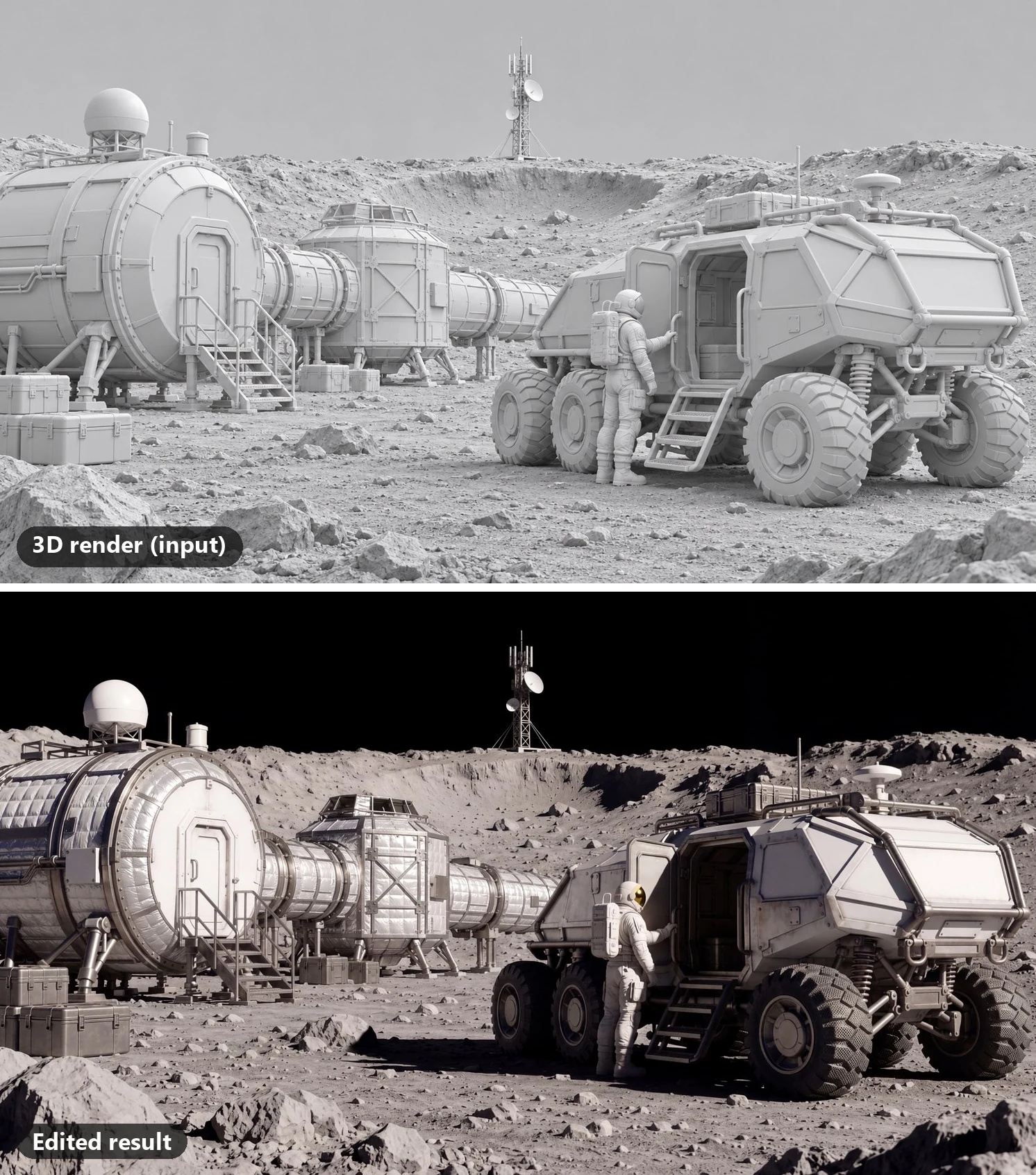
An untextured 3D render turned into a film still with the same layout. Example from MiniMax's H3-Image model card.
How to use MiniMax H3 Image on PoYo
One model ID covers both tasks: send a prompt for text-to-image, and add image_urls for editing.
Parameters
| Field | Type | Values | Default |
|---|---|---|---|
model | string | minimax-h3-image | Required |
input.prompt | string | 1–5,000 characters | Required |
input.image_urls | array | 1–16 public JPEG, PNG or WebP URLs, up to 20 MB each, 128–8,192 px per side | None |
input.size | string | 1:1, 5:4, 4:5, 4:3, 3:4, 3:2, 2:3, 16:9, 9:16, 21:9, auto (edits), or WIDTHxHEIGHT | 1:1 (text-to-image), auto (edits) |
input.resolution | string | 1K, 2K or 4K | 2K |
input.enable_prompt_expansion | boolean | Expand the prompt before generating (text-to-image) | true |
input.output_format | string | png or jpeg | png |
callback_url | string | URL that receives a POST when the task finishes or fails | None |
Common preset sizes:
size | 1K | 2K | 4K |
|---|---|---|---|
1:1 | 1024×1024 | 2048×2048 | 4096×4096 |
4:3 | 1184×896 | 2368×1760 | 4736×3552 |
3:2 | 1248×832 | 2496×1664 | 5024×3360 |
16:9 | 1376×768 | 2720×1536 | 5472×3072 |
9:16 | 768×1376 | 1536×2720 | 3072×5472 |
21:9 | 1568×672 | 3136×1344 | 6272×2688 |
A custom WIDTHxHEIGHT takes any integer width and height from 655,360 to 20,000,000 pixels in total, with an aspect ratio between 1:3 and 3:1, and the image comes back at exactly that size.
Generate a 4K image
curl --request POST "https://api.poyo.ai/api/generate/submit" \
  --header "Authorization: Bearer ${POYO_API_KEY}" \
  --header "Content-Type: application/json" \
  --data '{
    "model": "minimax-h3-image",
    "input": {
      "prompt": "A vintage travel poster for Kyoto, headline \"KYOTO\" in large bold serif letters at the top and subtitle \"City of a Thousand Gates\" below it, red torii gates receding up a mossy hill, autumn maple leaves, 1960s screen-print style",
      "size": "16:9",
      "resolution": "4K"
    }
  }'

Chinese and English text rendered and solved on a board. Example from MiniMax's H3-Image model card.
This returns a 5472×3072 image for 11.2 credits. The submit response contains the task ID:
{
  "code": 200,
  "data": {
    "task_id": "task-unified-1794383400-abcd1234",
    "status": "not_started",
    "created_time": "2026-11-14T10:30:00"
  }
}
Edit with several reference images
Images are numbered in the order of image_urls, so the first is <Picture 1>, the second <Picture 2>, and so on:
curl --request POST "https://api.poyo.ai/api/generate/submit" \
  --header "Authorization: Bearer ${POYO_API_KEY}" \
  --header "Content-Type: application/json" \
  --data '{
    "model": "minimax-h3-image",
    "input": {
      "prompt": "Place the sofa from <Picture 2> and the floor lamp from <Picture 3> in the empty living room in <Picture 1>. Keep the walls, windows and daylight of <Picture 1> unchanged.",
      "image_urls": [
        "https://example.com/empty-room.png",
        "https://example.com/sofa.png",
        "https://example.com/floor-lamp.png"
      ],
      "resolution": "2K"
    }
  }'
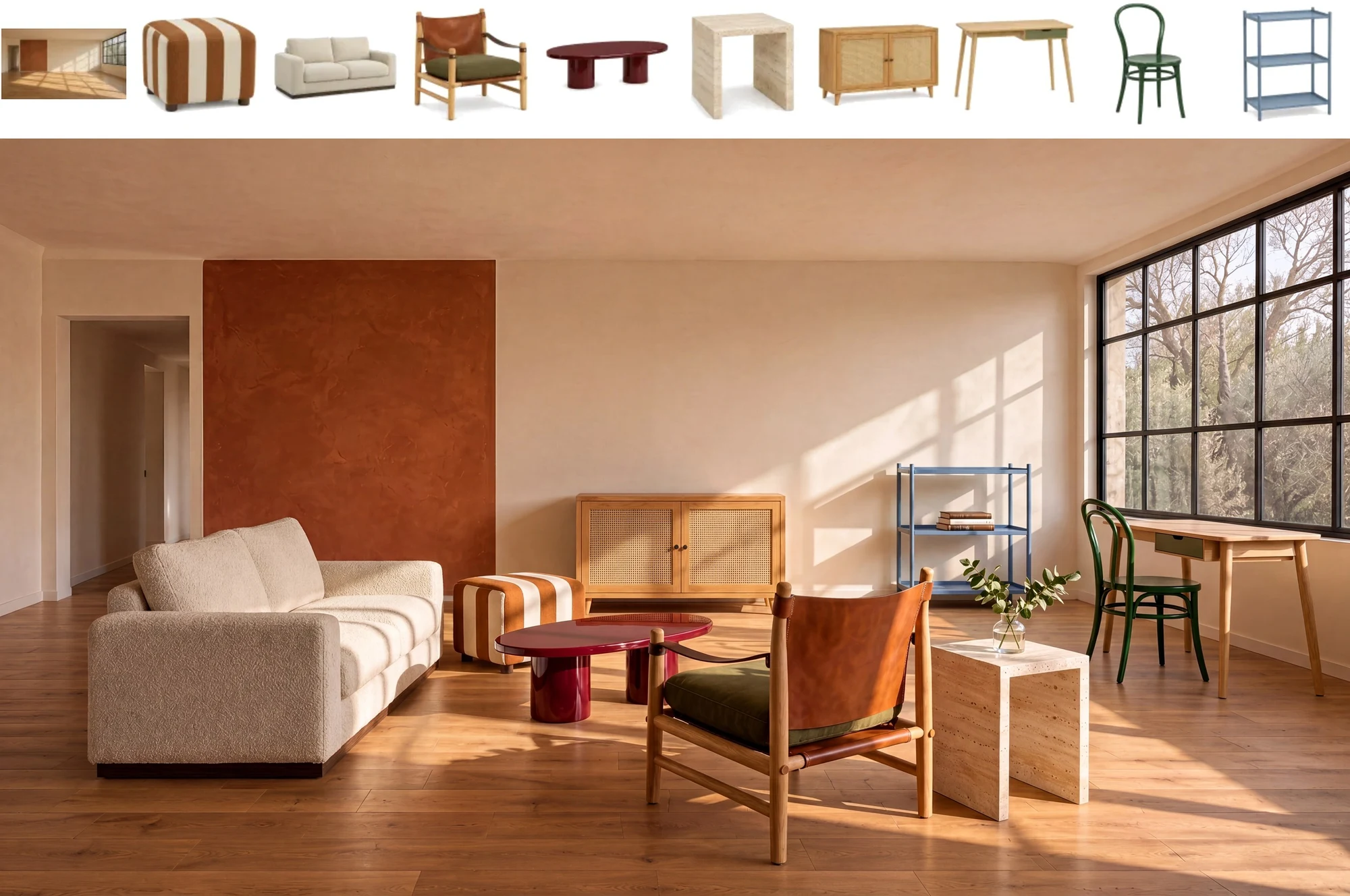
An empty room plus nine furniture pieces composed into one living room. Example from MiniMax's H3-Image model card.
With the default size: "auto", the output follows the aspect ratio of <Picture 1> at about 2048×2048 pixels of area. This request costs 3.2 + 3 × 0.5 = 4.7 credits ($0.0235). Edits always use prompt expansion.
Poll for the result
curl --request GET "https://api.poyo.ai/api/generate/status/${TASK_ID}" \
  --header "Authorization: Bearer ${POYO_API_KEY}"
data.status | Meaning | Next step |
|---|---|---|
not_started | Queued | Poll again |
running | Generating | Poll again |
finished | Done | Read data.files[0].file_url |
failed | Failed, free of charge | Read data.error_message |
A minimal Python poller:
import os, time, requests

BASE_URL = "https://api.poyo.ai"
HEADERS = {"Authorization": f"Bearer {os.environ['POYO_API_KEY']}"}

def wait_for_image(task_id, interval=4, max_checks=60):
    for _ in range(max_checks):
        resp = requests.get(f"{BASE_URL}/api/generate/status/{task_id}", headers=HEADERS, timeout=30)
        task = resp.json()["data"]
        if task["status"] == "finished":
            return task["files"][0]["file_url"]
        if task["status"] == "failed":
            raise RuntimeError(task["error_message"])
        time.sleep(interval)
    raise TimeoutError(f"Still running; keep {task_id} and check again later")
In PoYo's tests in November 2026, a 1K or 2K image took about 12 seconds, a 4K image about 22 to 25 seconds, and an edit with three reference images about 44 seconds. If your wait times out, keep the task_id and query it again later; the task keeps running on PoYo's side.
Tips from MiniMax's prompting guide
MiniMax's official prompting tips, with how to apply them:
- "Task before style, layout before details." Say what the image is for and what is in it, then the layout, then the style through visible color, material and light.
- "Quote every word to show, with its position and line breaks." The official showcase renders logic puzzles in Chinese and English correctly on a board.
- When you want a clean image, write "no text, letters or numbers in the image" in the main prompt. The model reads exclusions best when they sit right in the prompt.
- "Give exact data for charts and educational images," with units and time ranges.
- "Give each reference image a role, and say what changes and what stays." For example: "<Picture 1> is the room, <Picture 2> is the sofa; keep the floor and windows."
- Write grids as rows and columns, such as "2 rows and 3 columns".
- Use 2K for drafts. It costs the same as 1K on PoYo and gives four times the pixels; switch to 4K for the final.
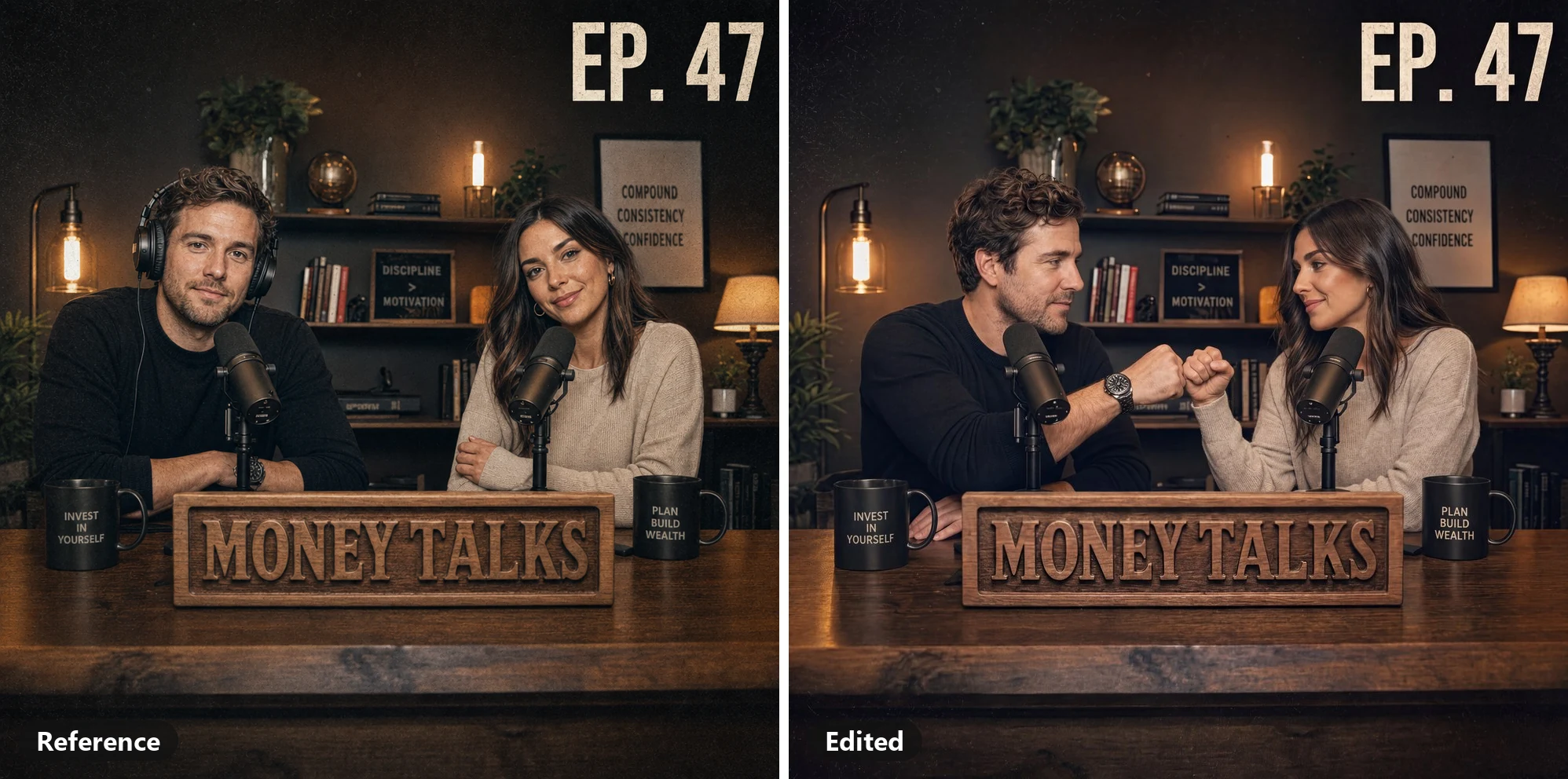
A clear instruction changes one detail and keeps the rest of the scene. Example from MiniMax's H3-Image materials.
For other image models, compare our Nano Banana 2.1 vs GPT Image 2.5 breakdown and the MAI Image 2.6 API guide. To build a video from H3 Image stills, see the GPT Image 2.5 + MiniMax H3 storyboard tutorial.
FAQ
Can MiniMax H3 generate images?
Yes, through MiniMax H3 Image. MiniMax H3 is the video and audio model; MiniMax H3 Image is the separate still-image model MiniMax released on November 10, 2026, built on the same architecture and specialized for images. On PoYo, call minimax-h3-image for images and hailuo-03 for video.
What is MiniMax H3 Image?
MiniMax H3 Image (MiniMax-H3-Image) is MiniMax's open-weight model for text-to-image and image editing. It is a 33.1B-parameter diffusion transformer that outputs native 4K images of about 16 megapixels and edits or composes up to 16 reference images.
How much does the MiniMax H3 Image API cost?
MiniMax lists $2.30, $1.50 and $3.80 per 1M text input, image input and image output tokens on its Standard tier, which works out to about $0.022 at 1K or 2K and $0.069 at 4K per image. On PoYo it is a fixed $0.016 per image at 1K or 2K and $0.056 at 4K, plus $0.0025 per reference image, with prompt expansion included.
Does MiniMax H3 Image support 4K?
Yes. 4K produces about 16 megapixels at every aspect ratio, for example 4096×4096 at 1:1 and 5472×3072 at 16:9. Custom sizes go up to 20,000,000 pixels.
How many reference images can MiniMax H3 Image use?
Up to 16 per edit. Refer to them in the prompt by order, as <Picture 1>, <Picture 2> and so on, and give each one a role.
Is MiniMax H3 Image open source? Can I run it locally?
Yes. MiniMax publishes the weights on Hugging Face under the MiniMax-H3-Image Community License. Running them takes about 135 GB of weights including the text encoder; a single B200 or B300 holds the whole model, and SGLang has recipes down to 12 GB cards with offloading. The license is royalty-free in its Applicable Territory, and larger companies or hosted services request written authorization from MiniMax. For production apps, the hosted API on PoYo gets you started with one key.
What is the difference between Standard and Highspeed?
On MiniMax's platform, Highspeed has the same parameters and limits as Standard but runs faster: MiniMax quotes 3–4× the speed of mainstream alternatives, against 1.5–2× for Standard. Its image input and output tokens cost twice as much, so a 4K image costs about $0.13 instead of $0.069. On PoYo, minimax-h3-image costs a fixed $0.056 at 4K.
What does prompt expansion do, and does it cost extra?
It rewrites your prompt into a detailed description of the whole image before generation. On MiniMax's API, the added text is billed as input tokens, about $0.006–$0.008 per request. On PoYo it is included in the per-image price. Turn it off for text-to-image when you want a long prompt followed as written; edits always use it.
Can I use MiniMax H3 Image outputs commercially?
Yes. MiniMax's license leaves the rights to generated outputs with you, and you are responsible for how you use them. Follow the acceptable use policy in the license and the terms of the platform you use.
How long does MiniMax H3 Image take?
In PoYo's tests, 1K or 2K images took about 12 seconds, 4K about 22 to 25 seconds, and a three-reference edit about 44 seconds. Submitting returns a task_id at once, so your application stays responsive while the image renders.