









Model icon
gpt-6.2-sol
Model:
GPT-6.2 Sol is OpenAI's efficient, versatile model for everyday work: coding, clear writing, and multistep agent tasks. OpenAI reports it comes within 0.5 points of GPT-6.2 Astra on FrontierCode 2.0 at about one-fifth the cost, and outscores GPT-6 Astra on LifeVal everyday tasks at about one-seventh the cost. Send text and images with a 1.05M-token context, up to 128K output tokens, and five reasoning effort levels.
Chat

This Playground is for demo purposes. Data is only valid in the current window and will be cleared on refresh.

Type a message...

Configuration
1.0
1.0
Pricing details

Pay as you go. No subscription, no hidden fees.

1 credit = $0.005
GPT-6.2 Sol
Input
$1.60/1M tokens
320 credits/1M tokens
$2.00/1M tokensSave 20%
Cache read
$0.080/1M tokens
16 credits/1M tokens
$0.100/1M tokensSave 20%
Cache write
$2.00/1M tokens
400 credits/1M tokens
$2.50/1M tokensSave 20%
Output
$8.00/1M tokens
1600 credits/1M tokens
$10.00/1M tokensSave 20%
How it's billed: Input and output tokens are billed separately, per 1M tokens.

Charges are based on the final output.

GPT-6.2 SOL

OpenAI's efficient GPT-6.2 model for coding, clear writing, and multistep agents

GPT-6.2 Sol API for Everyday Coding, Writing, and Agents

GPT-6.2 Sol is OpenAI's efficient, versatile model for everyday work and the successor to GPT-6.1 Sol. It powers through multistep agentic workflows, writes clearly and naturally, and delivers better results on demanding tasks with fewer output tokens. On FrontierCode 2.0, OpenAI reports that it comes within 0.5 points of GPT-6.2 Astra at about one-fifth the cost, with both models at max reasoning effort.

The model accepts text and image input, returns text, and supports a 1,050,000-token context window with up to 128,000 output tokens. On PoYo, call it with model ID gpt-6.2-sol through Chat Completions or Responses, with streaming on both and five reasoning effort levels from low to max.

Key Features of GPT-6.2 Sol API

OpenAI calls GPT-6.2 Sol its go-to model for everyday work, built to get more done per task across coding, daily tasks, professional assignments, and agent workflows.

01

Coding Within 0.5 Points of Astra at One-Fifth the Cost

A code change only helps when it meets the standard a maintainer would merge. Cognition's FrontierCode 2.0 tests exactly that on real codebases. OpenAI reports that GPT-6.2 Sol comes within 0.5 points of GPT-6.2 Astra on this benchmark at about one-fifth the cost, with both models at max reasoning effort, so teams can apply coding quality close to Astra's across many more tasks.

  • Make changes to real, existing codebases
  • Target maintainers' standards for merging
  • Run more coding tasks within the same budget
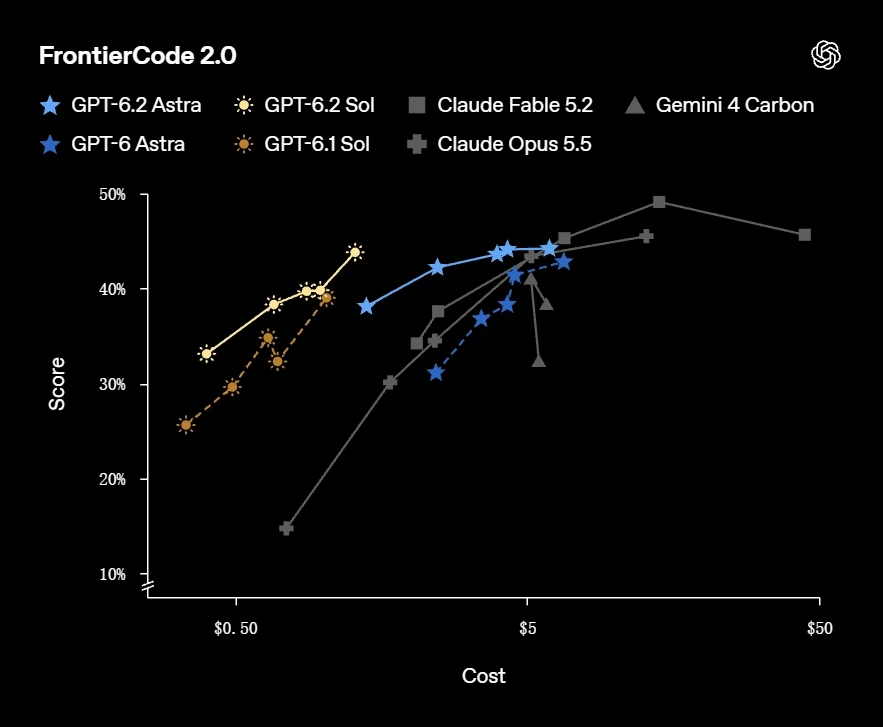
FrontierCode 2.0 score versus cost for GPT-6.2 Sol, GPT-6.2 Astra and other models

02

Everyday Tasks Tailored to Personal Needs

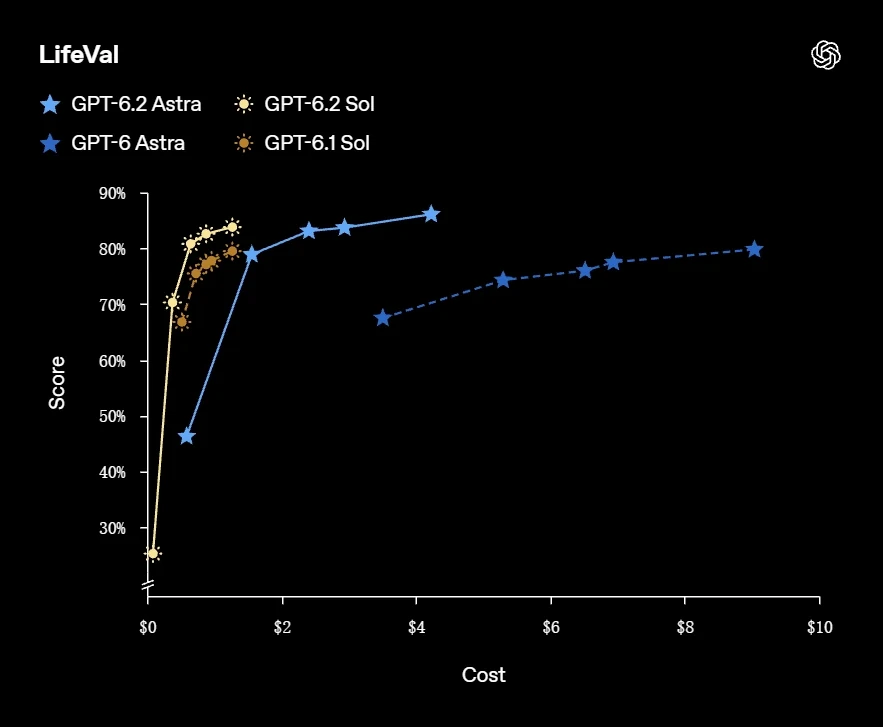
Everyday requests depend on a person's situation, such as shortlisting kindergartens after a move, finding a home that fits a family's budget and commute, or planning meals for a parent adjusting to a new diagnosis. OpenAI's LifeVal evaluation measures this kind of work. OpenAI reports that GPT-6.2 Sol outscores GPT-6 Astra on LifeVal at about one-seventh the cost.

  • Shortlist options against personal criteria
  • Plan around budgets, commutes, and routines
  • Tailor answers to each person's situation
LifeVal score versus cost for GPT-6.2 Sol, GPT-6.2 Astra and earlier GPT models

03

Long-Horizon Professional Knowledge Work

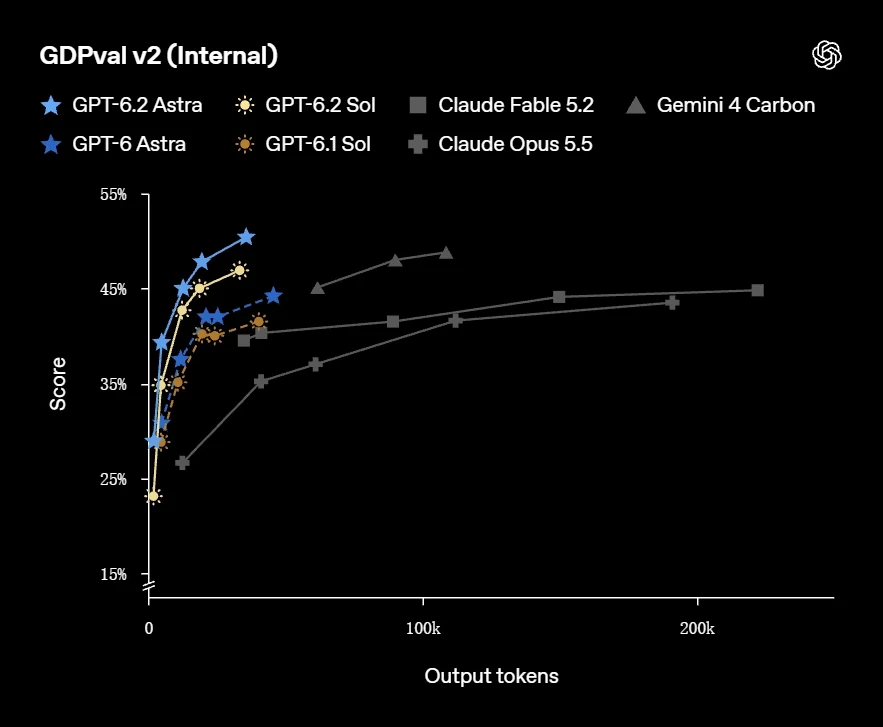
Real project assignments run through many stages before they produce a deliverable. OpenAI's internal GDPval v2 measures these long-horizon knowledge-work assignments from sectors like finance, data science, biotechnology, and marketing. OpenAI reports that GPT-6.2 Sol improves 5.3 points over GPT-6.1 Sol, and its chart plots each model's score against the output tokens it used.

  • Work through multi-stage project assignments
  • Handle finance, data, and marketing tasks
  • Deliver results with fewer output tokens
GDPval v2 score versus output tokens for GPT-6.2 Astra, GPT-6.2 Sol and other models

04

Multistep Agent Workflows at Low Cost per Task

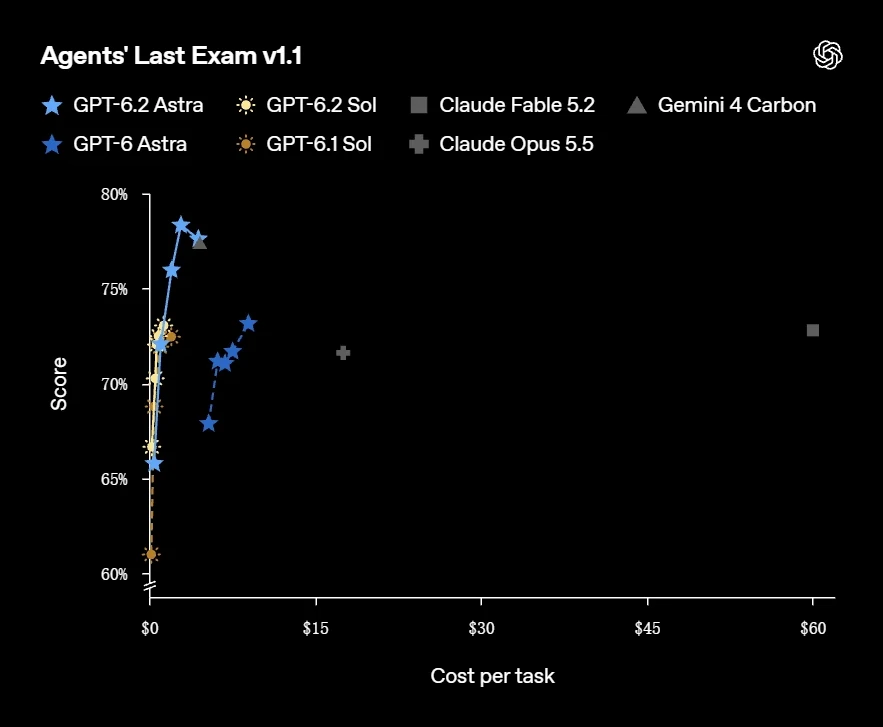
Agent workflows chain many model calls, so cost per task adds up with every step. OpenAI describes GPT-6.2 Sol as a model that powers through multistep agentic workflows and is intuitive to collaborate with. On Agents' Last Exam v1.1, which evaluates long-horizon professional workflows, OpenAI's chart places GPT-6.2 Sol's results among the lowest costs per task shown.

  • Carry agent tasks through many steps
  • Call function tools through the Responses API
  • Match reasoning effort to each workflow
Agents' Last Exam v1.1 score versus cost per task for GPT-6.2 Astra, GPT-6.2 Sol and other models

Who Can Benefit from GPT-6.2 Sol API?

01

Software Development Teams

Use GPT-6.2 Sol to implement changes in existing codebases, fix bugs, and review diffs, and reserve GPT-6.2 Astra for the hardest engineering projects.

02

Agent Builders

Build agents that plan steps, call function tools through the Responses API, inspect results, and carry long tasks through to completion.

03

Consulting and Finance Teams

Work through long project assignments, from gathering source material to drafting analyses and deliverables, with GPT-6.2 Sol handling each stage.

04

Personal Assistant Apps

Help users compare options, plan budgets and schedules, and organize everyday decisions with answers tailored to their own circumstances.

05

Content and Communication Teams

Draft reports, emails, and documentation in a clear, natural style, then revise them with GPT-6.2 Sol against your source material.

06

Operations and Support Teams

Send screenshots, charts, and scanned documents with your instructions, and let GPT-6.2 Sol turn what it sees into summaries and next steps.

GPT-6.2 Sol vs GPT-6.1 Sol vs GPT-6 Sol — Model Comparison

All three Sol models share a 1,050,000-token context window and a 128,000-token output limit, and PoYo serves each of them through Chat Completions and Responses. GPT-6.2 Sol keeps GPT-6.1 Sol's token prices, while OpenAI reports higher scores on coding, everyday tasks, and professional knowledge work.

CapabilityGPT-6.2 SolGPT-6.1 SolGPT-6 Sol
PositioningOpenAI's go-to model for everyday workComplex coding, computer use, and professional workflowsCost-optimized frontier model for coding and agent workflows
Context window1,050,000 tokens1,050,000 tokens1,050,000 tokens
Max output128,000 tokens128,000 tokens128,000 tokens
Reasoning effortlow, medium (default), high, xhigh, maxlow, medium (default), high, xhigh, maxnone, low, medium (default), high, xhigh, max
API on PoYoChat Completions and ResponsesChat Completions and ResponsesChat Completions and Responses
GDPval v2 (Internal)5.3 points above GPT-6.1 SolBaseline for GPT-6.2 Sol's 5.3-point gain—
FrontierCode 2.0Higher than GPT-6.1 Sol at every cost level chartedBelow GPT-6.2 Sol—
Terminal-Bench-Science 0.1Higher than GPT-6.1 Sol in OpenAI's GPT-6.2 chartMore than 2× GPT-6 Sol's scoreLess than half of GPT-6.1 Sol's score
Official price · Input / cached input / output (1M tokens)$2.00 / $0.10 / $10.00$2.00 / $0.10 / $10.00$2.00 / $0.20 / $10.00
PoYo price · Input / cached input / output (1M tokens)$1.60 / $0.08 / $8.00$1.60 / $0.08 / $8.00$1.60 / $0.16 / $8.00

Benchmark results are as reported by OpenAI in its GPT-6.2 and GPT-6.1 launch materials; — marks a model outside that benchmark's chart. Prices are standard rates per million tokens; see the pricing table above for full PoYo rates.

How to Use GPT-6.2 Sol API on PoYo

Step 1: Register and Create an API Key
Sign in to PoYo and create a key for your application.
Create API Key →

Step 2: Add Credits
Fund your account and review the input, output, and cache token rates in the pricing table above.
Add Credits →

Step 3: Integrate the API
Send requests with model gpt-6.2-sol to /v1/chat/completions or /v1/responses, and use Responses for function tools. Test prompts, image inputs, and reasoning effort in the Playground before moving them into your application.
View Documentation →

Frequently Asked Questions about GPT-6.2 Sol API

What is GPT-6.2 Sol?

GPT-6.2 Sol is OpenAI's efficient, versatile model for everyday work, released on November 17, 2026 alongside GPT-6.2 Astra. It succeeds GPT-6.1 Sol and handles coding, writing, and multistep agent workflows. It accepts text and image input and returns text. On PoYo, call it with model ID gpt-6.2-sol through Chat Completions or Responses.

How is GPT-6.2 Sol different from GPT-6.1 Sol?

OpenAI describes GPT-6.2 Sol as smarter and more efficient than GPT-6.1 Sol, delivering better results on demanding tasks with fewer output tokens. On GDPval v2, OpenAI reports a 5.3-point gain. The context window, max output, and reasoning settings stay the same, and GPT-6.2 Sol keeps GPT-6.1 Sol's official token prices. On PoYo, both models are priced the same.

Should I use GPT-6.2 Sol or GPT-6.2 Astra?

OpenAI positions GPT-6.2 Astra for your hardest projects and GPT-6.2 Sol for everyday work. On FrontierCode 2.0, OpenAI reports that Sol comes within 0.5 points of Astra at about one-fifth the cost, both at max effort, and Sol's standard token rates are one-quarter of Astra's. Use Sol for high-volume coding, writing, and agent tasks, and Astra for the most demanding work.

How much does GPT-6.2 Sol API cost on PoYo?

PoYo charges per million tokens: 320 credits ($1.60) for input, 1,600 credits ($8.00) for output, 16 credits ($0.08) for cached input reads, and 400 credits ($2.00) for cache writes. That is 20% below OpenAI's standard rates of $2, $10, $0.10, and $2.50. You pay only for the tokens you use.

Which reasoning effort levels does GPT-6.2 Sol support?

GPT-6.2 Sol supports five reasoning effort levels: low, medium, high, xhigh, and max, with medium as the default. Use lower levels for quick, high-volume requests and higher levels for complex coding or multistep agent work. Set it per request with reasoning_effort in Chat Completions or reasoning.effort in the Responses API.

Can I use GPT-6.2 Sol with Chat Completions and the Responses API?

Yes. PoYo serves GPT-6.2 Sol on both /v1/chat/completions and /v1/responses, with streaming on each. For function tools, use the Responses API, which is OpenAI's recommended route for tool calling with GPT-6.2 models.

Does GPT-6.2 Sol accept image input?

Yes. GPT-6.2 Sol accepts images together with text, so you can send screenshots, charts, photos, and scanned documents in the same request and receive a text response. You can try image inputs in the Playground before integrating.

Why Use PoYo for GPT-6.2 Sol API Access

01

Familiar API Formats

Call GPT-6.2 Sol through OpenAI-compatible Chat Completions or Responses, so existing OpenAI clients can connect by changing the base URL and key.

02

20% Below Official Rates

Pay $1.60 per million input tokens and $8 per million output tokens, 20% below OpenAI's standard rates, with no subscription required.

03

One Key for Many Models

Use the same PoYo API key for GPT-6.2 Sol, GPT-6.2 Astra, and the other chat, image, video, and audio models available on PoYo.

04

Playground Before Integration

Test prompts, image inputs, and reasoning effort with GPT-6.2 Sol in the Playground, then reuse the same request format in your application.