
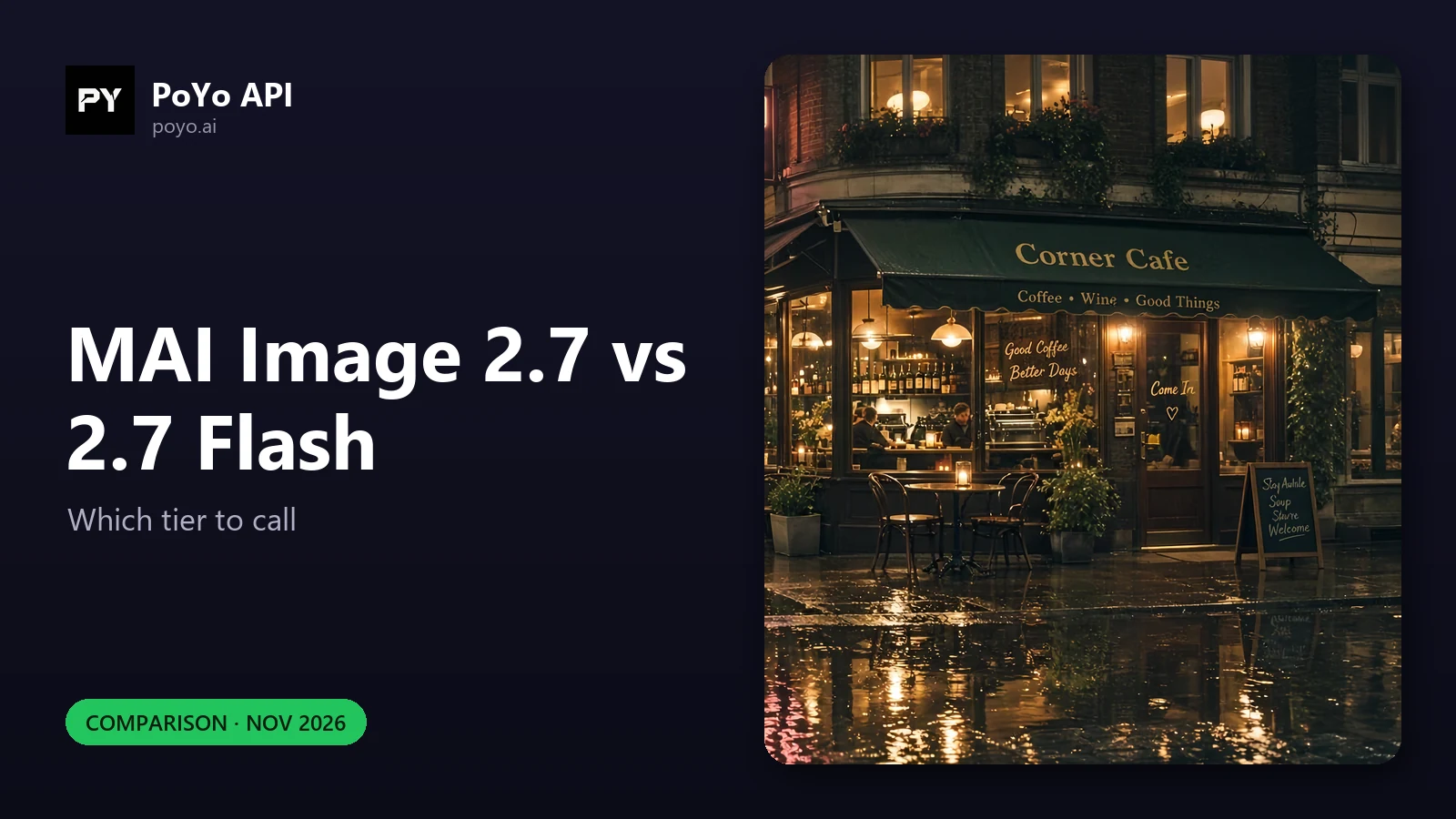
The MAI Image 2.7 API comes in two tiers on PoYo, mai-image-2.7 and mai-image-2.7-flash, and they accept exactly the same request. The choice is purely cost, speed and how much the final pixels matter. On our launch-day test, the same 2K request cost 3.4 times less and finished about 24 seconds sooner on Flash, and both rendered the sign text correctly. Both tiers live on the MAI Image 2.7 model page.
Short answer: default to Flash for drafts, previews, thumbnails, stickers and any high-volume job. Call MAI Image 2.7 for the final render of hero images, demanding edits and text-heavy designs, and for anything a customer pays for per image.
What Microsoft says about the two tiers
Microsoft's model card describes MAI Image 2.7 Flash as "an optimized version of MAI Image 2.7". Its Foundry documentation lists Flash with the "same generation and editing capabilities as MAI-Image-2.7, offered as a faster, lower-cost variant", best for "the same scenarios as MAI-Image-2.7 when you need lower cost and faster generation".
In the launch post, Microsoft says "Flash delivers the speed and efficiency needed for production workloads" and that Flash powers its Canvas editor in MAI Labs. Microsoft's #1 ranking on Artificial Analysis's image editing leaderboard (1,215 Elo as of November 16, 2026) is stated for MAI Image 2.7; the launch post does not give a separate rank for Flash.
Same request, different model ID
The PoYo schemas for the two tiers are identical apart from the model enum: same prompt limit (32,000 characters), same 1 to 5 image_urls, same size presets and custom sizes up to 4,194,304 pixels, same 1K/2K, same background and output_format. Switching tiers never requires touching input:
{
  "model": "mai-image-2.7-flash",
  "input": {
    "prompt": "A university campus poster at dusk with the title \"Open Day 2026\", photorealistic, cinematic light",
    "size": "16:9",
    "resolution": "2K"
  }
}
Change "mai-image-2.7-flash" to "mai-image-2.7" and the request is valid on the flagship. That makes per-request routing cheap to build.
MAI Image 2.7 API vs Flash: price
| Per 1M tokens | MAI Image 2.7 | MAI Image 2.7 Flash | Flash vs 2.7 |
|---|---|---|---|
| Text input | 1,000 credits ($5.00) | 350 credits ($1.75) | 35% of the price |
| Image input | 1,600 credits ($8.00) | 500 credits ($2.50) | 31% |
| Image output | 6,800 credits ($34.00) | 2,000 credits ($10.00) | 29% |
Output tokens on PoYo are about one per 1,024 pixels, so per image (output only):
| Size | MAI Image 2.7 | MAI Image 2.7 Flash |
|---|---|---|
1024x1024 (1:1, 1K) | 6.96 credits ($0.0348) | 2.05 credits ($0.0102) |
2720x1536 (16:9, 2K) | 27.74 credits ($0.1387) | 8.16 credits ($0.0408) |
2048x2048 (1:1, 2K) | 27.85 credits ($0.1393) | 8.19 credits ($0.0410) |
Microsoft frames the gap the same way: its model page says Flash costs "less than half the cost of our flagship model", and the launch post puts the two at "$35" and "$10" per 1,000 images. The pricing post has cost tables for every size.
Same-prompt test on launch day
The PoYo team sent the same request to both tiers on the PoYo production API on November 19, 2026: a rainy-night cafe with a neon sign reading "OPEN LATE", size: "16:9", resolution: "2K", output_format: "png". Times are submit to result with a client polling every few seconds.
mai-image-2.7 | mai-image-2.7-flash | |
|---|---|---|
| Output | 2720x1536 | 2720x1536 |
| Sign text | "OPEN LATE", exactly as written | "OPEN LATE", exactly as written |
| Cost at current rates | 27.802 credits (about $0.139) | 8.1803 credits (about $0.041) |
| Time | About 66 s | About 42 s |
Derived estimate: both charges are about 4,080 output tokens plus about 58 prompt tokens at each tier's rates, so the price ratio (3.4x) comes straight from the rate card, not from different output sizes.
What this test does not show: it is one prompt and one run per tier. It says both tiers can render a short quoted phrase at 2K; it does not measure fine detail, edit fidelity across several reference images, or how often each tier needs a retry. Run your own sample of real prompts on both before you fix a routing rule.
Which tier to call
| Request | Tier | Why |
|---|---|---|
| Prompt exploration, drafts, A/B variants | Flash | 29% of the output price; you will throw most of them away |
| Thumbnails, previews, in-app generation where users wait | Flash | Faster in our test (about 42 s vs 66 s) |
| Transparent stickers, icons, catalog cutouts in bulk | Flash | Our transparent 1K test comes to 2.062 credits (about $0.0103) |
| Final hero and campaign images | MAI Image 2.7 | The tier Microsoft's benchmark claims are about |
| Precise edits on client assets, multi-image compositions | MAI Image 2.7 | Microsoft positions the flagship for precise, multi-reference editing |
| Dense in-image text (packaging, posters with small print) | Start on 2.7 | Both handled a short sign in our test; longer copy is untested |
A draft-then-final pattern
A common way to use both tiers: generate several cheap drafts on Flash, pick one, then render the final on MAI Image 2.7.
import os
import requests

def submit(model, input_body):
    r = requests.post(
        "https://api.poyo.ai/api/generate/submit",
        headers={"Authorization": "Bearer " + os.environ["POYO_API_KEY"]},
        json={"model": model, "input": input_body},
        timeout=60,
    )
    body = r.json()
    if body.get("code") != 200:
        raise RuntimeError(body)
    return body["data"]["task_id"]

brief = {"prompt": "A rainy-night cafe with a neon sign reading \"OPEN LATE\"", "size": "16:9"}

draft_ids = [submit("mai-image-2.7-flash", brief) for _ in range(4)]
final_id = submit("mai-image-2.7", {**brief, "resolution": "2K"})
Poll each task_id as shown in the MAI Image 2.7 API guide. Four 1K drafts on Flash plus one 2K final on the flagship come to about 8.2 + 27.8 = 36.0 credits (about $0.180), a derived estimate from the rates and our measured 2K charge.
There is no seed field, so the final render will not reproduce a chosen draft exactly. If the composition matters, pass the chosen draft's URL in image_urls and ask MAI Image 2.7 to keep its layout while refining detail. That adds image input tokens (1,600 credits per 1M on the flagship); we have not measured that flow yet.
When to skip Flash entirely
- You generate few images and each one ships. At low volume the absolute saving is small: about $0.098 per 2K image.
- Retries cost more than the saving. If a Flash output fails your review and you rerun on MAI Image 2.7 anyway, you paid for both. Track the reject rate per tier.
And when to skip the flagship: if your review step cannot tell the two apart on your prompts, the flagship's extra cost buys nothing.
Frequently asked questions
Is MAI Image 2.7 Flash the same API as MAI Image 2.7?
Yes. Same endpoint, same fields, same limits; only model changes from mai-image-2.7 to mai-image-2.7-flash.
How much cheaper is the MAI Image 2.7 Flash API? Output tokens cost $10.00 per 1M on Flash versus $34.00 on MAI Image 2.7. In our same-request test the cost at current rates is 8.1803 versus 27.802 credits, 3.4 times less.
Is the MAI Image 2.7 Flash API faster? In our November 19, 2026 test, a 2K 16:9 image took about 42 seconds on Flash and about 66 seconds on MAI Image 2.7, submit to result.
Does MAI Image 2.7 Flash support transparent backgrounds and editing?
Yes. background: "transparent", output_format, and 1 to 5 image_urls work the same on both tiers.
Should I use MAI Image 2.7 Flash or MAI Image 2.6 Flash? MAI Image 2.7 Flash is cheaper per output token ($10.00 vs $15.20 per 1M) and supports larger sizes and transparency. See MAI Image 2.7 API vs MAI Image 2.6 API.