
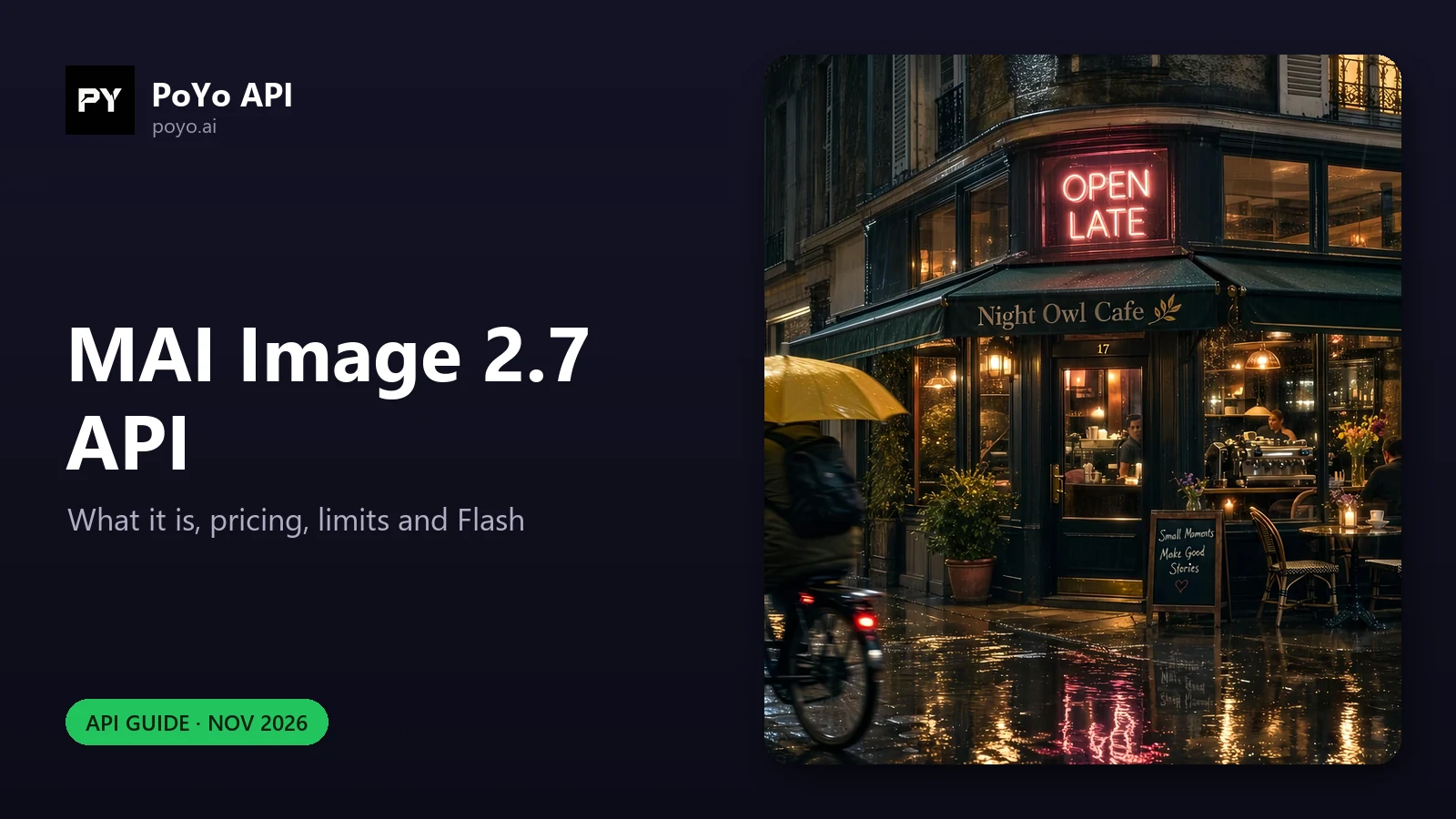
The MAI Image 2.7 API gives you Microsoft AI's newest image model through one REST endpoint on PoYo: mai-image-2.7 for final assets and mai-image-2.7-flash for cheaper, faster jobs. Both take the same request body, generate from a prompt or edit up to 5 reference images, and can return transparent PNG or WebP files. This page covers what MAI Image 2.7 is, the exact limits, the token prices, and what we measured on launch day.
What is MAI Image 2.7?
MAI Image 2.7 is the image generation and editing model from Microsoft AI (MAI), released together with MAI Image 2.7 Flash on November 17, 2026. According to Microsoft's model card, it is a diffusion-based model with 20 billion non-embedding parameters, built for both text-to-image and "precise, controllable image-to-image editing", and MAI Image 2.7 Flash is "an optimized version of MAI Image 2.7".
Microsoft says the model was "rebuilt from the ground up for multimodal editing workflows" and lists object removal, replacement, attribute changes, inpainting, text updates and artifact cleanup (such as motion blur) among its editing actions. Microsoft also says MAI Image 2.7 ranked #1 on Artificial Analysis's AA-Image-Editing v2.1 leaderboard as of November 16, 2026, with 1,215 Elo across 5,478 votes.
For an API integration, that translates into three kinds of request worth sending here:
- Edits that must leave the rest of the image alone: a product color change, a replaced object, a rewritten sign or label.
- Images with in-image text: Microsoft's model card reports "improved rendering of text within generated images, including labels, posters, packaging, and signage".
- Assets that need a real alpha channel: Microsoft says both models "support transparent backgrounds", and PoYo exposes this as
background: "transparent".
MAI Image 2.7 API at a glance
| MAI Image 2.7 | MAI Image 2.7 Flash | |
|---|---|---|
| PoYo model ID | mai-image-2.7 | mai-image-2.7-flash |
| Submit endpoint | POST https://api.poyo.ai/api/generate/submit | Same |
| Result | Poll GET /api/generate/status/{task_id} or use callback_url | Same |
| Input modes | Text-to-image; edit 1 image; combine 2 to 5 images | Same |
| Request fields | prompt, image_urls, size, resolution, background, output_format | Same |
| Microsoft release | November 17, 2026 | November 17, 2026 |
| Docs | MAI Image 2.7 API reference | MAI Image 2.7 Flash reference (same schema) |
The two PoYo schemas differ only in the model ID, so switching tiers is a one-string change. The tier comparison covers when each one pays off.
Limits and request fields
| Field | Rule on PoYo |
|---|---|
prompt | Required, 1 to 32,000 characters, must contain non-whitespace text. Put exact on-image text in quotes. |
image_urls | Optional array of 1 to 5 public HTTP(S) URLs, JPEG, PNG or WebP. One image is edited, several are combined. Reference images are used at up to about 1 megapixel. |
size | 1:1 (default), 4:3, 3:4, 3:2, 2:3, 16:9, 9:16, or a custom WIDTHxHEIGHT |
| Custom size | Both sides divisible by 16, each side at least 768, total at most 4,194,304 pixels; used exactly as given |
resolution | 1K (default, about 1 megapixel, 1:1 is 1024x1024) or 2K (about 4 megapixels, 16:9 is 2720x1536) |
background | opaque (default) or transparent; transparent needs png or webp |
output_format | png (default), jpeg, webp |
| Images per request | 1 |
With image_urls and no size, the output follows the aspect ratio of the first reference image at about 1 megapixel. The 4,194,304-pixel ceiling matches Microsoft's model card, which gives the same "maximum total pixel count" and notes that either side can exceed 2048 while the total stays inside it.
MAI Image 2.7 API pricing
PoYo bills both models by tokens, at the rates in our price list. 1 credit = $0.005.
| Per 1M tokens | MAI Image 2.7 on PoYo | MAI Image 2.7 Flash on PoYo |
|---|---|---|
| Text input | 1,000 credits ($5.00) | 350 credits ($1.75) |
| Image input | 1,600 credits ($8.00) | 500 credits ($2.50) |
| Image output | 6,800 credits ($34.00) | 2,000 credits ($10.00) |
On PoYo, output tokens follow pixel count: about one token per 1,024 pixels. A 1024x1024 image is about 1,024 output tokens, which is about 6.96 credits ($0.035) on MAI Image 2.7 and 2.05 credits ($0.0102) on Flash, plus a small charge for the prompt's text tokens. The pricing breakdown works through every size.
What we measured on launch day
The PoYo team ran these on the PoYo production API on November 19, 2026. Times are submit to result as seen by a client polling every few seconds, so treat them as approximate.
| Request | Output | Cost at current rates | Time |
|---|---|---|---|
mai-image-2.7, 16:9, 2K, png, rainy-night cafe with a neon sign reading "OPEN LATE" | 2720x1536 | 27.802 credits (about $0.139) | About 66 s |
mai-image-2.7-flash, same request | 2720x1536 | 8.1803 credits (about $0.041) | About 42 s |
mai-image-2.7-flash, 1:1, 1K, background: transparent, png | 1024x1024 RGBA, fully transparent background | 2.062 credits (about $0.0103) | About 42 s |
In both cafe runs the sign read "OPEN LATE" exactly as written in the prompt. The transparent run returned a real alpha channel, not a white or checkerboard background; the transparent background guide shows the full request.
Your first MAI Image 2.7 API request
curl https://api.poyo.ai/api/generate/submit \
  -H "Authorization: Bearer $POYO_API_KEY" \
  -H "Content-Type: application/json" \
  -d '{
    "model": "mai-image-2.7",
    "input": {
      "prompt": "A university campus poster at dusk with the title \"Open Day 2026\", photorealistic, cinematic light",
      "size": "16:9",
      "resolution": "2K"
    }
  }'
The response carries data.task_id with status not_started. Poll the status endpoint until it is finished and read the image from data.files[0].file_url, or pass a top-level callback_url to receive a POST when the task ends. Always check the code field in the body: some validation errors return HTTP 200 with code: 400. The API guide has a bounded Python polling loop and a JSON body for every input mode.
Where MAI Image 2.7 is available
Microsoft offers MAI Image 2.7 as a hosted model, not downloadable weights. It is in public preview on Microsoft Foundry, where Microsoft's documentation lists MAI-Image-2.7 and MAI-Image-2.7-Flash (version 2026-11-02) under Global Standard deployment, and you can try it in MAI Labs, which Microsoft describes as intended for personal, non-commercial use.
On PoYo you call both models with the API key you use for every other model, with no Azure subscription or deployment step. PoYo's request shape also differs from Foundry's: one JSON endpoint takes image_urls for edits (Foundry uses a separate multipart edits endpoint), and you choose an aspect ratio plus 1K/2K or a custom size instead of raw width and height.
Which requests to route where
| Request | Model to call |
|---|---|
| Final hero images, precise edits, text-heavy posters and packaging | mai-image-2.7 |
| Drafts, previews, thumbnails, high-volume catalog and sticker jobs | mai-image-2.7-flash |
| Prompts that need live web facts (current events, real places) | mai-image-2.6 with enable_web_search, see MAI Image 2.6 |
MAI Image 2.7 does not accept the web search option that MAI Image 2.6 has. Everything else in a 2.6 request carries over; the 2.7 vs 2.6 comparison lists the field changes and the migration diff.
Frequently asked questions
What is the MAI Image 2.7 API model ID?
Use mai-image-2.7 for the flagship and mai-image-2.7-flash for Flash. mai-image-2-7 is only the PoYo page slug and is rejected as a model ID.
How much does the MAI Image 2.7 API cost? On PoYo, MAI Image 2.7 costs $5.00 / $8.00 / $34.00 per 1M text input, image input and output tokens, and Flash costs $1.75 / $2.50 / $10.00. A 1024x1024 image works out to about $0.035 on MAI Image 2.7 and about $0.0102 on Flash.
Can the MAI Image 2.7 API generate new images, or only edit?
Both. A request with only prompt generates a new image. Adding 1 to 5 URLs in image_urls turns the same request into an edit or a multi-image composition.
Does the MAI Image 2.7 API support transparent backgrounds?
Yes. Send "background": "transparent" with "output_format": "png" or "webp". Our launch-day Flash test returned a 1024x1024 RGBA PNG with a fully transparent background.
What is the largest image the MAI Image 2.7 API can return?
4,194,304 pixels, for example 2048x2048 or a custom 3072x1344. At 2K, 16:9 returns 2720x1536.
How long does a MAI Image 2.7 API request take?
In our November 19, 2026 test, a 2K 16:9 image took about 66 seconds on MAI Image 2.7 and about 42 seconds on Flash. Use polling with a deadline or a callback_url rather than holding a request open.