Model icon
claude-fable-5-1
Chat
Model:
Claude Fable 5.1 supports long-horizon agentic coding, research, vision, knowledge work, 1M context, and up to 128K output.
Chat

This Playground is for demo purposes. Data is only valid in the current window and will be cleared on refresh.

Type a message...

Configuration
1.0
1.0
Pricing details

Transparent pricing with no hidden fees. Pay as you go.

Anthropicclaude-fable-5-1
Input
PoYo price
$8.00/1M tokens
1600 credits
Official price
$10.00/1M tokens
Official
You save
20%
Anthropicclaude-fable-5-1
Cache read
PoYo price
$0.200/1M tokens
40 credits
Official price
$0.250/1M tokens
Official
You save
20%
Anthropicclaude-fable-5-1
Output
PoYo price
$40.00/1M tokens
8000 credits
Official price
$50.00/1M tokens
Official
You save
20%

* Actual fees are based on the final output.

Anthropic's most capable generally available model

Complete guide to using Claude Fable 5.1 API for Long-Horizon Coding and Knowledge Work

Claude Fable 5.1 API for Long-Horizon Coding and Knowledge Work

Claude Fable 5.1 is Anthropic's most capable generally available model, released on September 1, 2026. It is built for demanding reasoning, multi-day agentic coding, multistep research, and document, spreadsheet, and slide work.

Claude Fable 5.1 model access

01

Claude Fable 5.1

Use model ID claude-fable-5-1. Anthropic positions Fable 5.1 for demanding reasoning and long-horizon agentic work when Claude Opus 5 still falls short.
View API docs

Key Features of Claude Fable 5.1 API

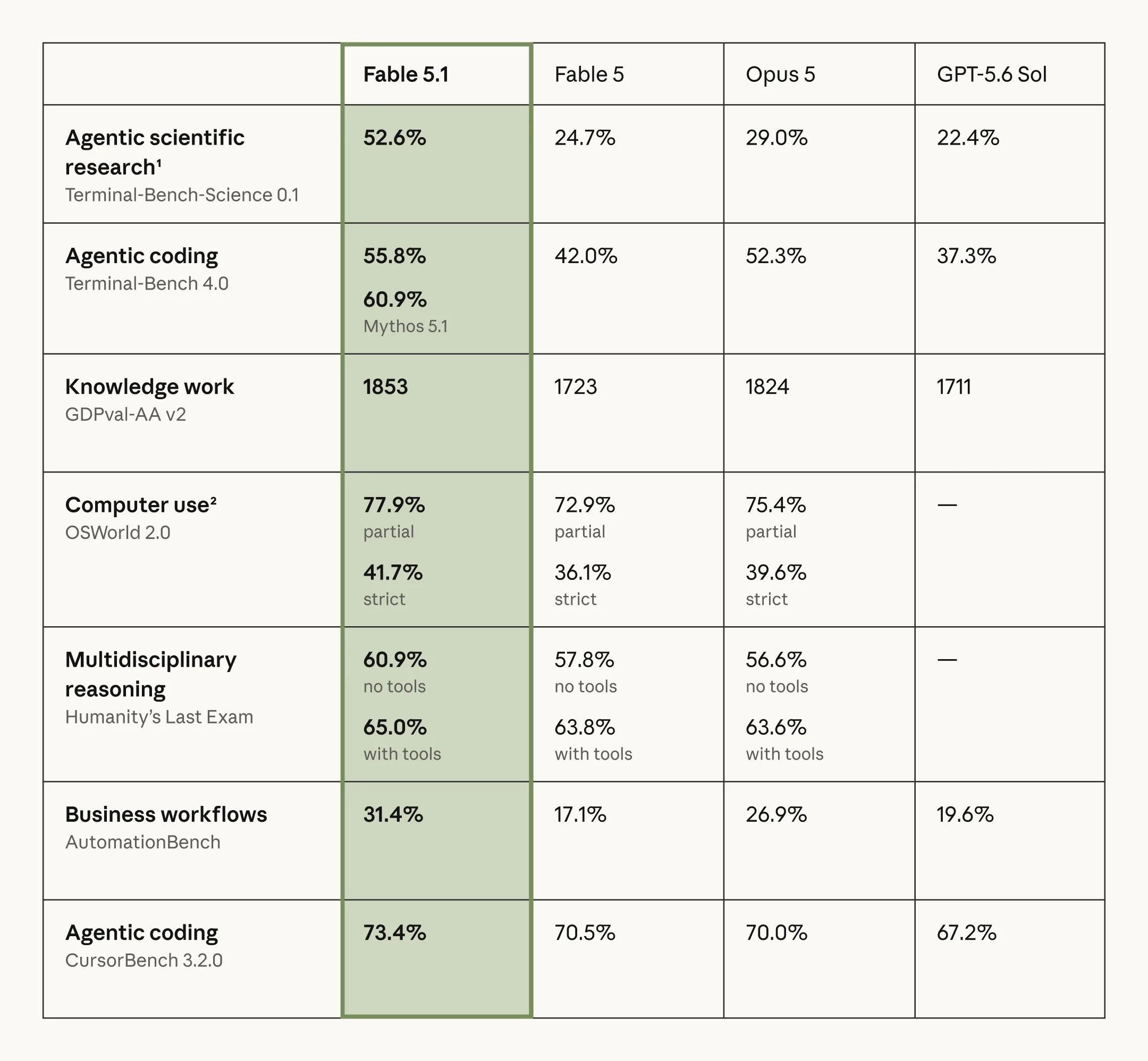
Official Anthropic launch materials show a large jump over Fable 5 on agentic science, coding, computer use, and knowledge work, plus 75% cheaper cache reads.

01

A new performance frontier on agentic benchmarks

Anthropic reports Claude Fable 5.1 at 52.6% on Terminal-Bench-Science 0.1, versus 24.7% for Fable 5, 29.0% for Opus 5, and 22.4% for GPT-5.6 Sol. It also leads the published Fable 5.1 table on Terminal-Bench 4.0, AutomationBench, CursorBench 3.2.0, and Humanity's Last Exam.

  • Terminal-Bench-Science 0.1: 52.6% vs 24.7% on Fable 5
  • Terminal-Bench 4.0: 55.8% vs 42.0% on Fable 5
  • AutomationBench: 31.4% vs 17.1% on Fable 5
Official Claude Fable 5.1 benchmark comparison table

02

Scientific research, including protein binder design

Anthropic used Fable 5.1 and Mythos 5.1 on molecular design, computational biology, and planetary mapping. In protein design tests, lab-confirmed binders reached nearly a 50% hit rate across 12 targets, compared with typical 10–15% hit rates in protein design today.

  • Lab-confirmed protein binders across 12 targets
  • GPU kernel optimizations that sped up seven open-source biology models by up to 2.5x
  • Useful for research analysis, not a substitute for lab validation

03

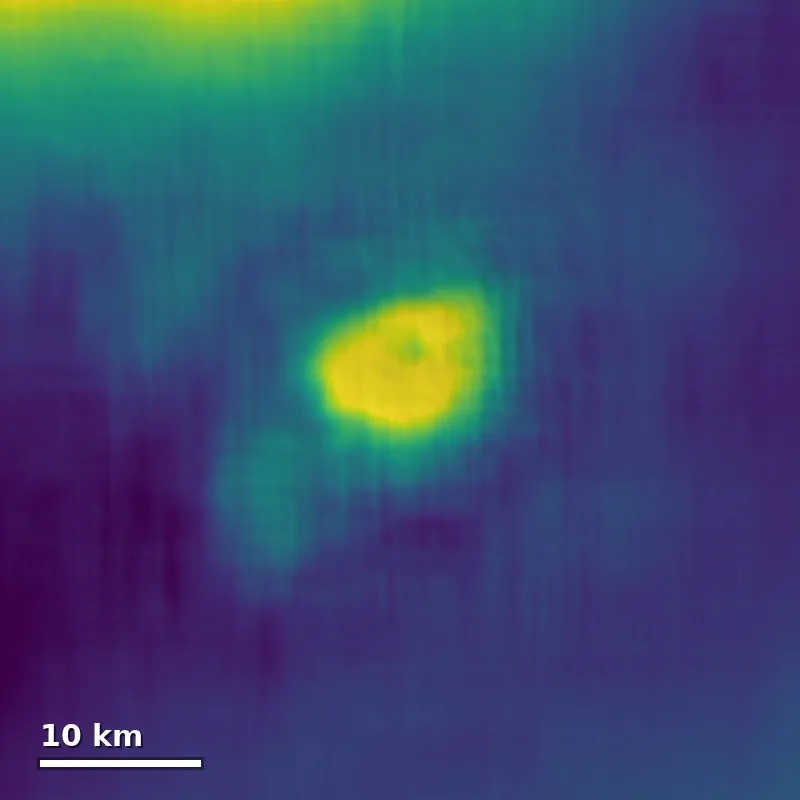
Computational mapping from Magellan radar to a new Venus DEM

Claude Fable 5.1 trained a neural network on NASA Magellan radar and an existing map covering one-fifth of Venus. Anthropic says the new elevation map covers a third of the planet, resolves details down to two to three kilometers instead of 10 to 20, and improves height accuracy by up to 25%.

  • Input: Magellan radar plus an existing lower-resolution elevation map
  • Output: a higher-resolution digital elevation model
  • Released by Anthropic under a Creative Commons license
Official Claude Fable 5.1 Venus elevation map compared with Magellan radar

04

Long-running agents with cheaper cache reads

Base input and output prices stay at the Fable 5 rates, but cache reads drop 75% to $0.25 per million tokens officially. Anthropic estimates typical workloads cost about 25% less than Fable 5, and highly agentic workloads up to about 45% less. PoYo keeps the same 20% discount on those official rates.

  • 1M token context window and up to 128K output tokens
  • Adaptive thinking is always on; default effort is high
  • Official cache reads: $0.25 / 1M tokens; PoYo: $0.20 / 1M tokens

Best use cases for Claude Fable 5.1 API

01

Ambitious coding projects

Use Fable 5.1 for repository-scale features, code review, performance work, and multi-day autonomous coding sessions that need root-cause debugging.

02

Long-running agents

Run jobs that take hours, span tools and apps, recover from failed steps, and keep sending progress updates without constant supervision.

03

Enterprise knowledge work

Hand off deep research, analysis, documents, spreadsheets, and slides, then review completed deliverables instead of supervising every step.

04

Research and scientific analysis

Analyze technical papers, experimental notes, diagrams, and long research trails where earlier models lose the thread.

05

Vision-heavy professional work

Read charts, nested tables, PDFs, and design screenshots, then check coding output against the original visual goal.

06

Cost-sensitive agent loops

Keep Fable-class quality on cached, tool-heavy loops. Official cache reads are 75% cheaper than Fable 5, which is where long agent runs spend most of the bill.

Claude Fable 5.1 vs Claude Opus 5 vs Claude Fable 5

Anthropic's docs compare Claude Fable 5.1 with Claude Opus 5 first, then with Claude Fable 5. Start with Opus 5 for most workloads and move to Fable 5.1 for demanding reasoning and long-horizon agentic work, or when Opus 5 at higher effort still falls short. Uncached, Fable 5.1 is twice Opus 5 ($10 / $50 vs $5 / $25). Cache reads invert: $0.25 vs $0.50. Versus Fable 5, input and output stay the same while cache reads drop 75%.

FeatureClaude Fable 5.1Claude Opus 5Claude Fable 5
Model IDclaude-fable-5-1claude-opus-5claude-fable-5
ReleasedSeptember 1, 2026July 24, 2026June 9, 2026
PositioningDemanding reasoning and long-horizon agentic workRecommended default for most Claude workloadsPrevious Fable-class general-use model
Context window1M tokens1M tokens1M tokens
Max output128K tokens128K tokens128K tokens
Official input / output$10 / $50 per 1M tokens$5 / $25 per 1M tokens$10 / $50 per 1M tokens
Cache read$0.25 per 1M tokens (0.025x input)$0.50 per 1M tokens (0.1x input)$1.00 per 1M tokens (0.1x input)
Cache write (5m / 1h)$12.50 / $20 per 1M tokens$6.25 / $10 per 1M tokens$12.50 / $20 per 1M tokens
PoYo price1600 / 8000 / 40 credits per 1M tokens ($8 / $40 / $0.20)400 / 2000 credits per 1M tokens ($2 / $10)Not listed on PoYo
LatencySlowerModerateSlower
ThinkingAdaptive, always on; cannot be disabledAdaptive; can be disabled at high or belowAdaptive, always on
Default efforthighhighhigh
Knowledge cutoffJune 2026May 2026January 2026
Fast modeNoYes (research preview, $10 / $50)No
Terminal-Bench-Science 0.152.6%29.0%24.7%
Terminal-Bench 4.055.8%52.3%42.0%
AutomationBench31.4%26.9%17.1%
Best fitLong-horizon coding, research, and prefix-heavy agentsMost production coding, chat, and enterprise workEarlier Fable-class workloads before the 5.1 upgrade

Sources: Anthropic Claude Fable 5.1 overview and pricing (September 1, 2026). Benchmark scores are Anthropic's published figures with production safeguards enabled. PoYo prices are 20% below official Fable 5.1 rates; Opus 5 PoYo rates follow the live catalog.

How to use Claude Fable 5.1 API

Create a PoYo API key
Get API Key

Set the model ID
Use claude-fable-5-1 as the model ID in your request.

Choose an endpoint
Use the OpenAI-compatible endpoint /v1/chat/completions, or the Anthropic-native endpoint /v1/messages.

Open API docs
View API docs

Claude Fable 5.1 API FAQ

What is Claude Fable 5.1?

Claude Fable 5.1 is Anthropic's most capable generally available model, released on September 1, 2026. It is built for demanding reasoning, long-horizon agentic coding, multistep research, and document, spreadsheet, and slide work. On PoYo, call it with model ID claude-fable-5-1.

What is the Claude Fable 5.1 model ID?

Use claude-fable-5-1. There is no date suffix. The same ID works on PoYo through OpenAI-compatible /v1/chat/completions and Anthropic-native /v1/messages.

How much does Claude Fable 5.1 cost?

Official Anthropic rates are $10 input, $50 output, and $0.25 cache read per million tokens—the same input and output as Fable 5, with cache reads cut 75%. PoYo charges 1600, 8000, and 40 credits per million tokens, about $8, $40, and $0.20, which is 20% below official. Batch API input and output are 50% off official token rates.

What is the Claude Fable 5.1 context window?

1 million tokens, with up to 128K output tokens on the synchronous Messages API. Input is text and images; output is text. The reliable knowledge cutoff is June 2026, the newest among current Claude models.

What's the difference between Claude Fable 5.1 and Claude Fable 5?

Fable 5.1 keeps Fable 5's $10 / $50 token prices, drops cache reads from $1.00 to $0.25, defaults to high effort, and posts large gains on agentic science, coding, computer use, and knowledge work. Anthropic also documents three breaking changes: forced tool_choice returns 400, older models cannot read Fable 5.1 thinking blocks, and editing earlier turns can invalidate later thinking blocks.

Is Claude Fable 5.1 better than Claude Opus 5?

On Anthropic's published table, yes, with gaps from 1.4 points to 23.6 points. The largest lead is Terminal-Bench-Science 0.1 (52.6% vs 29.0%). Most other gaps are under five points. Uncached, Fable 5.1 costs twice as much as Opus 5. Anthropic still recommends starting with Opus 5 and moving to Fable 5.1 only when Opus 5 at higher effort falls short.

When should I use Fable 5.1 instead of Opus 5?

Use Fable 5.1 for long-horizon research and terminal agents, business workflow automation, dense document vision, or prefix-heavy agent loops where cheaper cache reads can offset the 2x uncached price. Stay on Opus 5 for most production work, latency-sensitive routes, classification, or jobs that need thinking disabled or Opus 5 fast mode.

How does Claude Fable 5.1 reduce agent costs?

Base input and output prices did not change. Cache reads fell 75% to $0.25 per million tokens (0.025x input, versus 0.1x on other Claude models). Anthropic estimates typical workloads cost about 25% less than Fable 5, and highly agentic workloads up to about 45% less. PoYo keeps a further 20% discount, so cache reads are $0.20 per million tokens.

Is Claude Fable 5.1 good for coding?

Yes. Anthropic positions it for long-running agentic coding, repository-scale features, root-cause debugging, and multi-day sessions. It leads Anthropic's published Terminal-Bench 4.0 (55.8%) and CursorBench 3.2.0 (73.4%) table among Fable 5, Opus 5, and GPT-5.6 Sol. Use it when Opus 5 at higher effort still misses, not as the default for every coding request.

When was Claude Fable 5.1 released?

September 1, 2026. Anthropic lists it as active (latest), with a retirement commitment of not sooner than September 1, 2027.

Can I disable thinking on Claude Fable 5.1?

No. Adaptive thinking is always on. Steer depth with the effort parameter: low, medium, high (default), xhigh, and max. Anthropic says gains over Fable 5 are largest at higher effort, while medium often matches Fable 5 at lower cost.

Which Claude Fable 5.1 API endpoints are available on PoYo?

Use /v1/chat/completions for OpenAI-compatible chat requests or /v1/messages for Anthropic-native Messages API requests. Set the model to claude-fable-5-1 in either case.

Is Claude Mythos 5.1 available on PoYo?

No. Mythos 5.1 is invitation-only from Anthropic through Project Glasswing. Fable 5.1 is the generally available model with the same specifications and token prices, plus additional safeguards for biology and cybersecurity.

Why use Claude Fable 5.1 on PoYo

01

One API key

Call Fable 5.1 with the same PoYo key you already use for other chat, image, and video models.

02

Two request formats

Use OpenAI-compatible Chat Completions or Anthropic-native Messages with one model ID.

03

20% below official

Input, output, and cache-read rates stay aligned to Anthropic's published Fable 5.1 prices, then discounted 20%.

04

Playground and status

Test prompts on the model page, watch service status, and review pricing before moving the same model ID into production.