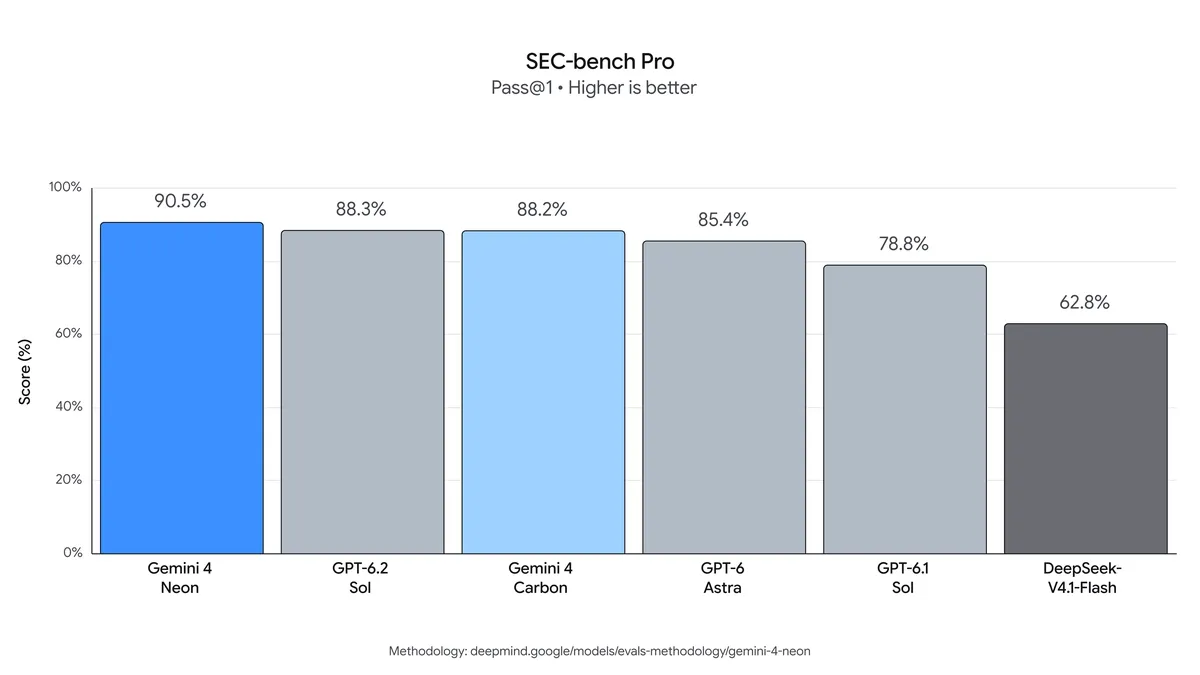
What is Gemini 4 Neon?
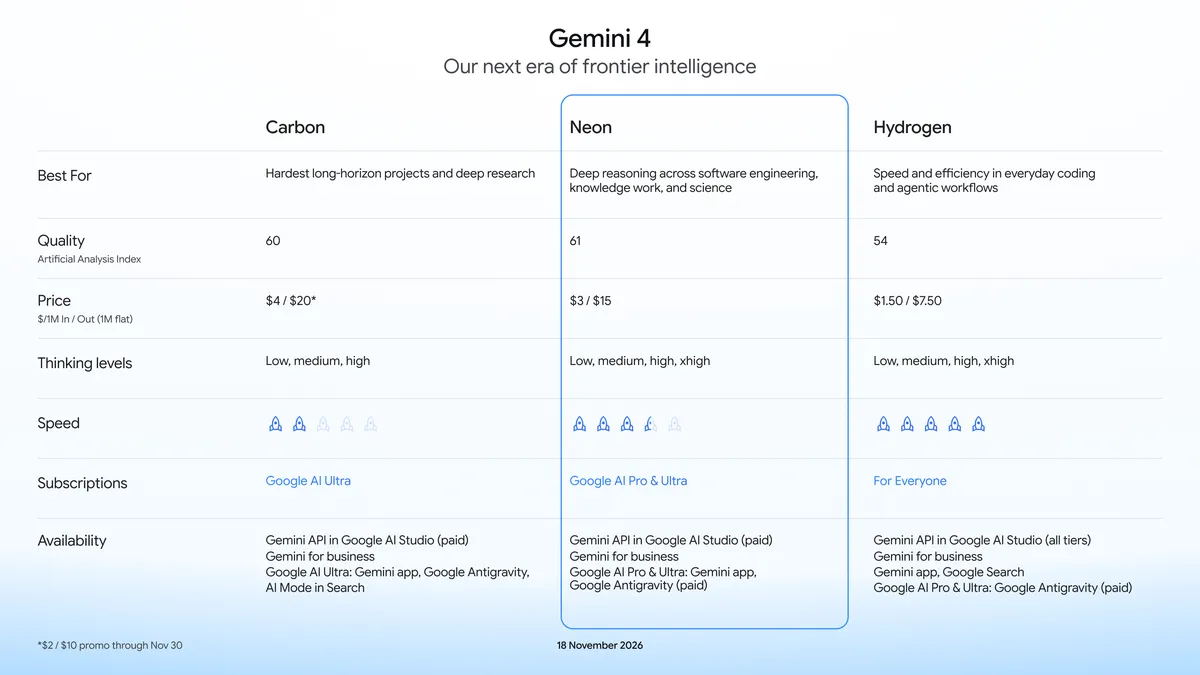
Gemini 4 Neon (model ID: gemini-4-neon) is Google DeepMind's high-speed frontier reasoning model released on November 18, 2026. Adapted from Gemini 4 Carbon and positioned between Gemini 4 Hydrogen and Carbon, the Gemini 4 Neon API combines a unified 1M-token multimodal context window, four thinking levels (low, medium, high, xhigh), and fast end-to-end execution for coding, agentic workflows, knowledge work, and science.
How much does the Gemini 4 Neon API cost on PoYo compared to Google?
Google's official global standard pricing for the Gemini 4 Neon API is $3.00 per 1M input tokens, $15.00 per 1M output tokens (including thinking tokens), and $0.15 per 1M cached input tokens. On PoYo, the Gemini 4 Neon API costs $2.40 per 1M input tokens (480 credits), $12.00 per 1M output tokens (2,400 credits), and $0.12 per 1M cache read tokens (24 credits) — a flat 20% discount off official pricing.
Is there a free tier for the Gemini 4 Neon API?
No. Google lists gemini-4-neon as paid-tier only on the Gemini API and Google AI Studio with no free API quota. On PoYo, you can use the Gemini 4 Neon API pay-as-you-go with credits at 20% off official rates and test it directly in the web Playground before deploying.
How does Gemini 4 Neon compare to Gemini 4 Carbon and Gemini 4 Argon?
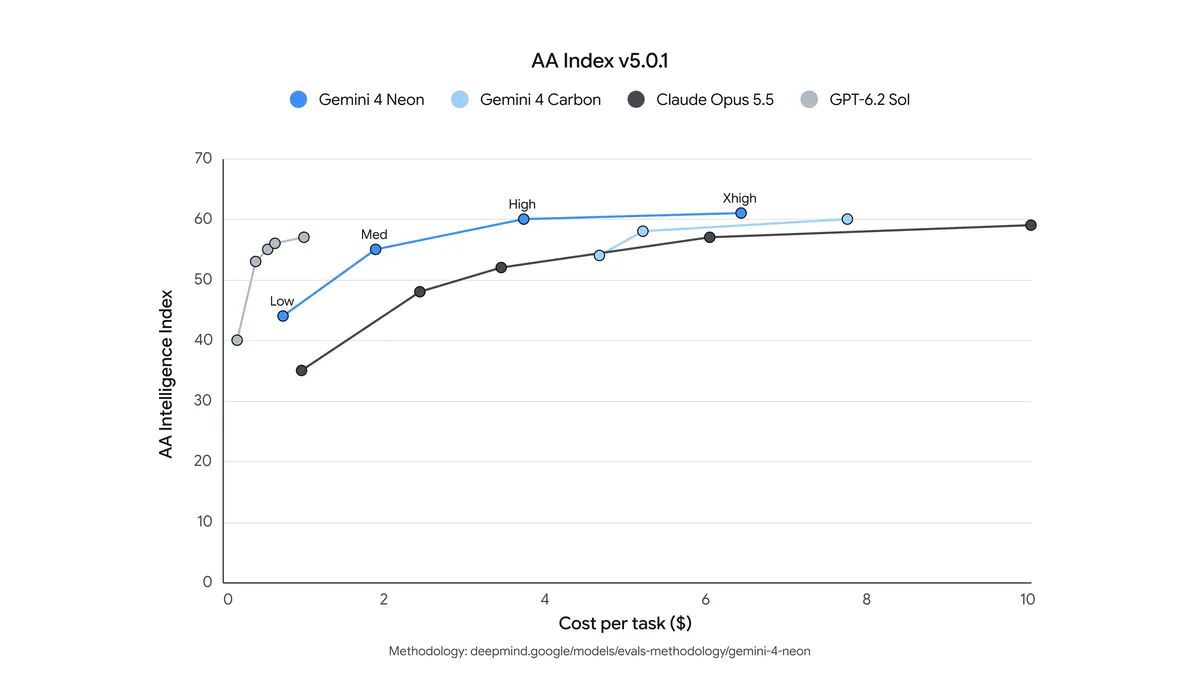
In the Gemini 4 lineup, the Gemini 4 Neon API sits between Hydrogen and Carbon. Compared with Gemini 4 Carbon (official $4/$20 standard, $2/$10 promo through Nov 30, max thinking high), Gemini 4 Neon adds an xhigh thinking level, runs roughly twice as fast, achieves a 32% lower cost per task at default high thinking, and scores 61 on the Artificial Analysis Intelligence Index (vs Carbon's 60 and Argon's 50). Compared with earlier Gemini 4 Argon, the Gemini 4 Neon API delivers major gains in coding agents, steerability, and scientific reasoning.
What thinking levels does the Gemini 4 Neon API support, and how are thinking tokens billed?
The Gemini 4 Neon API supports four configurable thinking levels: low, medium, high (default), and xhigh. Use low or medium for low-latency interactive tasks, high for balanced agentic work, and xhigh for peak reasoning depth. As with Google's official billing, internal thinking tokens are counted and billed as part of output tokens.
What is the context window and maximum output length of the Gemini 4 Neon API?
The Gemini 4 Neon API provides a unified 1,048,576-token (1M) context window shared across input, thinking, and output tokens. Synchronous output defaults to a 64K-token limit per response, with long-decode support extending up to 1M tokens.
How does Gemini 4 Neon compare to Claude Opus 5.5 and GPT-6.2 Sol?
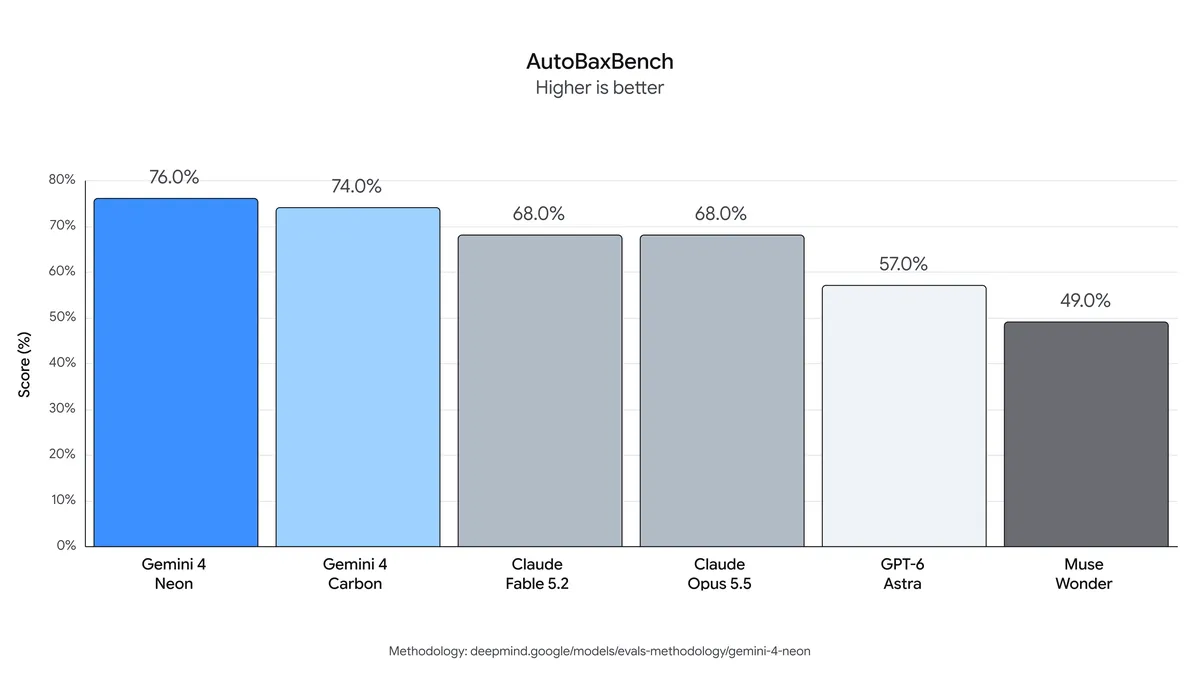
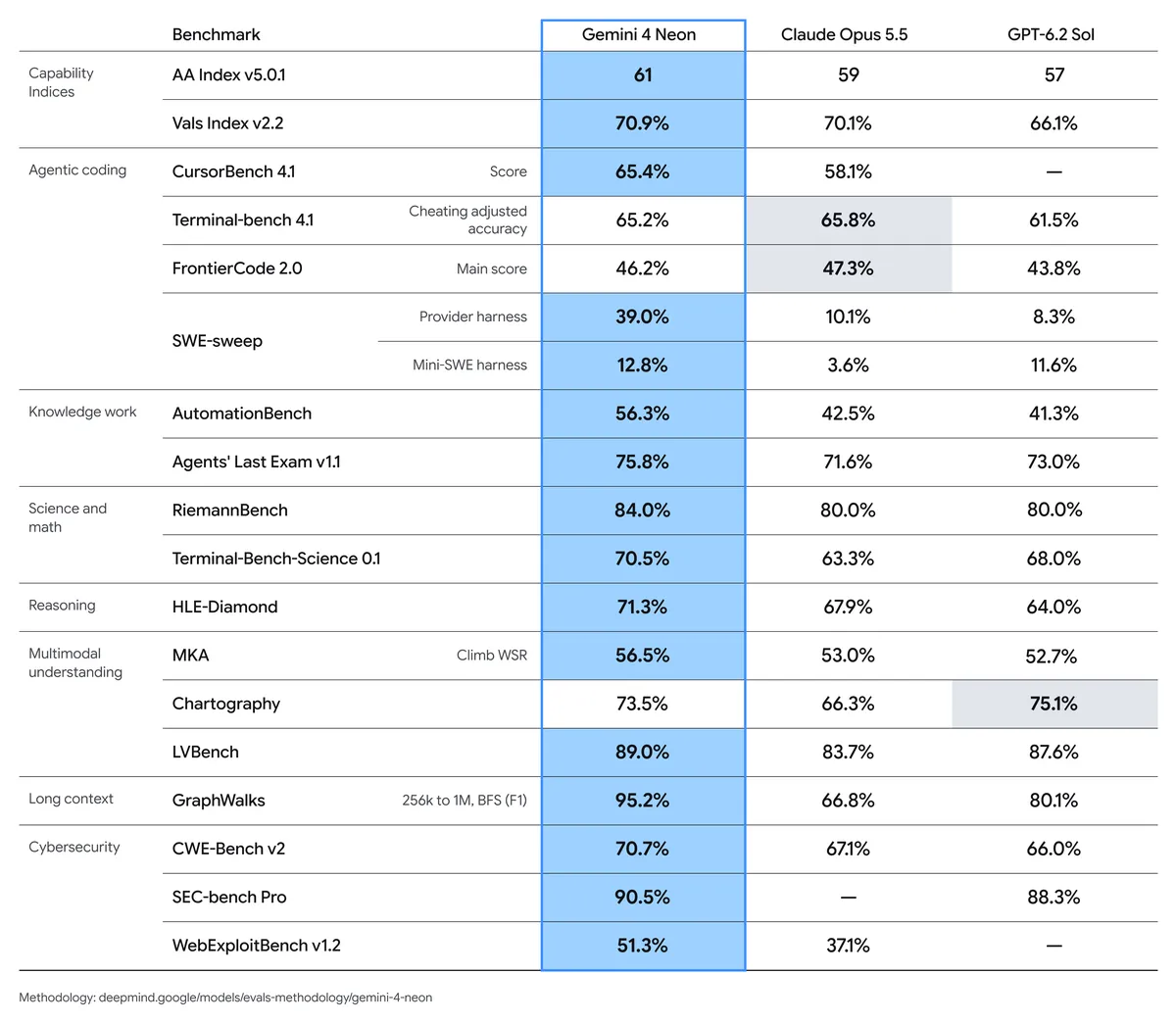
On Google DeepMind's November 2026 benchmark table, Gemini 4 Neon leads Claude Opus 5.5 and GPT-6.2 Sol on AA Index v5.0.1 (61 vs 59 and 57), Vals Index v2.2 (70.9% vs 70.1% and 66.1%), CursorBench 4.1 (65.4% vs 58.1%), AutomationBench (56.3% vs 42.5% and 41.3%), RiemannBench (84.0% vs 80.0%), and GraphWalks 256K–1M (95.2% vs 66.8% and 80.1%). Claude Opus 5.5 edges ahead on Terminal-Bench 4.1 (65.8% vs 65.2%) and FrontierCode 2.0 (47.3% vs 46.2%), while GPT-6.2 Sol leads on Chartography (75.1% vs 73.5%).
How do I call the Gemini 4 Neon API with the OpenAI SDK or Gemini native format?
For OpenAI SDKs, set base_url to https://api.poyo.ai/v1, pass your PoYo bearer key, and set model to gemini-4-neon. For native Gemini 4 Neon API requests (including thinking_level, includeThoughts, and native multimodal parts), POST to https://api.poyo.ai/v1beta/models/gemini-4-neon:generateContent or :streamGenerateContent.