
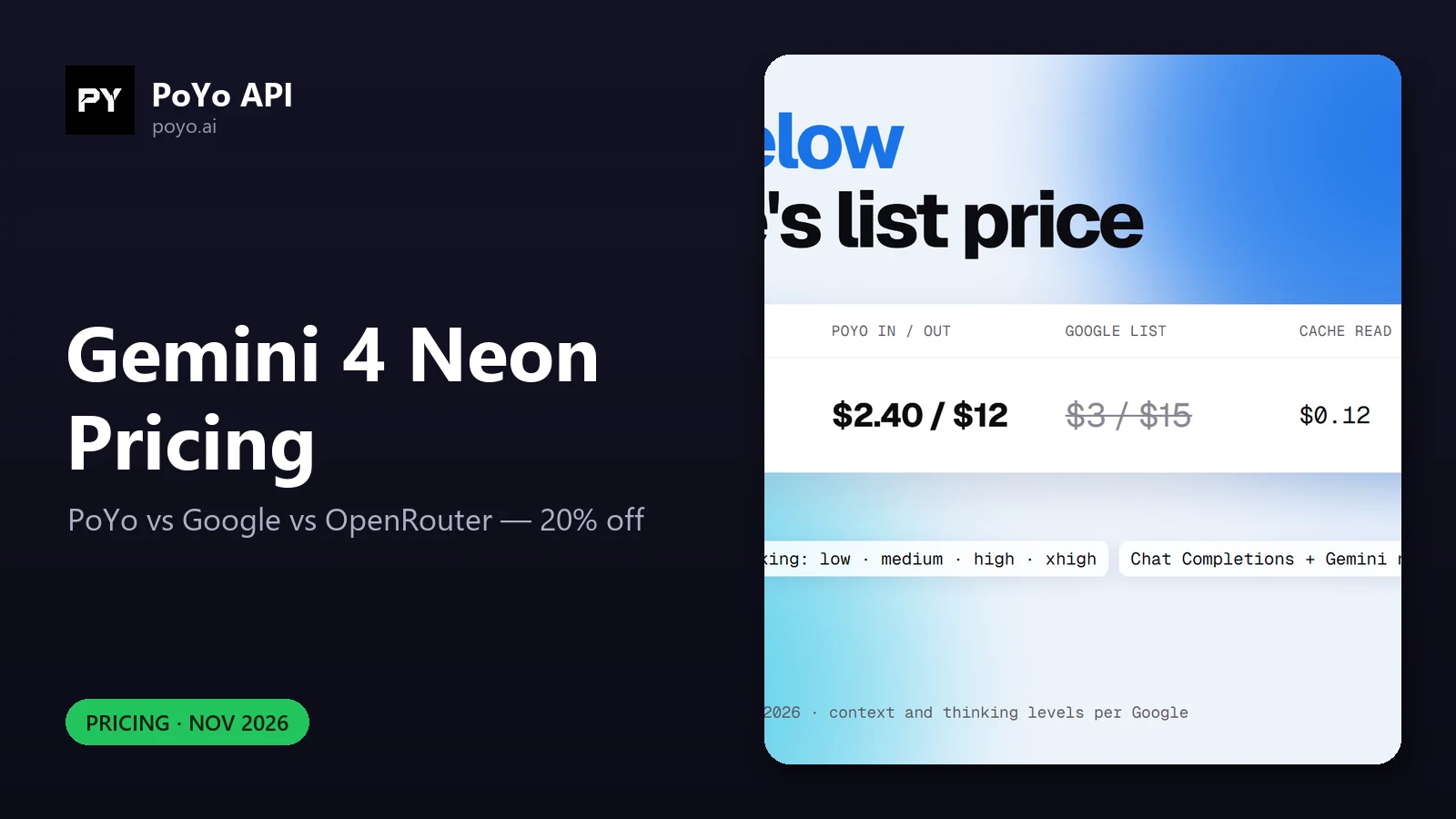
Gemini 4 Neon API pricing on PoYo is $2.40 per 1M input tokens, $12.00 per 1M output tokens, and $0.12 per 1M cache-read tokens for the model ID gemini-4-neon, 20% below Google's list price on every meter. This post puts PoYo, Google, and OpenRouter side by side, works out four real request shapes, and lists what is and isn't billed. Current PoYo rates are always on the Gemini 4 Neon model page.
PoYo prices are as listed on November 23, 2026. Google prices come from its Gemini API pricing page and OpenRouter prices from its public models API, both read on November 23, 2026.
Gemini 4 Neon API price per 1M tokens
| Meter (per 1M tokens) | PoYo | PoYo credits | Google (paid tier, standard) | OpenRouter |
|---|---|---|---|---|
| Input | $2.40 | 480 | $3.00 | $3.00 |
| Output, incl. thinking tokens | $12.00 | 2,400 | $15.00 | $15.00 |
| Cache read | $0.12 | 24 | $0.15 | $0.15 |
One PoYo credit is $0.005, so 480 credits = $2.40. Google lists Neon on its paid tier only: "Gemini 4 Neon is not available on the Free tier." OpenRouter lists the same per-token prices as Google.
PoYo's prices cover the synchronous endpoints: POST /v1/chat/completions and POST /v1beta/models/gemini-4-neon:generateContent / :streamGenerateContent. Request shapes for both are in the Gemini 4 Neon API guide.
What is and is not billed
| Item | Billed? | Source |
|---|---|---|
| Prompt tokens (text and media) | Yes, input rate | PoYo price list |
| Visible answer tokens | Yes, output rate | PoYo price list |
| Thinking tokens | Yes, output rate. Google: "Every token the model processes is counted and billed, including thinking tokens" | Google pricing page |
| Prompt tokens served from cache | Yes, cache-read rate ($0.12 per 1M on PoYo) | PoYo price list |
| Explicit cache creation or storage | Not applicable: Google lists "Implicit caching only (explicit caching is not supported)" | Google pricing page |
| Free quota | None at Google | Google pricing page |
| Google Search / Maps grounding | Google: 5,000 free requests a month, then $14 per 1,000. PoYo's documented request schema has no grounding field | Google pricing page, PoYo docs |
Because caching is implicit, you can't force a cache hit. You make one likely by keeping a long, identical prefix (system prompt, repository snapshot, document) at the start of each request.
Worked Gemini 4 Neon API cost examples
Token counts below are request shapes you can replace with your own. Output counts include thinking tokens.
1. Repository review: 200K input, 8K output
PoYo:    200,000 × $2.40 / 1M = $0.480    8,000 × $12.00 / 1M = $0.096   total $0.576 (115.2 credits)
Google:  200,000 × $3.00 / 1M = $0.600    8,000 × $15.00 / 1M = $0.120   total $0.720
2. Agent loop: 12 turns, about 60K input and 3K output per turn
Each turn resends the history, so the run adds up to 720K input and 36K output tokens.
| Case | PoYo | |
|---|---|---|
| No cache hits | $1.728 + $0.432 = $2.160 (432 credits) | $2.160 + $0.540 = $2.700 |
| 80% of input served from cache (576K cached, 144K fresh) | $0.346 + $0.069 + $0.432 = $0.847 (169.3 credits) | $0.432 + $0.086 + $0.540 = $1.058 |
The second row shows why a stable prefix matters more than the per-token discount: cache reads cost 5% of fresh input. Treat it as a best case, since implicit caching is not guaranteed.
3. Chat feature: 100,000 requests a month, 2,000 input and 500 output each
PoYo:    200M input × $2.40 = $480     50M output × $12.00 = $600    total $1,080 / month (216,000 credits)
Google:  200M input × $3.00 = $600     50M output × $15.00 = $750    total $1,350 / month
One such request costs $0.0108 (2.16 credits) on PoYo.
4. The same question at two thinking levels
Thinking tokens are billed as output, so the thinking level changes the bill more than the prompt does. Take a 1,500-token prompt with a 1,000-token answer, and assume (for illustration only, not a measurement) 1,500 thinking tokens at low and 6,000 at xhigh:
| Thinking level | Output billed | PoYo cost |
|---|---|---|
low | 2,500 tokens | $0.0036 + $0.0300 = $0.0336 |
xhigh | 7,000 tokens | $0.0036 + $0.0840 = $0.0876 |
Measure your own thinking counts from usage before choosing a default level.
Gemini 4 Neon vs Carbon and Argon on price
| PoYo price (per 1M tokens) | Input | Output | Cache read |
|---|---|---|---|
gemini-4-neon | $2.40 | $12.00 | $0.12 |
gemini-4-carbon | $1.60 | $8.00 | $0.08 |
gemini-4-argon | $1.60 | $8.00 | $0.16 |
Neon costs 1.5× Carbon per token on PoYo. Google says Neon reaches a 32% lower cost per task than Carbon at the default high level, because it finishes tasks with fewer tokens. That figure is Google's, computed at Google's prices. On PoYo, Neon is cheaper per task than Carbon only when it uses less than two-thirds of Carbon's tokens for the same job. Run both on a sample of your traffic and compare usage before you switch. The full routing comparison is in Gemini 4 Neon API vs Gemini 4 Carbon, and Carbon's own pricing is in Gemini 4 Carbon API pricing.
How to keep the Gemini 4 Neon API bill down
- Cap output. Set
max_tokensormaxOutputTokenson every request; output is five times the input price. - Pick the thinking level per route. Google's default is
high. Keepxhighfor the requests that need it. - Front-load stable context. Same system prompt and documents first, changing question last.
- Trim agent history. Summarize old tool output instead of resending it every turn.
- Route bulk work by price. Jobs where speed doesn't matter can go to
gemini-4-carbonorgemini-4-argonat $1.60 / $8.00.
Estimate a month before you ship
A quick estimate needs three numbers from a sample of real requests: average input tokens, average output tokens (read from usage, so thinking is included), and monthly request count. Multiply input by $2.40 and output by $12.00 per 1M, then add 10–20% headroom for retries and longer-than-average answers. Re-run the estimate after a week of production logs, since thinking counts vary with prompt difficulty. For per-request reconciliation, the field mapping and a cost function are in the Gemini 4 Neon API guide.
Frequently asked questions
How much does the Gemini 4 Neon API cost?
On PoYo: $2.40 per 1M input tokens (480 credits), $12.00 per 1M output tokens (2,400 credits), and $0.12 per 1M cache-read tokens (24 credits).
Is the Gemini 4 Neon API cheaper on PoYo than on Google?
Yes, by 20% on each meter. Google's paid-tier price is $3.00 input, $15.00 output, and $0.15 cached input per 1M tokens (read November 23, 2026).
Are Gemini 4 Neon thinking tokens billed?
Yes. Google bills thinking tokens at the output rate, and PoYo follows the same meter: $12.00 per 1M on PoYo.
Is there a free Gemini 4 Neon API tier?
No. Google says Neon is not available on its Free tier. PoYo bills pay-as-you-go credits with no monthly commitment.
Is the Gemini 4 Neon API cheaper than Gemini 4 Carbon?
Not per token. On PoYo, Carbon is $1.60 / $8.00 per 1M and Neon is $2.40 / $12.00. Google says Neon uses fewer tokens per task; measure that on your own workload.