
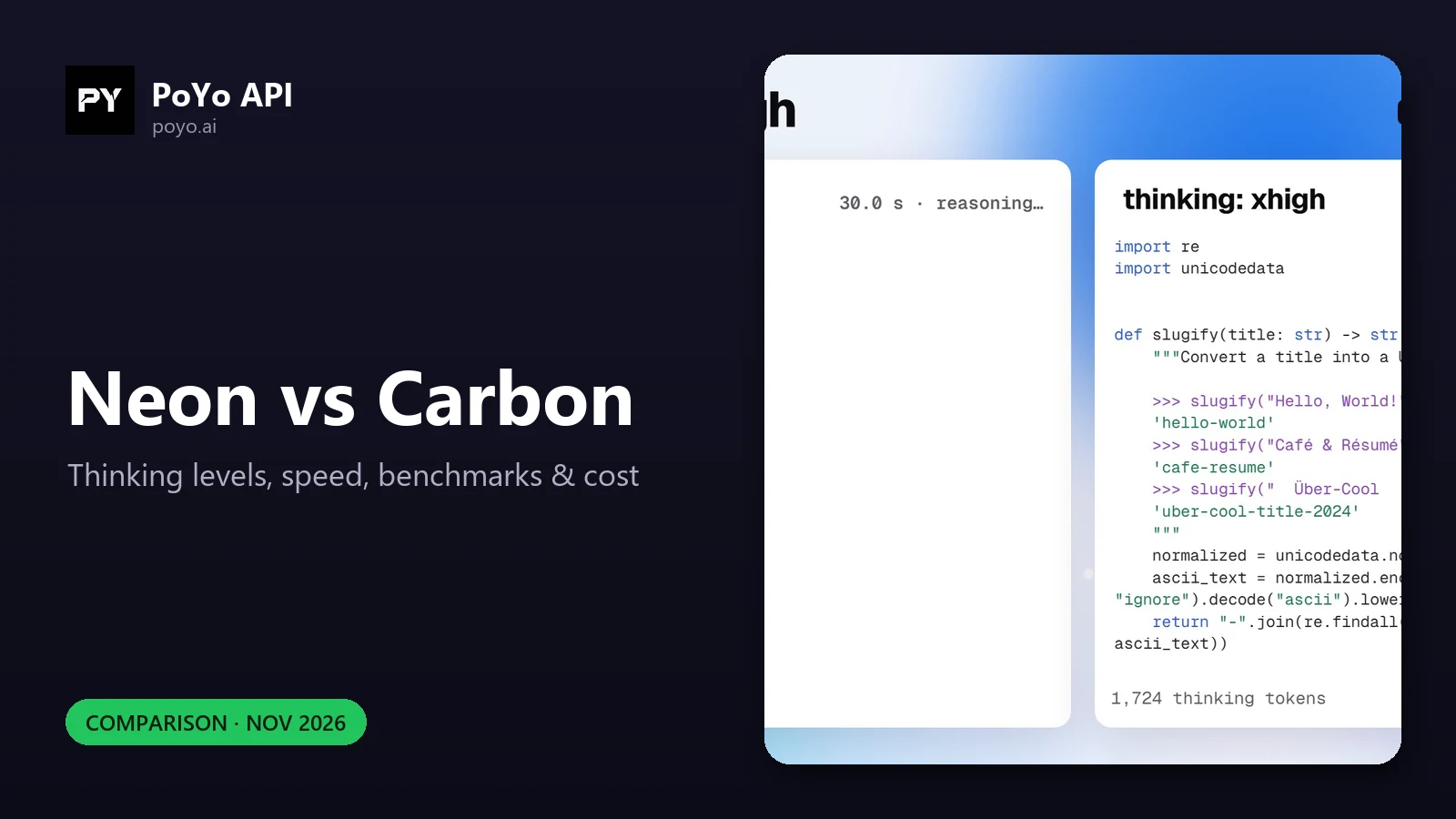
The Gemini 4 Neon API and the Gemini 4 Carbon API take identical requests on PoYo; only the model ID changes. The real choice is between speed and a fourth thinking level on Gemini 4 Neon (gemini-4-neon) and a lower per-token price on Gemini 4 Carbon (gemini-4-carbon). This post compares the two field by field, prices the same request on both, and shows the one-line migration.
Gemini 4 Neon API vs Gemini 4 Carbon API at a glance
| Gemini 4 Neon | Gemini 4 Carbon | |
|---|---|---|
| Model ID | gemini-4-neon | gemini-4-carbon |
| Google's positioning | High-speed frontier reasoning, adapted from Carbon | Deepest long-horizon reasoning in Gemini 4 |
| Official release | November 18, 2026 | October 2026 |
| PoYo endpoints | Chat Completions, Gemini Native | Chat Completions, Gemini Native |
| Context window | 1,048,576 tokens | 1,048,576 tokens |
| Default max output | 64K tokens | 64K tokens |
| Input types | Text, image, audio, video, PDF | Text, image, audio, video, PDF |
| Thinking levels | low, medium, high (default), xhigh | low, medium, high |
| Speed | Google says about 2× Carbon end-to-end | Baseline |
| PoYo price, input / output per 1M | $2.40 / $12.00 | $1.60 / $8.00 |
| PoYo cache read per 1M | $0.12 | $0.08 |
| Google official, input / output per 1M | $3.00 / $15.00 | $2.00 / $10.00 through Nov 30, 2026; $4.00 / $20.00 after |
Request differences: field by field
| Field | Neon | Carbon | Change when switching |
|---|---|---|---|
model (Chat Completions) | "gemini-4-neon" | "gemini-4-carbon" | Yes |
| URL path (Gemini Native) | /v1beta/models/gemini-4-neon:generateContent | /v1beta/models/gemini-4-carbon:generateContent | Yes |
messages / contents | Same shape | Same shape | No |
max_tokens / maxOutputTokens | Up to 64K default | Up to 64K default | No |
stream / :streamGenerateContent | Supported | Supported | No |
inlineData media parts | Supported | Supported | No |
| Thinking level | Adds xhigh | Up to high | Only if you use xhigh |
Response object and usage fields | Same | Same | No |
| Error codes | Same | Same | No |
PoYo's model page says thinking-level control goes through the native format. PoYo's published generationConfig schema doesn't list a thinking field yet, so requests that don't set one run at Google's default high on both models. Check the Gemini Native docs before you rely on xhigh.
Migration diff
Chat Completions, Python OpenAI SDK:
 resp = client.chat.completions.create(
-    model="gemini-4-carbon",
+    model="gemini-4-neon",
     messages=messages,
     max_tokens=8192,
 )
Gemini Native:
-POST https://api.poyo.ai/v1beta/models/gemini-4-carbon:generateContent
+POST https://api.poyo.ai/v1beta/models/gemini-4-neon:generateContent
Nothing else in the JSON changes. Update any cost code that hard-codes Carbon's $1.60 / $8.00 to Neon's $2.40 / $12.00.
Price for the same request
Same token counts on both models (PoYo prices, output includes thinking):
| Request shape | Neon on PoYo | Carbon on PoYo |
|---|---|---|
| Chat turn: 2,000 in / 500 out | $0.0108 (2.16 credits) | $0.0072 (1.44 credits) |
| Code review: 30,000 in / 4,000 out | $0.120 (24 credits) | $0.080 (16 credits) |
| Repo review: 200,000 in / 8,000 out | $0.576 (115.2 credits) | $0.384 (76.8 credits) |
With equal token counts, Neon costs 1.5× Carbon. The counts won't be equal in practice. Google says Neon reaches a 32% lower cost per task than Carbon at the default high level on the Artificial Analysis Intelligence Index, because it completes tasks with fewer tokens. That is Google's figure at Google's prices. On PoYo's prices, Neon comes out cheaper per task only when it uses less than two-thirds of Carbon's tokens for the same job, so measure on your own traffic. More scenarios: Gemini 4 Neon API pricing.
What Google's benchmarks say
All scores are from Google DeepMind's Neon and Carbon model cards. Where version numbers differ between the cards, Google's comparison table puts them in the same row.
| Benchmark | Neon | Carbon |
|---|---|---|
| Artificial Analysis Intelligence Index (v5.0.1 / v5.0) | 61 | 60 |
| Vals Index v2.2 | 70.9% | 70.4% |
| Terminal-Bench (4.1 / 4.0) | 65.2% | 65.2% |
| SWE-sweep (Mini-SWE harness) | 12.8% | 9.6% |
| AutoBaxBench (secure coding) | 76.0% | 74.0% |
| AutomationBench | 56.3% | 53.9% |
| RiemannBench | 84.0% | 80.0% |
| Terminal-Bench-Science 0.1 | 70.5% | 64.8% |
| SEC-bench Pro | 90.5% | 88.2% |
| Agents' Last Exam v1.1 | 75.8% | 77.4% |
| GraphWalks (256K to 1M, BFS F1) | 95.2% | 96.2% |
| CWE-Bench (v2 / v1) | 70.7% | 71.0% |
On Google's numbers, Neon matches or beats Carbon on most coding, automation, science, and security rows. Carbon keeps a small lead on long-horizon agent work (Agents' Last Exam) and very long-context recall (GraphWalks).
When to switch to the Gemini 4 Neon API
| Route | Call | Why |
|---|---|---|
| IDE copilots, interactive coding, chat UIs | Neon | Google's ~2× speed claim; latency is what users notice |
| PR review, secure patch drafting | Neon | Higher AutoBaxBench and SEC-bench Pro in Google's table |
| Math, science, hard architecture questions | Neon at xhigh | Carbon has no xhigh level |
| Multi-step tool workflows | Neon | AutomationBench 56.3% vs 53.9% |
| Overnight batch analysis, latency doesn't matter | Carbon | 1.5× cheaper per token on PoYo |
| Long-horizon research agents, 500K+ token recall | Carbon | Leads on Agents' Last Exam and GraphWalks |
A simple rollout: send 10% of one route to gemini-4-neon, log usage and wall time for both models for a week, then compare cost per finished task rather than cost per token.
import random

def pick_model(route: str) -> str:
    if route in {"ide", "pr_review", "science"}:
        return "gemini-4-neon"
    if route == "batch":
        return "gemini-4-carbon"
    return "gemini-4-neon" if random.random() < 0.10 else "gemini-4-carbon"
For a first request, see the Gemini 4 Neon API guide; for Carbon's own comparison with its predecessor, see Gemini 4 Carbon API vs Gemini 4 Argon.
What to log during the trial
| Metric | Where it comes from | Why |
|---|---|---|
| Input tokens | usage.prompt_tokens / usageMetadata.promptTokenCount | Should be similar on both models for the same prompt |
| Output tokens | usage.completion_tokens / totalTokenCount − promptTokenCount | Where Google's fewer-tokens claim shows up, if it does |
| Wall time | Your own timer around the call | Tests Google's speed claim on your prompts |
finish_reason | Response | Truncation rate at your max_tokens cap |
| Task success | Your tests or reviewer | Cost per finished task, not per call |
If Neon's output tokens per task come in under two-thirds of Carbon's, it is also the cheaper option on PoYo.
Frequently asked questions
Is the Gemini 4 Neon API better than the Gemini 4 Carbon API?
On Google's tables, Neon scores higher on most coding, automation, science and security benchmarks, and Google says it runs about twice as fast. Carbon leads on Agents' Last Exam and GraphWalks, and is cheaper per token on PoYo.
Is the Gemini 4 Neon API cheaper than Gemini 4 Carbon?
Not per token: Neon is $2.40 / $12.00 per 1M on PoYo, Carbon $1.60 / $8.00. Google says Neon's cost per task is 32% lower at its default level because it uses fewer tokens.
How do I migrate from the Gemini 4 Carbon API to the Gemini 4 Neon API?
Change model to gemini-4-neon, or swap the model in the Gemini Native URL path. The request body, response, and errors stay the same.
Does Gemini 4 Carbon support xhigh thinking?
No. Carbon's levels stop at high. xhigh is new with Gemini 4 Neon.
Do both models have the same context window?
Yes: 1,048,576 tokens with a 64K default output cap per response.